

Discovery
|
Charlotte Cumper, Dan Rocca and Sandy Kimber
Ask an Immunologist: Long COVID
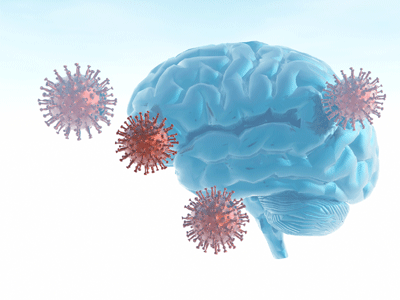
What scientists have learned about causes, diagnostics, and treatments for the “brain fog” known as long COVID
One of the more confounding scientific questions to emerge from COVID-19 is why some individuals never fully recover from it. A review published earlier this year by Nature Reviews Microbiology, at least 65 million people worldwide have long COVID since the pandemic began in 2020. The scientific community has made considerable progress in identifying different pathological changes and risk factors for long COVID, but we are still a long way away from finding the best treatments for patients. As this article points out, what could be right for one patient with long COVID, might not be right for another. This Q&A is intended to answer some of the most common questions surrounding long COVID, using the most recent and reliable data available. But we can’t cover everything here. Please share your own questions in the Comments section and we will be happy to answer them as best we can. Or send your questions directly to Dan Rocca at [email protected] or Sandy Kimber at [email protected].
What causes long COVID?
It’s not fully understood why some individuals go on to have long COVID, and it is possible that there may be different causes for different people. Theories range from persistent reservoirs of SARS-CoV-2, the virus that causes COVID, in tissues, to dysregulation of the immune system. It has also been proposed that long COVID could be a result of the reactivation of other latent pathogens, such as Epstein–Barr virus (EBV – glandular fever). The chances of having long COVID do not appear to be linked to the severity of the initial COVID-19 infection.
Is long COVID unique to this virus or do all viruses have a longer, more severe phase?
Fatigue and cognitive impairment (“brain fog”) are two of the most common symptoms of long COVID. However, these symptoms can also be seen following a range of viral infections, such as EBV, rubella, HIV, and flu, to name a few. The symptoms can persist for months or years. Some patients even experience lifelong symptoms. Post-viral fatigue (PVF) is well documented, although it has sometimes been dismissed by medical professionals. The focus on long COVID may further the field of research into PVF caused by other viruses.
What distinguishes long COVID from a normal course of COVID-19?
The primary definition of long COVID is the duration of symptoms after the acute infection. Most people will recover from COVID within four weeks, during which time they may experience symptoms such as excessive fatigue and “brain fog”. Post-COVID syndrome is defined as symptoms persisting for more than 12 weeks. In some cases, new symptoms may appear after the initial infection that cannot be explained by alternative diagnosis, including cardiac problems.
How does long COVID damage the heart?
Damage is caused by immune cell infiltration and the resulting inflammatory responses, rather than from the infection alone. Inflammation in turn leads to the damage of the inner lining of the blood vessels and membranes. When the circulatory system becomes leaky there is a potential for reduction in blood flow, thus affecting oxygen delivery. Insights on long COVID published earlier this year, cites the analysis of more than 150,000 individuals one year after SARS-CoV-2 infection. The study found a significant increase in the risk of cardiovascular diseases, including, dysrhythmias, stroke and heart failure, independent of the severity of initial COVID-19 presentation1.
What is the potential role of blood clots in long COVID?
 Blood clotting due to an injury prevents blood loss, however for some individuals with COVID-19 abnormal blood clotting may occur in small blood vessels, which can lead to significant damage. For instance, if multiple clots form in several places complications can arise such as organ damage, heart attack, stroke, pulmonary embolism and deep vein thrombosis. In fact, microclots can be detected in both acute COVID-19 and long COVID. This finding is advantageous because where there is consistency of an outcome associated with infection e.g., formation of clots, researchers can look to find therapeutics to target this outcome, both as a diagnostic tool confirming infection and as a treatment to alleviate symptoms and/or prevent death.
What can immune profiling telling us about long COVID?
Given that long COVID is a very complex and diverse syndrome we really need a systematic approach to get a grip on the underlying causes and mechanisms. Immune profiling, which involves using an impressive battery of techniques to look at immunity, is a great way to snapshot a patient’s immune health. Everything from immune cell-associated genes and proteins to immune subsets themselves can be correlated with disease symptoms.
Several seminal studies have used this approach to gain early clues as to what immune-related changes are occurring in long COVID sufferers. One surprising finding has been the significant correlation between specific T cell populations and their reactivity to the glandular fever-causing virus EBV, as well higher levels of EBV-specific antibodies and viral loads detected in some patients during acute SARS-COV-2 infection. This is key because reactivation of latent viruses like EBV - that has been long implicated in ME and chronic fatigue syndrome - lead to symptoms that are similar to long Covid.
More intriguing still, profiling of long COVID patient serum found not only elevated signatures of inflammatory cytokines like IL-6, TNF and IL-1—indicative of lasting changes in systemic immunity— but also a decrease in the steroid hormone cortisol. In Addison’s disease for example, where adrenal glands are damaged, the ensuing low cortisol can result in fatigue, dizziness and mood changes, symptoms that not only overlap with long COVID but may partially shed light on the causes.
Currently, all these studies ultimately highlight correlations with - but not necessarily direct causes of - long COVID. Nevertheless, they provide crucial indicators as to what may underpin the disease and provide potential novel biomarkers to accurately diagnose patients.
Can long COVID be treated with antiviral drugs like Paxlovid?
Studies have found that Paxlovid can reduce the risk of developing long COVID if administered during the acute phase of the initial infection (within five days from a positive test). Yale School of Medicine is currently running clinical trials to investigate whether 15 days on Paxlovid, compared with placebo, can improve the health of people who are already living with long COVID.
What progress have we made in treating long COVID? Is the prognosis better?
As there is still so much that we don’t know about what causes long COVID, the majority of treatments currently available tend to be palliative, such as the use of painkillers and complementary medicine. As research continues and diagnosis, as well as stratification of long COVID improves, it is likely that more targeted treatments will develop. Ongoing clinical trials demonstrate the multitude of strategies, sometimes conflicting, that are being taken to ameliorate long COVID and highlight the complexity of the disease. For instance, approaches to treat possible systemic changes in inflammation include the anti-IL-6 drug Siltuximab or general inflammatory inhibitor Ibudilast. Other treatments target potential viral reservoirs of SARS-COV-2 that may linger and include booster COVID-19 mRNA vaccines or intravenous immunoglobulin therapy. One interesting avenue for therapy is rectifying changes observed in the gut microbiome of some long COVID patients that could contribute to disease by harnessing either fecal microbiota transplantation or probiotics. Ultimately, given that long COVID is potentially caused by a variety of different mechanisms, it may be that a more personalised approach will be required, tailored to the individual.
Are there good in vitro or in vivo models to study long COVID?
In terms of supporting long COVID, researchers are only just starting to pull apart the differences between acute and long-term effects of infection. What’s missing is a thorough understanding or consensus of what defines long COVID at the cellular and organ level. Understanding the biomarkers , such as levels of specific disease-associated proteins in the blood or tissues that are specific to long COVID is a first important step. For instance, recent work has highlighted that when individuals present with higher levels of inflammatory cytokines IL-6, CRP, and TNF-α following SARS-CoV-2 infection for one or more months, they are more likely to experience long-term COVID symptoms. Modelling some of these features of long COVID in appropriate animal models could be crucial. For instance, mimicking even mild respiratory infection in transgenic mice that overexpress human ACE2—the SARS-COV2 host receptor—leads to significant inflammatory changes in the brain that are incredibly reminiscent of the neurological symptoms seen in humans. Strikingly, even after one week several cytokines that are found to be elevated in long COVID patients are also increased in this model, including CCL11 that has been implicated in cognitive impairment.
Whether true long COVID models in ‘humanized’ mice are possible is actively being investigated but there have been great leaps in mimicking many of the immune responses and pathology to the virus seen in humans using this approach. The good news is that there is a tremendous level of research that hopefully will lead us soon to better treatments and diagnostics, and make the journey for long COVID patients easier.
References:
1. Nature - Long COVID - major findings and recommendations
2. Markers for Long COVID
3. Nature – Inflammasome – 2022
Looking for more information about Long Covid and the heart – check out this useful resource from the British Heart Foundation.
Charlotte Cumper is a Senior Scientist in Infection, Sandy Kimber is Group Leader in Infection, and Dan Rocca is Research Leader in Advanced Modalities and Innovation at Charles River’s Portishead, UK site, which specializes in immunology, viral and bacterial infections and immuo-oncology.