Cell & Gene Therapy
|
Arif Azam Khan, PhD
Ask the Scientist: Antigen-Specific T Cells
Trained assassins of the immune system
Our immune system keeps us alive by fighting off viruses, other pathogens and by eliminating defective or damaged cells that might become cancerous. This takes a team effort by multiple immune cell types and one of the key players in this team is the T lymphocyte or T cell. T cells originate from bone marrow progenitor cells, mature in thymus, and migrate to the periphery. These naïve T cells start proliferating and differentiate into effector T cells (assassins) after encountering antigens (from pathogen or cancer cells) presented by antigen presenting cells (APC), which are kind of like roaming matchmakers in search of a perfect date.
A small fraction of antigen-experienced T cells become memory T cells with long term immunity and will mount a robust immune response after a subsequent encounter with familiar pathogens that infected an individual previously. But inevitably, the size of the naïve T cell repertoire shrinks and wane over time, as does most of our bodily functions. This is what leads to impaired adaptive immunity in elderly.
Helper CD4+ T cells assist B cells (humoral immunity mediated by antibody) and cytotoxic CD8+ T cells along with other cell types including dendritic cells and macrophages to modulate the immune response. CD8+ T cells are called cytotoxic T cells because of their ability to destroy or disintegrate pathogen-infected cells or cancer cells. Yet T cell responses can also be detrimental if they induce response against self-antigens—think of it as a friendly fire—and lead to autoimmune diseases such as Type 1 diabetes, psoriasis, multiple sclerosis, and rheumatoid arthritis.

Human Immune and Stem Cells Product Catalog
Charles River is a trusted provider of research-use and GMP-compliant human immune cells and stem cells for advanced therapies and basic research. Our portfolio also includes disease state biospecimens for disease-focused research.
Download Catalog
T cell recognition of antigens presented by antigen-presenting cells
T cell receptors (TCRs) present on T cells recognize a fragment of the antigen (peptide) bound to Human Leukocyte Antigen (HLA class I or class II) on antigen presenting cells (APCs). Each T cell expresses a unique TCR generated through a random recombination process during development in thymus. A large repertoire of unique TCRs armor the adaptive immune system to respond to a wide variety of antigens. As shown in Figure 1, Class I HLA presents intracellular antigens originating from viruses or tumors to cytotoxic CD8+ T lymphocytes, whereas Class II HLA presents extracellular antigens to CD4+ T cells. The TCR–antigen-HLA interaction is a critical element of acquired immunity and surveillance by T cells against a wide range of infection and cancer. Antigen-specific T cell is a clone of CD4+ or CD8+ T cells which can recognize a specific peptide presented by antigen-presenting cells. These specific peptides can be derived from viruses, bacteria, and cancer cells. The T cell receptor repertoire is highly diverse (100 million unique TCR in naïve CD4+ and CD8+ T cells in young adults) and can mount immune responses to a multitude of foreign antigens.
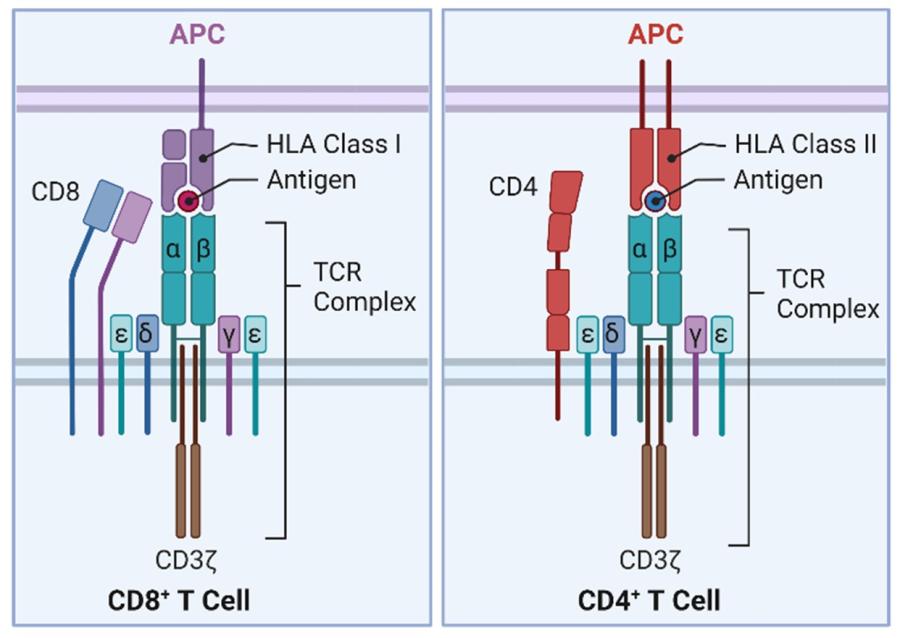
Figure 1. Adaptive immune response can recognize a wide variety of antigens because of a large repertoire of unique T Cell Receptors (TCR). Human TCR composed of TCRα and TCRβ chains, and co-expressed with CD3 chains. TCR recognition of peptide-HLA complex triggers signaling cascades that result in T cell activation and induction of T cell function (proliferation, cytokine production, release of lytic granules). Created with BioRender.com
Activation and expansion of antigen-specific T cells in vitro
Antigen-specific T cells are an important component of long-term protective immunological memory following vaccination, clearing of infection or elimination of cancer cells. However, frequency of these antigen-specific T cells is very low among circulating T cells, making them difficult if not impossible to isolate. This impedes our ability to study how they function during induction of immune responses. For many decades adoptive transfer of antigen-specific T cells has been used to restore protective immunity where autologous or allogenic T cells were isolated, expanded in vitro and infused into cancer patients or virus-infected immunocompromised patients.
Unlike CAR-T cells, antigen-specific T cells are not genetically engineered. They are derived from healthy donors and express native TCRs. CAR-T cells recognize only surface proteins whereas TCRs are far more versatile. They can recognize all types of proteins, including intracellular proteins processed and presented by APC. Both TCRs and CARs aim to induce antigen-specific activation of cytotoxic T cells with a single T cell specificity. Antigen-specific T cells are derived by initial priming of naïve T cells with APC and peptide of interest followed by expansion in vitro (Figure 2).
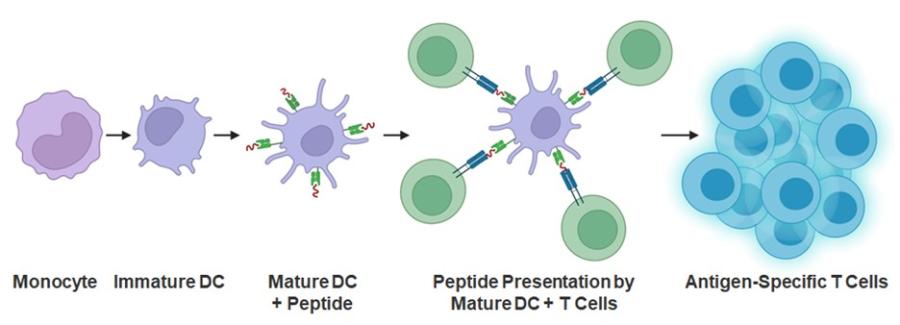
Figure 2. Schematic diagram of antigen-specific T cell generation in vitro. T cells are initially primed by APCs followed by subsequent stimulation and expansion. Monocytes are used to differentiate into matured dendritic cells (DCs) in the presence of cytokines. Matured DCs are pulsed with immunodominant epitope (peptide) and autologous T cells are co-cultured with peptide loaded matured DCs for the activation and expansion of antigen-specific T cells. Created with BioRender.com
Quality and quantity of antigen-specific T cells are assessed in vitro by HLA-peptide multimer (tetramer) staining, antigen-specific proliferation assay, cytotoxicity of target cells and cytokine production. Functional characteristics of antigen-specific T cells are verified by IFN-γ production in response to the antigen stimulation with cognate peptide. Stimulation of antigen-specific CD8+ T cells with cognate peptide induces robust production of IFN- γ and killing of the target cells (virus infected cells or cancer cells).
BROWSE ANTIGEN-SPECIFIC T CELLS
Use of antigen-specific T cells
In vitro co-culture of the antigen-specific T cell with target-expressing tumor cells provide insight into the pharmacology of immunotherapy where T cell activation (IFN-γ production) and T cell-mediated death of target cells are quantified. In addition to evaluating the efficacy of tumor cell killing by cell therapy, antigen-specific T cells are also suitable for testing how well immunomodulators enhance the killing of tumor cells.
Live cell imaging-based assays can be used to visualize the killing of adherent tumor target cells by co-cultured effector cells (antigen-specific T cells) and quantify the change in the number of viable tumor cells over time.
To support the concept that a single T cell specificity can lead to an anti-tumor immunity, antigen-specific T cells have been used to assess the potential of therapeutic fusion protein, to selectively activate and expand HPV16 E7(11-20)-specific CD8+ T cells as an off-the shelf therapy for the treatment of HPV16-driven tumors, including head and neck squamous cell carcinoma (HNSCC), and cervical and anal cancers (1).
In recent years, tumor-organoid models have gained popularity as a powerful 3D tool for identifying immunotherapy or combination therapies that require high numbers of tumor-specific T cells. Human breast tumor organoids and a NY-ESO1 specific CD8+ T cell co-culture system were used to validate the activity of epigenetic modulators in terms of T cell-mediated organoid dissociation (2). Myelin Basic Protein (MBP)-specific CD4+ T cells were used for the development of small molecule inhibitors to inhibit antigen binding and presentation by HLA-DR2b in multiple sclerosis (3). This study highlights the importance of silencing pathogenic T cells for the development of immunotherapy based on blockade of autoantigen presentation in autoimmune disease. Moreover, antigen-specific T cells can be used as a positive control to study the effect of small molecule drugs and biologics in improving the T cell responses, including killing target cells and evaluating the potency of cell-based therapies.
Utility of Antigen-Specific T Cells (ASTCs)
This webinar highlights the usage of antigen-specific T cells when developing immunomodulatory therapeutics to a wide range of diseases caused by viruses, bacteria, tumor cells, and autoimmunity.
Watch On Demand
Where do we go from here?
Cell-based immunotherapies have transformed the oncology and virology landscape. Whether the treatment is CAR-T cells, vaccine development, checkpoint inhibitors or adoptive T-cell therapy, the mechanism of action always comes back to the T cell mediated lysis of affected cells. Assays designed at measuring the ability of T cells to kill the target cells are important tools to understand the potency of such treatments. Currently there are more than 70 interventional clinical trials across the globe using antigen-specific T cells targeting tumor or virus antigens. Ever expanding antigen-specific T cell-based immunotherapies offer hope for curative responses in patients with cancer, autoimmune disease, and infectious disease.
BROWSE ANTIGEN-SPECIFIC T CELLS
References:
1. Quayle, SN et. al. CUE-101, a novel E7-pHLA-IL2-Fc fusion protein, enhances tumor antigen-specific T-cell activation for the treatment of HPV16-driven malignancies. Clin Cancer Res. 2020;26:1953–1964
2. Zhou, Z et. al. An organoid-based screen for epigenetic inhibitors that stimulate antigen presentation and potentiate T-cell-mediated cytotoxicity. Nat Biomed Eng. 2021;5:1320–1335
3. Ji, N et. al. Small molecule inhibitor of antigen binding and presentation by HLA-DR2b as a therapeutic strategy for the treatment of multiple sclerosis. J Immunol. 2013;191(10):5074-84
About the author:
Arif Azam Khan, PhD (Senior Scientist Lead). Arif brings extensive research experience in human T and B cell immunobiology for the target identification and preclinical exploratory studies. In current role, he is actively involved in the development of antigen-specific T cells and specialized immune cells including regulatory T cells for research in immuno-oncology, autoimmunity, cell-based therapy and infectious disease.