Research Models
|
Mary Parker
Avian Flu Outbreak 2022: Spreading Faster and Farther
First human case of avian influenza A (H5N1) reported in the US
While humans are still battling the ongoing COVID-19 epidemic, birds in the United States and Canada are facing their own challenge: a new highly pathogenic avian flu outbreak. So far only one human has been infected with a mild case, marking the first ever human infection of avian influenza A (H5N1) in the US. The risk to humans for this outbreak is low (so far), but the risk to wild and domesticated birds is growing.
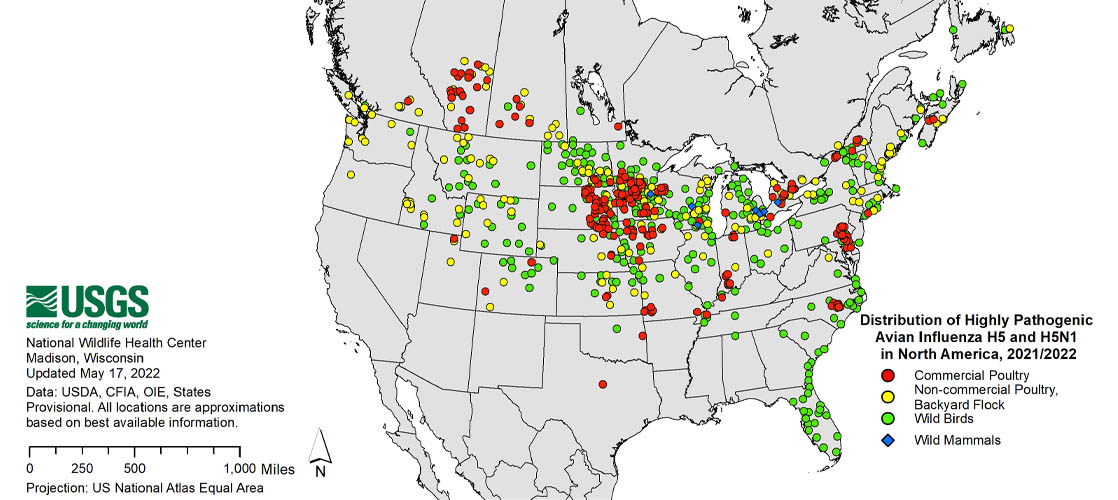
This version of the avian influenza virus started circulating in late 2021 and has been gaining momentum ever since. The virus has been detected in 40 bird species so far. Almost 38 million domesticated birds have been affected in the US as of May 20th, with 38 states reporting wild bird infections and 35 reporting domestic bird infections. As a comparison, the 2015 avian flu outbreak, considered the worst to date, affected 50 million domestic birds. However, that outbreak was not found in as many species or in as many geographic areas as the current outbreak, meaning the current outbreak is likely on track to surpass that figure before it is through.
Charles River’s chicken flocks are used to produce a range of products, from specific-pathogen-free (SPF) eggs for vaccine development to chicken cell products for drug development. Since SPF eggs must remain free of more than 32 specific pathogens, the biosecurity surrounding them is much tighter than in other commercial flocks. However, the risk to any bird is a risk that all commercial and hobby farmers take very seriously.
“If an SPF egg supplier were to break with avian influenza, we would see an impact on vaccine production,” said Nastassja Ortega, Director Laboratory Operations for Charles River’s avian facility. “And I don’t mean just chickens, it impacts people too. SPF eggs are used in human influenza, yellow fever, and MMR vaccines, for example. That is why containment is so important.”
Avian flu outbreak spread through wild birds
Researchers of past avian flu outbreaks have mainly focused on the spread of avian flu through wild ducks, specifically dabbling ducks. The ducks are often asymptomatic and can spread the virus through waterways as well as by flying overhead of domestic outdoor flocks. However, recent research conducted by Tufts University has shown that gulls, geese, and swans also strongly contribute to the spread of avian flu.
According to Tufts researchers, the current outbreak may have come from great black-backed gulls over the Atlantic Ocean. Gulls are heavily influenced by anthropogenic effects – they often converge in areas with high human populations and are attracted to farming, fishing, and cities. They are strong, long-distance flyers, and may be responsible for carrying the virus the farthest, though not likely responsible for diffusing the virus locally.
Geese may be the key to moving this particular strain of avian flu around North America. According to an anecdotal account from wildlife disease specialist Dr. Margo Pybus in Canada, avian flu seemed to simmer down in areas where geese have moved on.
Bird flu prevention
 While there have been avian flu outbreaks before, notably in 2014 and 2016, those outbreaks eventually petered out with careful flock management. However, this strain seems to be more resilient than previous strains, making biosecurity for poultry farmers more important.
The USDA offers free resources for training poultry farmers through their Defend the Flock program, which can be adapted to both commercial and hobbyist poultry farmers. At the most basic level, avian flu prevention boils down to:
- Not allowing visitors to approach or handle your birds
- Washing hands and changing clothes before and after handling or feeding birds
- Using disposable boot covers or footbath stations
- Disinfecting tools when moving between flocks
- Keeping a sharp eye out for signs of illness in your birds, including lethargy, soft or misshaped eggs, swelling and discoloration, nasal discharge, diarrhea, or sudden death without other symptoms
Economic impact of the avian flu outbreak in 2022
Predictably, this avian flu outbreak is projected to have an impact on meat and egg prices over and above what is already projected due to inflation. Due to supply chain lag, the effect of the flu has not been fully reflected in prices yet, but experts expect it is coming.
The effect on farmers will be even more pronounced, especially in areas hit hardest by the flu. The effect of flock loss will ripple out to other industries, from feed to farm tourism.
The threat of an ongoing avian flu outbreak is at the top of mind for all poultry suppliers. For now, farmers and poultry suppliers are tightening biosecurity, keeping vigilant observations of their flocks, and preparing for every eventuality.