
Safety Assessment
|
Regina Kelder
Can Scientific Research Thrive Without Animals?
What chemical testing is teaching us about finding viable alternatives
Thirteen months ago, the Biden Administration amended a section of the Federal Food Drug and Cosmetics Act that marked an important clarification of what has always been believed was mandated animal testing for investigational drugs. The FDA Modernization Act 2.0 brought legislation into practice, and indicated support for in vitro and in silico technologies, including organ chips, sophisticated computer modeling and cell-based assays.
The legislation marked the latest and loudest effort, so far, to usher in a new era of alternatives. Even before the passage of the Modernization Act by Congress, the FDA had expanded the use of one drug based on microphysiological systems (MPS) and used this data in at least four preliminary drug filings. And the FDA was far from the only US agency seeking alternatives to animal data. Seven years ago, the US amended a 40-year-old environmental law codifying the Environmental Protection Agency’s commitment to reduce and replace the use of vertebrates in chemical testing. The law, named for former NJ Senator Frank R. Lautenberg, reflected a decades long effort to move toxicity testing away from animals to in vitro methods. Since then, the EPA has released work plans describing its efforts to reduce vertebrate animal testing and released several science policy documents concerning the acceptance of new approach methodologies.
But the FDA Modernization Act 2.0, endorsed by activists and approved almost unanimously by the US Congress, cast an even brighter light on the need for alternatives, the sooner the better.
The long road to replacing animals
 Yet while researchers are rapidly developing alternative technologies that promise more accurate, faster and, in some cases, cheaper results, it arguably will take decades and decades of hard work, collaboration and money before regulators, scientists and product or drug developers are confident enough to replace all animals with new methods. For some specific tests, it might never be possible to find an alternative to animals. On the other hand, if we banned animal use outright the scientific community and regulators and the public would have to accept the risk that some alternative tests might leave gaps in our regulatory decision process.
No one understands this better than the two federal groups that, since 2000, have been charged with identifying and vetting alternatives for a vast array of toxicology tests done on chemicals and drugs. The Interagency Coordinating Committee on the Validation of Alternative Methods (ICCVAM, a permanent committee of the National Institute of Environmental Health Sciences (NIEHS) composed of representatives from 17 different federal agencies), promotes the development and regulatory acceptance and use of alternative methods that reduce, refine, or replace animals. It also provides guidance to test method developers and facilitates collaborations that promote the development of new test methods. The National Toxicology Program's Interagency Center for the Evaluation of Alternative Toxicological Methods (NICEATM) provides scientific and administrative support to ICCVAM. NICEATM, an office within the NIEHS Division of Translational Toxicology, evaluates alternatives to animal use for chemical safety testing of chemicals.
With legislators and animal advocates pushing for fewer animal tests, and drug sponsors and regulators seeking data that gives them confidence in alternative methods, it’s become the job of organizations like ICCVAM and its scientific and operational leadership arm, NICEATM, to provide good guidance and demonstrate which non-animal methods are as good if not better than the conventional tests done in animals.
Their research records show that progress is being made on this front. According to NICEATM there are currently 140 alternative methods for chemical testing approved either in the US or abroad that reduce, refine, or replace the use of animals. The list includes tests that have been used for many years in Europe as well as innovations that fulfill the data requirements of the EPA and other US agencies.
These methods fall under 16 different areas ranging from dermal toxicity and endocrine disruptors to phototoxicity, biologics and skin sensitization tests. While most of the methods help to reduce or refine the use of animals in chemical testing, quite a few offer a full replacement of animal models. For instance, safety assessments for topically exposed chemicals, agrochemicals, cosmetics, and pharmaceuticals are now tested using in vitro human skin models as the gold standard. The EPA accepts cells (Organisation for Economic Cooperation and Development or OECD Test Guideline No. 432) as a first screening test for assessing the effect of chemicals on skin following UV exposure. And the EPA is working with stakeholder groups to replace the in vivo rat skin penetration test (OECD Test Guideline No. 427) with the in vitro human skin penetration test (OECD Test Guideline No. 428). Meanwhile, skin irritation and corrosion methods are being evaluated to replace animals with the in vitro 3D human-derived skin model tests (OECD Test Guidelines 431 and 439).
“Having the added benefit of reducing and replacing animal testing is fantastic and important from an ethical standpoint, but the primary driver of our work is doing better science and building more human relevant models to improve human health protection,” said Nicole Kleinstreuer, PhD, who directs NICEATM.
Dr. Kleinstreuer said modern chemico-informatics applications also offer a different approach for conducting safety studies that are as good, and in some cases, better than the animal version. NICEATM supports a range of computational toxicology projects that use mathematics, informatics, and computer models to better understand how to predict the toxic effects of chemicals.
For instance, it supports a massive publicly available data bank of QSARs (quantitative structure-activity relationships) that provide a systematic method to evaluate untested and hypothetical compounds for a specific biochemical function. The project, which goes by the name of OPERA, helps to augment nonanimal methods for measuring chemical toxicity. In the five years since OPERA launched it has provided predictions for estrogenic activity, androgenic activity, acute oral toxicity, and other endpoints.
Challenges to New Approach Methodologies
Still, the development of alternative models to animals remains an arduous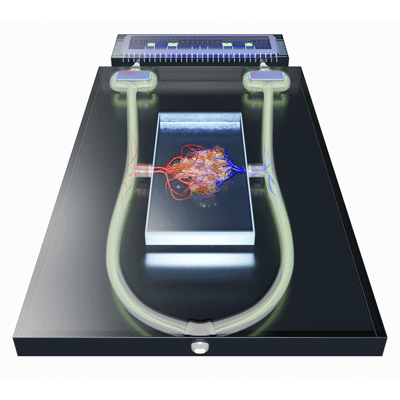 process, and significant challenges remain. Arguably one of the biggest is money. A 2021 report published by the UK-based NC3Rs notes that validating new methods for all animal tests is both a costly and lengthy one. The validation processes required to ensure new approaches are robust and reproducible are also lengthy, and historically involved large-scale ring trials to make sure the methodology is fit-for-purpose. There can also be significant time lags between the validation of an alternative approach and regulatory acceptance.
Skin irritation studies—one of the most basic adverse effects to model in vitro—took more than two decades before the OECD adopted a validated test guideline and 30 years for an integrated assessment approach be developed and put into use. And validated in vitro assays that predict the lengthiest and most severe animal tests (like chronic systemic toxicity), carcinogenicity and DART do not currently exist. Added to all that is that communicating science to the public is hard. Many consumers have a difficult time grasping how complex a process it is to find alternatives that are safe, effective, and better than animal models.
Another challenge is that regulations aren’t consistent worldwide, making harmonization difficult. Consider cosmetics. While animals are still allowed by US regulators for the testing of cosmetics, Europe banned animal testing for these products in 2009; Canada did the same in 2023, banning the testing of cosmetic products on animals and the sale of cosmetics products relying on animal test data.
Both Europe and Canada apply use a mix of in silico, in vitro and kinetic models to conduct risk assessments on cosmetics. The goal of these studies is not to identify adverse effects but to support the premise that if an ingredient in a cosmetic is too low to cause bioactivity in in vitro assays it will not be toxic to consumers either.
Reproductive toxicologist Alan Hoberman, PhD, says arguably the biggest challenge in finding alternatives is that regulators and industry want solutions that are foolproof even though the likelihood of this happening is slim. “All this round robin, this validation is never going to give you the perfect answer, the perfect test,” says Hoberman, Executive Director of Global Development, Reproductive and Juvenile Toxicity at Charles River Laboratories. “We should accept this reality and move forward, but instead we put these in vitro methods at a much higher level than we ever did with animals, which we already know are not perfect models.”
Hoberman says NICEATM deserves a lot of credit for its approaches in developing techniques to evaluate the extensive sets of data generated from animal studies and the proposed alternative tests, weeding out the relevant animal-based data and alternative test data. “They work with agencies and listen to scientists who understand how alternative tests can improve and add to our knowledge base when evaluating a particular toxicity,” he said.
Uterotrophic Database: Understanding study variability
 For example, NICEATM was instrumental in developing a curated database of high-quality in vivo uterine bioassay data culled from a massive amount of published studies. Not only was the database instrumental in understanding the variability from animal studies, but it also provided a much-needed systematic process for evaluating the performance of in vitro assays that measure estrogenic activity, something that until that point was difficult if not impossible to do.
Kleinstreuer, an expert in mathematical and computational models, was working at the North Carolina-based Integrated Laboratory Systems, a CRO that provides toxicology support to NIEATM, when she and her colleagues first began compiling the uterotrophic database, zeroing in on the estrogen receptor pathway specifically. “The objective of this database was to derive a set of reference chemicals that have reliable, reproducible results in animals that have estrogenic activity,” said Kleinstreuer, who was named NICEATM’s Deputy Director in 2016 and Director four years later.
The literature review, conducted in 2014, looked for studies that measured uterine weight changes in immature rats or ovariectomized (OVX) rats or mice, identified relevant endpoints and then merged the data into a single database which they analyzed for sources of variability. Among other things, the database proved invaluable as a resource against which in vitro method results for endocrine disruptor activity could be evaluated, and from which predictive in silico models could be built.
Kleinstreuer said their focus on uterotrophic assays was driven by the readiness of the new approach methods, and a regulatory need. The chemical substances covered by the EPA’s Endocrine Disruptor Pathway Program—adopted in 1998 and mandating the use of validated methods for the screening and testing of chemicals for endocrine disruptors—included nearly 10,000 chemical substances. Because the cost of animal testing is so high, the EPA could only test a small fraction of the chemicals, prompting the EPA to search for in vitro and in silico methods, including databases, as alternatives.
As outlined in an EPA white paper released in December 2022, there are now two new approach methodologies validated for screening of chemicals. One of them, the full Estrogen Receptor Pathway model, is recommended as an in vitro replacement for the uterine animal model. The other is an androgen receptor pathway model.
The more complex models of the future
While progress is being made in finding new approaches to assess acute conditions, like dermal tests, Kleinstreuer said more complex endpoints that involve assessing chronic effects over much longer time frames is another story entirely. “The biology is more complicated, so let’s think about how can we develop more complex systems, like MPS’s that connect different organ systems together and better represent the physiology of a whole organism,” she says.
Kleinstreuer sees MPS systems [like organ chips, organoids] in combination with computational modeling approaches as one way forward. “I also see tremendous potential in the area of systems biology, systems toxicology and digital twins, which can help us understand heterogeneity across populations of individuals.” A new NIH Common Fund grant program, for which Kleinstreuer helped lead strategic planning, called Complement Animal Research in Experimentation (Complement-ARIE) was recently announced by NIH Director Monica Bertagnolli, MD. The Complement-ARIE program will provide substantial funding for the development of combinatorial NAMs for biomedical research, and also emphasizes the need for validation and regulatory implementation.
Hoberman says when adopting new technologies, it ultimately comes down to how much risk Sponsors and regulators—and consumers—are willing to accept. “We fly on airplanes – how many times do panels fall off those planes. How many people would get on a plane if they knew that would happen,” says Hoberman.
Whether you are talking about chemicals or airplane parts, Hoberman said when something goes wrong, we try to understand “where our testing failed, so at least this flaw should never affect our safety again.”
This is part of our ongoing series Focus on 3Rs, about how organizations are striving to find alternative technologies.