
Discovery
|
David Clark, PhD
Chemical Space – the Final Frontier for Drug Compounds?
“It’s cheminformatics, Jim. But not as we know it!”
The art and science of medicinal chemistry consists in taking an initial chemical compound (often referred to as a “hit” or “active”) and optimising it by making successive modifications to its structure until it is fit to be designated as a pre-clinical candidate and move into late-stage development prior to human clinical trials.
But where do those initial “hits” come from? A publication from AstraZeneca in 2018 shed some light on this and is nicely summarised in a blog at drughunter.com. The study looked at the origins of 66 clinical candidates disclosed in the Journal of Medicinal Chemistry during 2016/2017 and its results are summarised in the pie chart below.
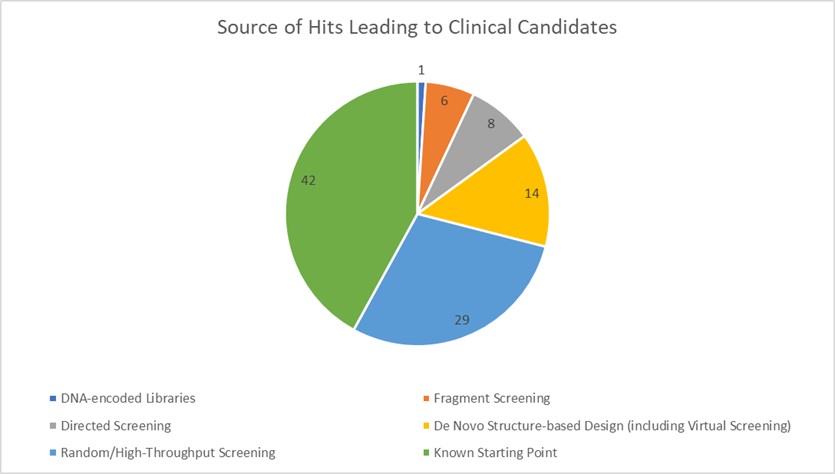
The study revealed that the starting point for most (42%) of candidates was a previously identified compound, i.e., an already disclosed active compound, a natural/endogenous ligand, or a molecule from a previous drug discovery program.
However, it is quite often the case that such a starting point is not available, particularly if we are dealing with a novel drug target. And in these cases, recourse is typically made to screening, either high-throughput screening (HTS), virtual screening (VS) or directed screening (DS). These account for around 40-50% of the hits in the study. What all these screening methods have in common is the need for a collection of chemical compounds as input – either as physical samples, for HTS and DS, or as electronic chemical structure databases in the case of VS.
Realistically, the largest collections of physical samples maintained by pharma/biotech companies probably number in the low millions of compounds. But this is not even a drop in the ocean when compared to the estimated size of drug-like chemical space, which is believed to be in the region of 1063 compounds!
But in the era of virtual screening, we don’t need to limit ourselves to what we can physically store or manage. If we have the hard disk space to store the required chemical structure databases, and the computer power to search them, we can go well beyond the millions.
A very recent example of this was reported in Science, in which a structure-based VS was carried out using a database of 281 million readily purchasable compounds derived from the ZINC database leading to the identification of several interesting compounds with potential to be developed as non-opioid analgesics. The docking of these compounds was accomplished in a week using a computer with 500 CPU cores (for comparison, an average desktop/laptop computer might have 2 to 12 CPU cores).
Compounds on demand
So far, so impressive. But things have moved even beyond this level. The current trend is for so-called “on demand” databases which contain structures of chemical compounds that have probably never been made but which, chemists believe, could be readily synthesised using well-validated chemical reactions (“recipes”) and available reagents (“ingredients”). Arguably, the best-known of these databases is Enamine REAL , which currently contains some 5.5 billion compounds. The docking of an earlier incarnation of this database, comprising ca. 1.4 billion compounds, against a structure of purine nucleoside phosphorylase was reported a few years ago by OpenEye Scientific. Almost incredibly, this required only 18 hours – but did involve 45,000 CPUs! In a similar fashion, a group of academics working with Enamine and ChemSpace have reported the development of an open source tool, VirtualFlow, and is using it to dock the same database and find inhibitors of the Keap1:NRF2 protein-protein interaction. Efforts such as these probably represent the current state-of-the-art for traditional structure-based virtual screening.
But we are not yet at the frontier! In a recent review about exploring ultra-large compound collections, Wendy Warr and her co-authors helpfully distinguish between “chemical libraries” and “chemical spaces”. In their terminology, “libraries are enumerated collections of full structures, usually fewer than 109 molecules” and thus, the collections referred to so far in this post (ZINC, Enamine REAL) fall into this category. By contrast, “chemical spaces” are combinatorially constructed collections of compounds that are usually extremely large. Being so large, it is intractable to enumerate all the precise chemical structures that are covered in any given chemical space. Instead, what is stored in the computer is a list of chemical reactions and, for each reaction, a set of associated reagents.
The size of some of the available chemical spaces is quite astonishing. The drug discovery software company, BioSolveIT, offers non-proprietary spaces comprising up to 1014 molecules, plus clever cheminformatics software that enables rapid searching of these spaces using methods based on 2D chemical structure similarity. So, scientists can simply sketch or import the 2D structure of a molecule of interest and then the software will retrieve molecules from the chemical space that are like it. This usually can be accomplished in just a few minutes using a typical desktop computer. If desired, the resulting list of compounds can then be subjected to more time-consuming computational evaluation, for instance, by docking them into a relevant protein structure. Several pharma companies have built their own proprietary chemical spaces, the largest of which is believed to be GSK’s “XXL” space, which numbers 1026 compounds according to one report.
As Warr et al. note, the next challenge will be developing methods that permit the searching of these enormous spaces using 3D, rather than 2D, chemical structures. In addition, researchers are already experimenting with docking algorithms that are formulated to deal more naturally with chemical spaces than chemical libraries. Two recently reported examples of this are Chemical Space Docking and the V-Synthes approach.
All these developments make it an exciting time to be involved in drug discovery. While our largest “man-made” space (at 1026 compounds) is still puny compared to Nature’s (at 1063), we are already “going where no-one has gone before”, even if we’ve not yet reached “the final frontier”!