

Discovery
|
David Clark, PhD
Computational Protein Folding – As Hot As We Predicted!
DeepMind's AlphaFold program has now predicted the protein structure that is a crucial part of the malaria parasite, living up to its reputation of transformational
To be honest, given the splash that AlphaFold made last year, you didn’t have to be a clairvoyant to predict, as we did, that it would be a hot topic in 2022.
Sure enough, AlphaFold’s protein folding abilities have continued to generate colossal interest amongst the scientific community. According to SciFinder, there have already been nearly 200 publications this year that mention the DeepMind program.
In 2021, as well as publishing their program’s source code, the DeepMind team released a database of about 1 million protein structures that had been predicted by AlphaFold. Almost incredibly, at the end of July 2022, the team published an enormous update to that database taking the total of predicted protein structures to more than 200 million! As the team notes in its blog post, this represents nearly all the catalogued proteins known to science and includes proteins from plants, bacteria, animals, and other organisms. In fact, the total number of species represented in the updated database is about 1 million (a hundred-fold increase over the 10,000 from the 2021 incarnation).
A few examples of where AlphaFold’s predictions have already made an impact on scientific research are listed in the DeepMind blog and some more in this article from New Scientist. Among these, was the use of a structure predicted by AlphaFold by a team of scientists at Oxford University led by Prof. Matt Higgins. Previously, the group had been able to use X-ray crystallography to gain partial information about the structure of a protein called Pfs48/45, which is being pursued as a key component of a future transmission-blocking malaria vaccine. Combining the knowledge from the X-ray experiments with a structure generated by AlphaFold gave the team a clear view of this crucial protein and has enabled the design of potentially improved vaccine candidates. The impact of AlphaFold has, says Higgins, been “transformational”. (Full details of this work can be found in this pre-print.)
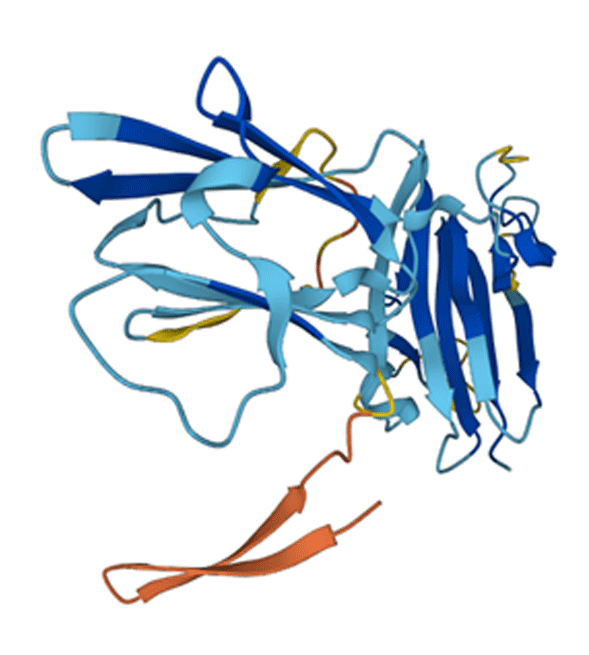
The structure of Pfs48/45 predicted by AlphaFold (https://alphafold.ebi.ac.uk/entry/V5NSK3)
This is, of course, just one example. But, even without a crystal ball, it is clear that in the near and foreseeable future, AlphaFold and the AlphaFold database, will continue to make an immense contribution to all kinds of scientific endeavour.