
Discovery
|
Regina Kelder
Could the Bird Flu Threatening Animals Take Flight in People?
A conversation with Charles River influenza expert Claire Richards
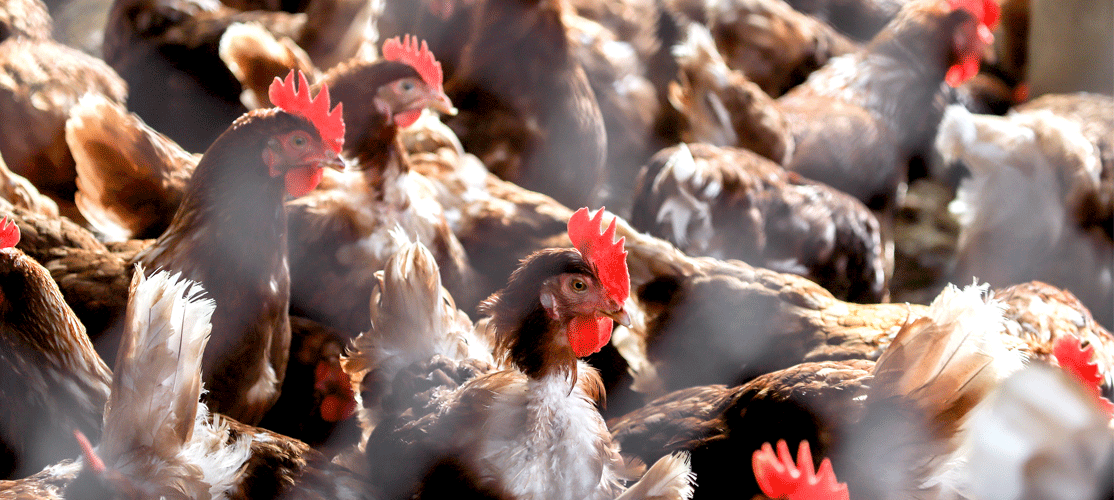
With the COVID-19 pandemic barely in the rearview, public health officials have been grappling with an unusual and scary form of avian influenza that is threatening domestic and wild animals, and even people. H5N1 is a subtype of Influenza A that causes influenza in birds. It was first isolated in Hong Kong in 1996 and has since evolved into different variants that have caused outbreaks in wild and domestic birds, as well as mammals and occasionally jumped to humans.
In 2020, a new and especially deadly variant began spreading along the migratory routes of birds to parts of Africa, Asia, and Europe, and by 2022 it had reached North and South America. During this latest panzootic, 26 countries have reported over 48 mammal species infected with the highly pathogenic influenza A virus, epidemiologists reported in March in Emerging Infectious Diseases. According to the US Centers for Disease Control and Prevention, as of June 16, US domestic poultry flocks were infected with bird flu in every state except Hawaii and detected in wild birds in every state. The virus is also circulating in at least 34 dairy herds in 13 states: Oklahoma, Idaho, Kansas, Michigan, New Mexico, North Carolina, Ohio, Texas, North Dakota, South Dakota, Minnesota, Colorado and Iowa, and turned up in a juvenile goat in March in Minnesota. Perhaps most concerning, there have been 11 reported human cases in the US since 2022, four attributed to sick dairy cows and the remainder from exposure to H5N1-infected poultry. Five of the 11 reported human cases have been lab-confirmed as H5N1, a number that is likely to grow as the outbreak worsens. Globally, there have been 36 lab-confirmed human cases since 2020 stemming from this latest variant, and eight deaths.
Most of the human cases of H5N1 have been mild and treatable, but in China one person died and another was hospitalized after being infected with the current variant of H5N1, while five of the 11 lab-confirmed cases in Cambodia reported in 2023 and 2024 were fatal. Two patients in Chile and Ecuador also experienced severe symptoms.
While the number of human cases is still low, there are ongoing worries that the virus—which has never had the capability to transmit efficiently from person to person—will pick up mutations that enable it to do just that and spark another pandemic. In June, Finland became the first country to offer preemptive bird flu vaccinations to select groups of people, including poultry farmers, veterinarians, scientists who study the virus, and people who work on fur farms housing animals like mink and fox where there have been outbreaks. This effort is part of an EU procurement of up to 40 million doses for 15 nations from manufacturer CSL Seqirus. Meanwhile, the US is providing US$176 million to Moderna through the Biomedical Advanced Research and Development Authority, or BARDA, for development of a pandemic influenza mRNA-vaccine. The money will support late-stage testing of a vaccine targeting H5 influenza viruses.
To gain a better understanding of bird flu, Eureka turned to Claire Richards, PhD, the Associate Director of Infection and Pharmacology at one of Charles River’s Discovery sites in the UK, which specializes in bacterial and viral infection models, including influenza models. Dr. Richards completed her PhD studying monoclonal antibodies against influenza viruses at the Babraham Institute in Cambridge and studied herpesviruses at both Cambridge University and the University of Bristol. Early in her career she worked on equine influenza virus, but later switched to the medical field because, as she says, “it's not the animal, the host that's important, it's the virus.”
What types of influenza research does Charles River do?
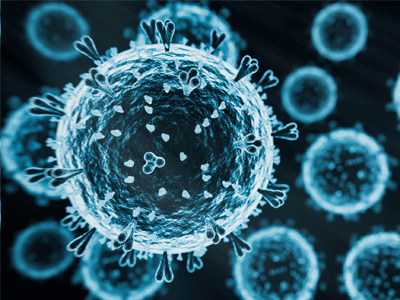 CR: We typically use a lab-adapted strain. One strain we use that is very well-characterized is PR8, which is an H1N1 virus. We use that model to assess novel vaccine strategies as well as testing new antiviral drugs. We can also use this model to look at the impact of the immune response to the virus, the viral load within the lungs and other organs. When assessing the potential of a novel vaccine you want to be able to understand what kind of immune response you are inducing and whether this is likely to be effective in limiting viral spread and the associated immune pathology.
How can you study H5N1 in the lab? Is there a lab-adapted strain for that?
CR: We have other influenza viruses that we use which include other subtypes which are commonly circulating, causing seasonal outbreaks such as H3N2, and other more clinically relevant H1N1 virus subtypes which were responsible for the Swine flu outbreak in 2009. We also use what we call reassortment viruses which enables the commonly used lab adapted strain PR8 (H1N1) to express the H5 and N1 antigens on the surface so we can determine the ability of potential vaccines to neutralize infection with an H5N1 virus. By having a range of different viruses validated in models of infection we are also able to assess potential for cross-protection using a single vaccine to induce protection against number of different strains expressing different H- and N-proteins. That is really important to know because one of the reasons we have seasonal vaccines, and we have to have vaccinations every year is because slight changes in the virus are enough to prevent the antibodies you raised against last year's strain from continuing to provide protection. If you are able to develop a vaccine that can give you cross-protective immunity against a range of influenza viruses, that obviously would give us much better control of potential future outbreaks.
Given H5N1’s devastating impact on wildlife, bird life, cattle, and the few cases popping up in humans, is CRL currently looking at vaccines that include the H5N1 virus?
CR: Yes, we are investigating ways of inducing more effective cross protective vaccines as well as novel vaccine platforms such as mRNA-LNP. We are also assessing potential antivirals that may provide rapid treatment or immunomodulatory compounds to minimise damage to organs as a consequence of infection.
How are influenza vaccines typically produced?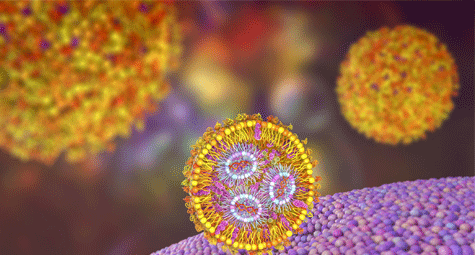
CR: Typically, the current influenza vaccines are produced in fertilized chicken eggs. It's a time-consuming process, and there are potentially more efficient ways being developed for manufacture, and production of future vaccines enabling a more rapid response to genetic changes. The mRNA-LNP vaccines are an example of that, but a lot more research needs to be put in place in order to make that really work for a range of different viruses. Once we do, we may be looking at RSV as well as influenza, herpes virus and a whole range of different viruses that will be able to harness this novel technology and provide better vaccines for the future.
That is really interesting about the mRNA-LNP technology because of course we used it to manufacture two of the three leading COVID vaccines.
CR: I think the whole vaccine development strategy changed as a consequence of COVID. It had always taken such a long time for new vaccines to be approved, which made it really difficult to develop new ones. There are novel strategies being developed to express viral antigens and present them to immune cells to induce effective immune responses, both antibody and T cell-driven. The use of rapid sequencing techniques for identification of genetic variation across emerging viruses enables accelerated development of future vaccines. Whether the next major outbreak will come from influenza, RSV, or another coronavirus, having that adaptability once we see the danger signs will allow us to get those vaccines prepared rapidly, as we did against SARS-CoV-2.
The earliest cases of H5N1 in humans, in 1996, had extremely high fatality rates, yet the recent cases this year in US individuals have been mild. Why is that?
CR: There may have been some slight change in the circulating viruses over the years which provided some protection, however, some people are inherently better at fighting the virus than others. Look at COVID. So many people got the virus, but the responses were very different so not everyone ended up in the hospital. The actual viral load or exposure may vary across individuals making their ability to fight the infection different. The individual’s health status and fitness will also have an impact. In fact, there are multiple factors that have an impact on the severity of clinical disease and the impact of infection.
Human-to-human transmission of H5N1 is rare, but in animals it’s rampant? What would it take for the virus to move faster in people?
CR: The virus needs to adapt to be more effective or efficient at infecting humans. We all have receptors on epithelial cells in the lung that the virus binds to, and the strength of that binding interaction is not that effective right now. But if the virus does adapt more to the human body and human receptors, it will transmit much more readily and become more virulent. So, you will see infections resulting from lower virus exposure levels and greater spread (or transmission) from person to person via aerosol or direct contact.
H5N1 is also impacting Europe’s animal population. How are they managing this?
CR: There have been lots of restrictions on housing of chickens and other livestock where there are reported cases or within a defined area. They have to keep them within the barns rather than free-range to prevent exposure and limit spread.
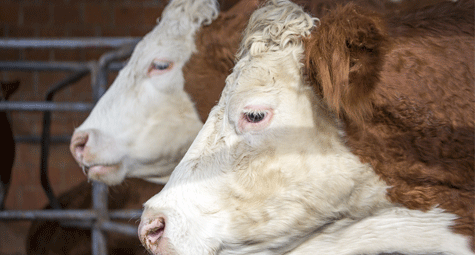 Lastly, there have been concerns about whether milk is safe to drink, but we know that pasteurization is effective in inactivating the H5N1 virus. What about consuming beef.
CR: The risk I would say is absolutely minimal. Viruses don’t generally survive well outside the body. So, if you dropped a bit of virus on a bench, it's not going to survive that well, unlike bacteria which would be quite happy to survive longer. If an animal is infected with bacteria, there may be a risk of infection if you eat it. On the other hand, viruses are very specific. They tend to like particular environments and they are quite temperature sensitive. As I mentioned earlier, they also infect cells by attaching to certain receptors; for influenza these are primarily expressed within the lung. Since these receptors are not really present in the gut and there is a low pH, which the virus cannot withstand, the risk of being infected with H5N1 via eating meat from infected cattle is minimal.