
Our Heroes
|
Mary Parker
Drug Repurposing Through Cell Painting Could Treat Rare Disease
A family in Poland races to find options for their daughter
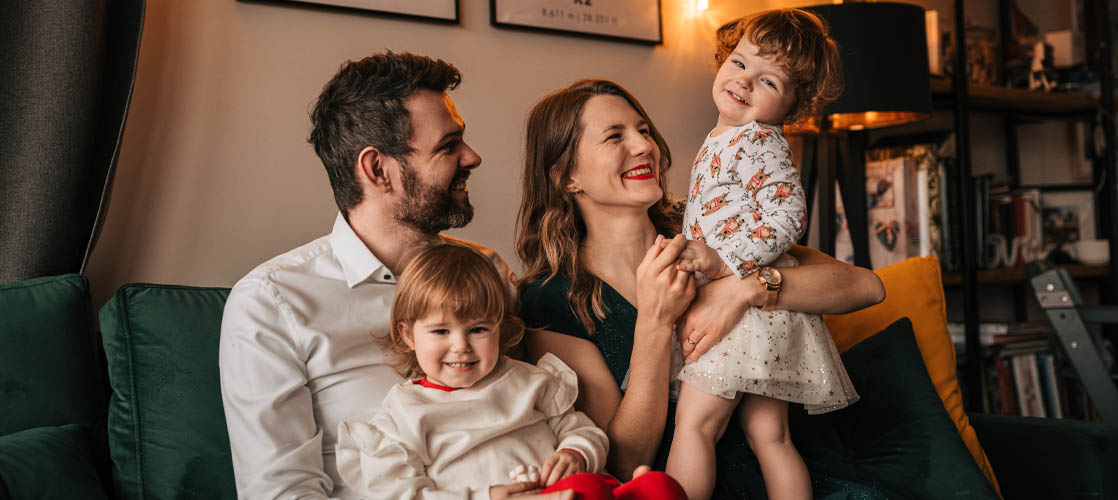
The Kośla family’s life changed on Christmas 2021 when their three-month-old daughter Lena – previously fairly healthy - had a series of seizures. Lena and her twin sister Zuzanna were accustomed to trips to the doctor because they had been born slightly prematurely, which is typical for twins. There had been little sign at birth that Lena would need extra help. Though she had lower muscle tone than her sister she was hitting every developmental goal and the doctors were not worried.
“[This low muscle tone] was a sign from the very beginning, but we kind of ignored that and doctors ignored that because of the twin situation,” said Lena’s father, Piotr Kośla. “During Christmastime she got her first epilepsy attack, and right away it was grand mal, which looks scary.”
The family rushed to the emergency room, where they got their first bittersweet bit of good luck – the ER on Christmas day in Warsaw, Poland was unusually quiet, so they were taken care of right away. The ER doctors could not diagnose epilepsy from one seizure, but they scheduled Lena for an EEG and other tests a few days later when she got her second attack and moved into status epilepticus (a much more dangerous, longer seizure). Lena experienced about 30 seizures in 48 hours, waking up with seizures, falling asleep from exhaustion, and waking up only to start the cycle over again, her father said.
The antiseizure drug levetiracetam provided some relief while the hospital scheduled every imaginable test for Lena, from blood to spinal fluid, but all came back normal. In their second bit of luck, they were able to squeeze Lena in as the 60th sample in the standard genetic test for epilepsy. Unfortunately, yet again the results came back normal.
Their young neurologist suggested a whole exome sequencing to try and shed some light on the origins of Lena’s seizures and it was here that they finally got their answer, on Valentine’s Day: a de novo mutation on Lena’s PACS2 gene (Phosphofurin Acidic Cluster Sorting Protein 2).
With a final diagnosis of the very rare PACS2 syndrome in hand, the family immediately sought solutions. Within days Piotr was on the phone with Professor Gary Thomas from the University of Pittsburgh, one of the few researchers studying this obscure but important gene.
“When you have a four-month-old kid and you get a diagnosis that is so nasty, people grieve, but it can [also] stop them from doing certain actions. Me and my wife are not that kind of people. We were grieving as parents but at the same time wanting to act. It took us a couple of weeks to decide to start the foundation, but in May 2022 we opened the PACS2 Research Foundation.”
PACS2 Research Foundation
The PACS2 Research Foundation was created to seek out or develop an effective treatment for PACS2 syndrome. The Koślas were helped in the beginning with a roadmap for drug development, created for them by Dr. Ethan Perlstein & Dr. Kristin Kantautas from Perlara. The roadmap included their top suggestions for finding a cure for PACS2, one of which was the development of an antisense oligonucleotide therapy. The foundation is already engaged in basic and translational research towards this and other treatment options (thanks in part to crowdfunding), including the approval in Poland of mouse models with PACS2 mutations or development of 3 iPSC lines to be differentiated into neuronal cells.
In the meantime, Lena and the 100 or so other families who have come forward after the Koślas began their work needed help fast. So Perlara recommended Charles River’s Leiden site in the Netherlands, which specializes in finding solutions for rare diseases, where they learned about the potential benefits of drug repurposing through cell painting.
Are Repurposed Drugs the Answer for PACS2 Syndrome?
When an orphan disease patient like Lena needs help as quickly as possible, the best possible outcome would be to repurpose an already approved drug that might alleviate her symptoms. The Koślas were introduced to Andre van Marle, a molecular and cell biologist at the Leiden site, who had the perfect control group of cells in Lena’s fraternal twin Zuzanna.
The project began with the assay development and optimization stages, where Andre and his team figured out the best approach in terms of cell density, compound exposure, and a workflow for quality control. At this stage they also determined the best machine learning model to analyze the cells, since machine learning is very good at image analysis. Using various stains to highlight different parts of the cells, the computer model was able to analyze the healthy cells from Zuzanna and compare them to Lena’s cells treated with various compounds to determine which drug made Lena’s cells look the most like her sister’s.
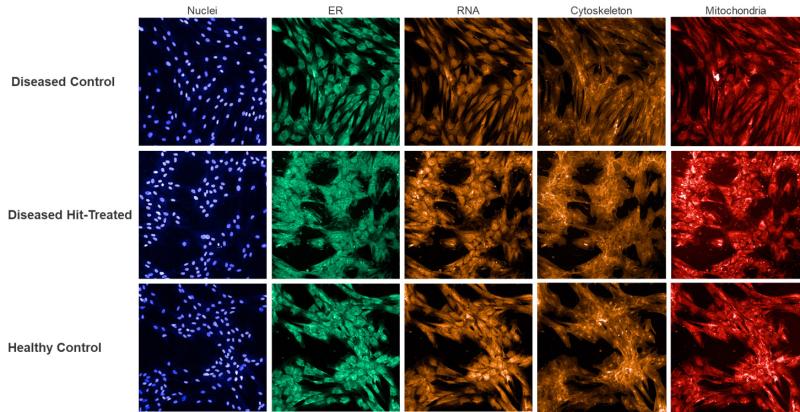
As of now, the approach has borne useful results. Several compounds have had promising effects on Lena’s cells, as can be seen in the image above. The middle row of drug-treated cells began to look more like the bottom row of healthy cells than the top row of diseased cells. With these candidates in hand, work has begun on the next stage of potency screens to determine what dosage of the drugs are most effective with the least amount of side effects.
It will be a while before these drugs can be given to Lena, but the project has proved the efficacy of the approach already. And with the Koślas meeting more PACS2 families every year, they are not the only people who will benefit from any potential treatments.
The PACS2 Research Foundation has connected families across the globe with doctors and scientists who are now talking to them and each other about potential treatments for PACS2 syndrome. The family’s sorrow has exposed them to a passionate network of rare disease advocates, and they know their lives will be changed by this forever.
“Rare diseases will be forever with us, and we want to go beyond PACS2,” said Piotr. “Many families are contacting us all over the world. They want to do something but don’t know where to start.
The family’s entrepreneurial spirit has inspired Andre and his team as well.
“We are in a situation where we can help someone, and Piotr’s enthusiasm is really contagious,” Andre said. “It really drives us to go the extra mile and do the best we can. That’s making everyone in Leiden really enthusiastic about doing science with a cause.”
From Cell Painting to Toxicology: Advancing Treatment for PACS2 Therapy
Discover how Lena’s ultra rare PACS2 diagnosis sparked a global scientific effort, accelerating a potential treatment from discovery to preclinical toxicology in just two years.
Listen to Podcast
If you are interested in helping Lena and many other families, you can learn more about donating to the PACS2 Research Foundation here.