
Podcast
|
Mary Parker
E84: A Family's Fight Against Batten Disease
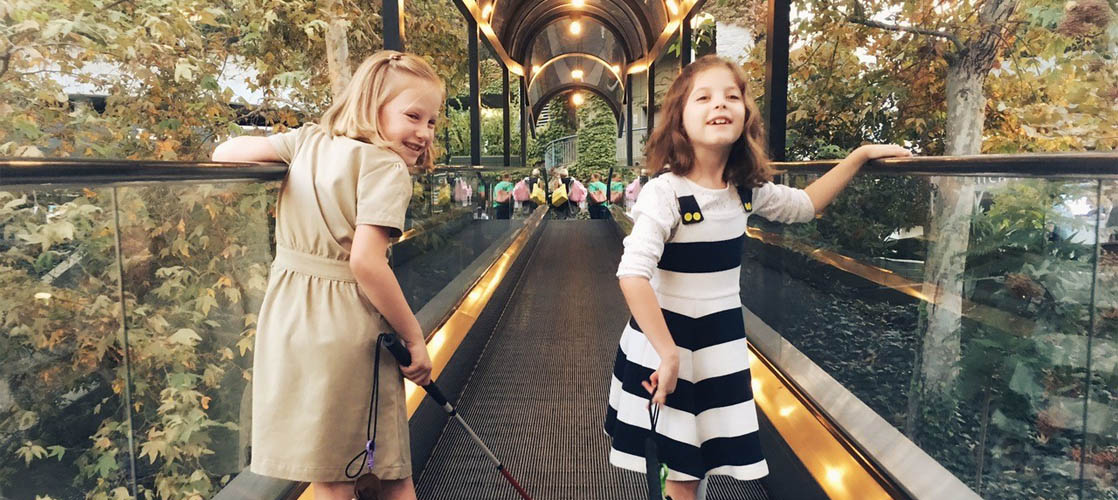
David and Karen Kahn were overjoyed when they welcomed twins Amelia and Makenzie in 2010. However, it wasn't long before they realized their girls were different. Since getting their Batten disease diagnosis, they have worked tirelessly to find a treatment not only for their girls, but for kids around the world, with the help of researcher Dr. Michelle Hastings. Listen to their story now, and learn more about their mission at www.forebatten.org.
-
Podcast transcript
Mary Parker:
I'm Mary Parker and welcome to this episode of Eureka's Sounds of Science. I'm joined today by some extraordinary rare disease advocates, Karen and David Kahn, the parents of twins Amelia and Makenzie, and Michigan Medicine's Michelle Hastings.
Michelle has been working in the antisense oligonucleotide field for 20 years and has developed a potential treatment for the twins who suffer from a rare variant of Batten disease. They're here to share not only their story, but also the state of research into treatments such as the use for rare disease patients. Welcome, Karen, David, and Michelle.
Michelle Hastings:
Thank you.
Karen Kahn:
Thank you.
David Kahn:
Thanks for having us.
Mary Parker:
Thank you so much for being here, and I'm very proud of myself that I got oligonucleotide on the first try. I was a little worried about that one.
David Kahn:
As are we [inaudible 00:01:00]-
Mary Parker:
It's arm twister.
David Kahn:
I wouldn't dare try to say it. So [inaudible 00:01:03].
Mary Parker:
So can we start with some background? Karen and David, how did you meet, and how did your family get started?
David Kahn:
Karen and I met at Auburn University, so college sweethearts. We met in the architecture program. We actually just happened to sit across the table from one another, and we fell in love with each other's shoes, and kind of that was the end of-
Karen Kahn:
[inaudible 00:01:26].
David Kahn:
... the story. Honestly been together quite a long time and started our family in 2010 after probably about four years of struggling. We went through a lot of medical assistance for Karen to get pregnant.
It was an unfortunate and stressful time, but we were rewarded with Amelia and Makenzie, twins, that were quote-unquote healthy at birth. Obviously, later, we found out that wasn't necessarily the case, but we did have some wonderful early years with the girls in our happy family.
Karen Kahn:
Yeah. As much of a struggle it was to get pregnant, I had an amazing pregnancy. And yeah, those beginning few years, I'm thankful, actually, we didn't know the girl's diagnosis because it was... we were incredibly happy and excited. I always wanted twins, so actually, it was just perfect.
Mary Parker:
And how old are they now?
Karen Kahn:
14. Yeah. Yeah, two teenagers.
Mary Parker:
Wow.
Karen Kahn:
Yeah.
Mary Parker:
And Michelle, can you tell us about your research background? How did you become interested in this branch of medicine?
Michelle Hastings:
Sure. So I started my research really studying through the basic biology of RNA, which is sort of the intermediary between your gene and the DNA and the protein that it makes. So I was really interested in understanding how that kind of intermediate stage of gene expression was important for making proteins.
And then, over time, they started to be developed these small molecules based on RNA. There was more technology around being able to use that to modulate the way that our genes are expressed. And so there is just a natural progression of studying the basic biology of RNA to using it as a tool to treat diseases that are caused by or result in this expression of our genes.
Mary Parker:
So, back to the Kahns. Can you tell me about your daughter's diagnoses?
Karen Kahn:
So pretty early on, which is not common with CLN3 Batten disease, but pretty early on, we noticed something was different with Amelia, and a lot of people said, "Well, you have twins, so you're just making this comparison," but still something seemed off. So, really, it was this search for years to get the correct diagnosis for Amelia. And so right after birth, she was so sensory-adversive and just overwhelmed and screaming for hours on end. And we took her... At that point, it was... we just thought she had autism.
And right before her second birthday, she actually was diagnosed with autism. And I remember we almost took her naked to get her diagnosis because, I mean, it was that bad. She was just arching her back, screaming. We couldn't put a diaper on her. It was rough. And so she got the autism diagnosis, and then we immediately started ABA. And we had a few years of really thinking, "Okay, we're going to conquer autism in Amelia, and she's going to be okay." And both girls went to preschool where Makenzie, ironically, at that point, was going as a typical child.
It was an immersion preschool, and Amelia was 40 hours of ABA. And for the first few years, it worked and then it all got to a point where no one knew what to do with Amelia again. Just we couldn't ABA, I guess, Batten out of her. At that point, the girls, three years of ABA, we went... they went off to kindergarten, and that was the first time anyone mentioned to us, "Hey, you should probably go get her vision checked." And we took her to the eye doctor, and we were told that she had perfect vision. First grade, again, we took her to the eye doctor and her vision's perfect.
And at that point, they really started questioning me about it. It was kind of, "Well, maybe she just wants glasses to be fun or all these things." And I'm like, "Amelia has been through three, four years now of ABA. She actually kind of is trained in this." It's a kind of bad way to say it, but just if she could see, she would tell you. It really required pushback from me for them to pursue further. And that is what led us going to getting an ERG, a specialized test. And even when the results from the ERG came back, I got questioned again, "Well, did she cooperate for the test?"
I'm like, "She was on my lap, and she was just a perfect angel for this test." And so we were lucky enough in a weird way that we got sent to a retinal specialist, and the retinal specialist we got sent to had studied that in Iowa where they had... they study Batten disease. So he took one look into her eyes, and with her behaviors, he knew what she had. And so we got sent to the genetic specialist. Really, they tested for a few different variants of Batten disease. And, of course, we had never heard of Batten disease at that point.
I didn't even... When they took the test, I kind of sat on it for a month, and then I started, "Well, what did they test for?" And I started Googling what they tested for and looking up all the things. And I said to Dave because he would kind of shut off. It's like, "We just wait." And I started Googling. I'm like, "She has Batten disease, something that no one in our family had ever heard of." Then it was Makenzie, like we said, had been developing typically the entire time. It really didn't cross her mind she could have it, and I've said this before, but she lost her... she started losing her color.
In retrospect, we realized that Amelia had lost her color as well as kind of the first things to go. We chalked it up to just kind of learning differences for Amelia, but as soon as Makenzie started losing her color, I'm like, "She has the exact same thing." Yeah. So I think it was a long way to diagnosis, but at the same time, it was relatively quick once we were able to put the vision and the behaviors together. But Makenzie is the more typical CLN3 Batten, where she really was developing normally until the vision loss. And honestly, she probably wouldn't have been diagnosed for a few more years if it hadn't been for her sister.
Mary Parker:
Well, it's a tough subject, but it can be so hard when parents are dealing with these mysterious symptoms. And at the same time, you can't expect every doctor to have encyclopedic knowledge of every rare disease. So, like you said, this guy working at Iowa, you'd... I mean, in a way, you did get very lucky with that. That's a really powerful thing when it can happen relatively quickly.
Karen Kahn:
We did. And I think the other thing too is having the diagnosis really changed the way we interacted with Amelia. We really were trying to force her to fit into society. We were doing ABA 40 hours a week. We were just really focused on that. And as soon as we got the diagnosis, we just kind let up and let her be. And she was much happier because we weren't... we knew we couldn't change what was happening, and it helped in a weird way. Yeah.
Mary Parker:
No, that makes perfect sense. And we were going to get into this later anyway, but David, if you don't want to get into your nitty-gritty details of your horrible experience, do you have any advice for parents who are in this part of the process now?
David Kahn:
I would imagine it's very unique and specific to every individual going through it. I mean, we know people that don't want to treat. They don't want to kind of get in the way of the course of nature, and that's fine. Obviously, we're a little different. We want to stand up and fight and fight for our girls and fight for other kids. If you wanted to go down a similar path and fight, my recommendation would try to assemble a team of talented people and compassionate people around you because it's going to take that.
And I know it's so cliche to say it takes a village, but it does. I mean, there are times where it takes five adults just to handle the two of them on certain days, certain moments that just life still goes on around you, and you're so focused on just making sure literally that you don't get poop all over the house. And it's just amazing how much effort and how many hands it takes to kind of get through some days. So being, I guess, brave enough to ask for help, being unashamed to ask for help is really probably the single most helpful thing.
If I could express that to somebody else, you don't have to be proud. You don't have to feel guilty. It sucks. And it's really hard. And some days are harder than others. Physically some days are harder than others. Emotionally, some days, the walls all come crashing down on both fronts and other days, it's like, "This is totally fine. I don't even know why we complain, right."
Mary Parker:
Yeah.
David Kahn:
That whole roller coaster happens sometimes multiple times throughout a single day. But having friends and family that can help, having the science behind us that can help, I mean, all that is instrumental in us getting up every day and making it to tomorrow.
Mary Parker:
Yeah. [inaudible 00:11:21] speaking of which I noticed on your website, which is forebatten.org, that'll be linked in the show notes, that you have had a lot of support from your family. And how did your family respond to this diagnosis?
David Kahn:
They knew that genetic testing was in limbo and what we were testing for. So everyone was kind of anxious to get that news one way or another, and they just went full force right away. I mean, my sister, I think, coined the ForeBatten Foundation right away, and we didn't even... we weren't even thinking that we were going to do that. So they really rallied around us. And so they were everything really.
Karen Kahn:
Yeah, each in their own way contributed, and it was huge. And I think that it's also taken seven, eight years to really appreciate it because it's not just a diagnosis that the girls received. Obviously we're devastated, but the grandparents are devastated also, your siblings, all the relationships change. It was hard. It was hard on everyone. The grandparents are grieving for us and the grandchildren.
And then, even for us to this day, being around typical children, the cousins, it's hard because it's just a reminder of our life didn't turn out how we wanted it to. But we also, because they gives so much to us and it's taken years, it's a process, we really still need to be involved in their life as well. It's not a one-way street. And sometimes it's hard, and we kind of on our own retreat, and then other times we're okay with it.
And so I think kind of a lesson learned of just people need to keep poking us, and if we can't handle it, then you'll know. We won't respond. We won't do something. Other times, we want to be involved because it's isolating. If we really just focused on the girl's diagnosis and just retreated completely, it would just be the four of us. And we need other people. We need our family, we need our friends still, and we need to somehow still feel normal.
Mary Parker:
Yep. Well, and you also need good doctors. So can you tell me about how you were connected with Michelle?
Karen Kahn:
Yeah, so when the girls were diagnosed and we talk about starting a foundation, A, we didn't know what we were doing. We didn't know when we started foundation that we were starting a nonprofit. It sounds silly, but we're just like, "Okay, yeah, we're going to treat the girls." We thought we were going to be that fairy tale story of treating the girls within a year.
You heard about it back then, and it still happens. And we had all the support behind us, and we were going to treat the girls. Life was going to be okay. And so we were really focused on gene therapy, and we were introduced to Michelle through another researcher who was working on gene therapy. And at that time, it was, "Okay, well, even after the gene therapy... after the girls get gene therapy, then as an adjunct treatment, we can in the future be looking at ASOs." So that-
Mary Parker:
Interesting.
Karen Kahn:
... was going to be the future for our girls. Obviously, that did not work out. The girls were not candidates for gene therapy, which we found out within six months after diagnosis. And that was not as bad as diagnosis day, but also was just absolutely crushing for us to find out that that wasn't going to be the path they took. And so we were connected with Michelle, and really we were... started funding supplemental research for the common mutation.
She was already working on the common mutation, and it was we just slowly started learning about ASOs, and it was going to be in the future for us. And then, obviously, things changed, and we spent a few years focused on the common mutation with Michelle. Personalized medicine was just coming around at the same time. Mila, I think, was diagnosed around the same year as the girls. So Julie was out there forging that path. And so we never were really considering personalized medicine until we had multiple doors shut in their face. We had gene therapy shut in their face.
Then we had the common mutation shut in their face, and then it was, "We don't give up." We're like, "Okay, what's next?" And so we started looking at the unique mutation that Dave carries. We can't look back on all that didn't happen. The fact that the girls were 14 when they were treated. I think it's amazing what has come from it, and I'm actually really proud of us and grateful for our team of researchers that helped us to get to this point.
Mary Parker:
If anyone is listening who hasn't heard this story, I believe Mila was the first patient who was ever given a personalized treatment, and it was also for Batten disease. This was a few years ago, and Charles River worked on that one as well. But over to Michelle. Can you tell us about the development of the treatment for the twins? How does it work?
Michelle Hastings:
Sure. So the twins, as Karen said, they have two different mutations. One is the common mutation, and the other is a very ultra-rare mutation that, as far as we know, only the twins have. And that mutation is duplication of a single nuclear base in the CLN3 gene. What happens when you have that sort of a duplication is everything downstream after that. All the information after that duplication is... becomes very garbled, and it doesn't then get made into the protein that it should get made into.
So we're using these antisense oligonucleotides that we can design to very specifically target and base pair in that region of the mutation. And what... in this case, what the ASO does is it causes that portion of the gene to get removed from the RNA, from the message, and the removal of that message actually corrects the message so that it's no longer garbled and it can make a protein again. The protein is missing a little piece, but it's better than having that... It does recover most of the message.
Mary Parker:
Mm-hmm.
Michelle Hastings:
And that's essentially how it works. It's highly personalized to that specific mutation.
Mary Parker:
Interesting. And I think another important distinction between ASOs and gene therapy is that ASOs can be given multiple times, whereas a gene therapy can kind of only be given once, and you get one shot at it.
Michelle Hastings:
Yeah, that's right. That's right. Now, gene therapies are typically... can only be given once due to the fact that you develop neutralizing antibodies that can then remove any beneficial effect of the gene therapy. We also... The ASOs were also... have some different assets over gene therapy, and in the case of CLN3, one issue is that we don't know a lot about... we don't know what the function of the protein is that the gene encodes.
Mary Parker:
Mm-hmm.
Michelle Hastings:
And so we don't really know when the gene is made or when the protein is made when the gene is turned on, where it's turned on, how much it's turned on. And when we use ASOs, we're targeting the natural message.
So we don't really need to know that. [inaudible 00:18:24] gene therapy you're sort of guessing how much, where you're going to deliver it, how much you're going to make of it when you're going to be making it. So they both have value, different approaches and in this case, the ASOs are... have some unique benefits for this disease.
Mary Parker:
Was there anything specific about these girls that made you decide to go the ASO route instead of trying for a gene therapy?
Michelle Hastings:
Well, certainly, as Karen said, they were not eligible for gene therapy because they did have those neutralizing antibodies. What we were working on the ASOs anyway because, as I said, we think that they do have some unique benefits that can probably help treat in a more specific manner. There's a lot of rare mutations that cause... that are found in this disease, CLN3 Batten disease.
The ASO approach that I told you about is not going to be applicable to all of those mutations. And we were lucky enough really that this particular mutation in an exon, it was in the eighth exon of the gene, that it can actually be removed without disrupting gene expression. And it's actually... This exon where the mutation is [inaudible 00:19:46] actually removal of it it's actually a naturally occurring isoform of the RNA. And so there was a lot of things about it that made it much more likely to have a therapeutic effect.
Mary Parker:
Oh, interesting. And you mentioned other versions of this disease. Are there any other diseases that could benefit from what you're learning from this treatment?
Michelle Hastings:
Yeah, I mean, absolutely. That's what we're so excited about. So the approach that we took for this disease is actually really based on ASO medicine for Duchenne muscular dystrophy. It uses a very similar approach of exon skipping to remove mutations.
And so it's already being used in the clinic and other diseases and rare diseases, but it has the potential to be applied to anything with the right type of a mutation that we can target it to not just rare and ultra-rare and personalized like this, but to even more common diseases where pathways might be disrupted.
Mary Parker:
Okay. My next question I'm actually going to alter a bit. So, originally, I was going to ask you how do you think personalized medicine can benefit patients more broadly. But I think that's pretty obvious. I mean, these are patients with rare diseases that could use these special treatments.
I guess my real question is, do you think personalized medicine could benefit patients more broadly? Like learning all of these things with each new patient, do you think it's likely that this is going to be able to scale up in a way that will benefit more people over time?
Michelle Hastings:
Yeah, I mean, it's a great question. I think that's really the big hope, right, is that for a long time, especially rare disease has not had really good answers. It's costly. For drug development right now, and the way that it is set up, it's very costly, and it's difficult to foresee that you can find treatments like this for all the diseases that they might be amenable to.
However, one of the reasons we were able to do this with the rare mutation for the twins was because the FDA put out a set of guidelines to really specifically tell us how we could do a rare an N-of-1 treatment like this without the exorbitant costs that it would normally take to run a... set up a clinical trial and do all the things that you need to do to make a medicine. And so that was sort of a game changer. That's not going to replace clinical trials for more common conditions.
But I think that what we're learning in the rare disease space and doing these personalized medicines is going to inform and hopefully decrease costs of drug development. These medicines, like ASOs, are... the only thing that changes when you change them is the sequence, not the overall chemistry and structure of the oligos. And so there's a lot of hope that the safety is going to be similar across them, and that's going to sort of help with development and lower costs.
Mary Parker:
Yeah.
Michelle Hastings:
We definitely have a lot of hope that this will change the way that medicines are made and gives new hope for rare disease.
Mary Parker:
Yeah. Not to bring Robert Frost into it, but it just seems like the more people go down this path, the more people explore these different pathways to personalized medicine, the easier the path will get for everybody else that walks on it. So the Kahns. You are one of the... Unfortunately for you, you're one of the original explorers.
Probably every step of the way seems like you're learning something new, and you have to make up your own protocols. But the people that are coming after you can follow your blueprint. They might start with a different disease and end with a different treatment, but the drug development process is pretty similar across the board.
Karen Kahn:
Absolutely, and I think that's one of the huge kind of goals of our foundation are... is information sharing. Our girls are lucky enough to be some of the first to be treated with ASOs, but it's so important to share the lessons learned everything about it to make that pathway easier to make it more accessible for more and more children.
Mary Parker:
Yeah. David, are there any other goals for the ForeBatten Foundation?
David Kahn:
Well, I mean, it sounds kind of blunt and oversimplified, but we do want to cure Batten disease. I mean, that would be truly the goal. We set out to create an opportunity for us to raise some dollars to put towards great research to help the other members of the community that are struggling and give them a little bit of shining light in their dark days.
So that's another arm of our foundation, is just helping other families that are suffering. But ultimately, it's to find answers. And hopefully, those answers lead to a cure, if not a significant treatment. We know how long of a road it is and how potentially impossible the climb is, but it's not going to persuade us from trying. When we started the foundation, it was to save the girls.
Where we are, I guess, intelligent enough based on our experience to know that that's probably not a reality. But to be able to use our girls as an opportunity to prove some science is super important to us. I hate to look at them as Guinea pigs, but they're the ones that have the disease and that are able to tell us the answers of how this medicine is working.
Mary Parker:
Yep.
David Kahn:
So, hopefully, it can provide them much-improved quality of life for whatever they have left. But ultimately, we know that this trial, this treatment, this approach is hopefully going to affect... positively affect future families. And if it does prove out and not necessarily help our girls directly, we hope that this medicine put into a much younger child with the disease can have a long-lasting impact.
Mary Parker:
I'm certain it could.
Karen Kahn:
Yeah, after the girls were treated, I think we took about... It was a very, very stressful year leading up to treatment. I mean, we set an aggressive path once we decided to move forward with ASOs and personalized medicine, and we set an aggressive path. And so we really did kind of after they were treated the first time, take a month to just enjoy our accomplishments.
And then, really quickly, it became, "Okay, what's next? How do we help more kids? Yeah, how do we treat the common mutation? Let's move forward." It was really, I feel like, a springboard for... In a weird way, we're just... I feel like it's the start of the foundation again. It's like a rebirth of it, and there's so many other things we still want to accomplish. We want to save the vision of these kids. We want to be able to not just treat the other symptoms but vision.
I think that was devastating in the beginning when our girls lost their vision. I remember Dave walked around blindfolded for, I don't remember how long he lasted, but I was traumatized, and even every time I was falling asleep and just closing my eyes for darkness, I just couldn't imagine that that was the world they lived in now. And Dave said it so many times before, but losing your vision and being blind is one thing, but when you also are losing literally your mind as well, it just is such a difficult thing.
And I think that the girls, throughout their day, they still tell us. I mean, Makenzie, every day still at some point, will mention that she used to be able to see, and she's really funny when she calls people out, when they tell her to look at something, she's like, "I'm blind." Love it that she speaks up for herself and [inaudible 00:27:28]. Yeah, there's still so much more we want to do with the foundation, and Dave's right.
I still think giving back to other families is another arm of the foundation. That's really important to us because we've been lucky enough to have an amazing support, especially from the golf community and the funds we've raised for research, but it's also about the everyday and just enjoying those happy moments in the beginning when the kids are younger.
Mary Parker:
Yeah. So Michelle, back to you. What are some of your goals for this line of research? What are you working on next?
Michelle Hastings:
Well, as Karen mentioned, we're really focused, laser-focused, on trying to make a similar type of ASO for the common mutation.
Mary Parker:
Mm-hmm.
Michelle Hastings:
Again, it's designed a little bit differently because the target is a little bit different, but we were sort of stymied and going after that originally just because of the cost, as I mentioned, and not being able to get a pharma partner to develop it because it's rare. And we are determined now that we have forged this path with this... with the ultra-rare using those FDA guidelines for the [inaudible 00:28:40] to move forward with all the work that we've done for the common mutation that's going to be able to treat most kids with this disease.
And so that's really our... my immediate focus. The story of developing this in this timeframe has also garnered a lot of interest. So in working with other scientists and clinicians that have similar stories to us, that they have something that they think would be really promising as a medicine, and working with them to help find a path forward also, and our own research as well. We're involved in programs with cystic fibrosis and other diseases pretty heavily and working really on trying to get this out there for more diseases and more people.
Mary Parker:
How can our listeners help the foundation, and what are some of your immediate goals for the coming year?
David Kahn:
Our immediate goals for the coming year are and for every year are to raise funds and raise awareness so we can continue to apply them towards these programs that are trying to achieve our goals. As we all know, this research and this science costs a lot of money, and unfortunately, we need more money to be able to continue down all these rabbit holes that we're searching for answers.
So, every year, it's actually happening. This spring, this late February, early March, we have a two-week-long online auction that is pretty much 99% golf-related. It's been coined the greatest auction in golf from GolfDigest and other publications. And we're just so very proud of what's been grown over the last seven years specifically. My father has really single-handedly put this thing together and continues to do so.
That's his way of giving to the cause and fighting for his granddaughters, and he's just been able to assemble some amazing experiences and packages in the golf world that you otherwise couldn't get a hold of. And so our seventh annual fundraiser is happening, like I said, in the end of February. It's just a great opportunity to not only give to our cause and to make a difference but to get something pretty cool and fun in return.
Mary Parker:
Yeah, absolutely.
David Kahn:
So you can learn more about that at forebatten.org, F-O-R-E-B-A-T-T-E-N, little play on the golf world.
Mary Parker:
And that link will be in the show notes as well if anybody wants to check it out.
David Kahn:
Yep. And as the weeks go on, or there'll be some more marketing out there, more specific to that event and that auction. And the other aspect of what people can do is really learning more about the disease and spreading awareness. Our donor base is only as good as how large it is, honestly.
And so every year, our goal is to not just keep hitting the same people but to try to expand that audience so we can get more people involved and more people aware. We all have a lot of opportunities to give to great causes, and most people already have stuff that are near and dear to their heart, right. So to be able to break through and touch people in a way that makes them consider giving to you is, it's a tough task, but it's what we're always focused on.
Mary Parker:
And finally, I already asked you earlier what your advice was for parents receiving a similar diagnosis. So now I'm going to ask [inaudible 00:32:24]... actually ask Michelle. If a parent finds their way to you or any family member finds their way to you with a family member with a rare disease, what would be some of the most useful things they could bring you to get the ball rolling and get the process started?
Michelle Hastings:
Yeah, that's a great question, and that's something that now that is... that's really happening. I think one thing about this type of an approach, personalized medicine, and rare disease, in particular, is that it really does take working together as a team, me as a scientist, working with the physicians, and also with the families that have... Obviously, they have a burden above trying to find a medicine, but it's really helpful to work together as a team.
One thing that is really important for this type of medicine, these personalized medicines, is to get genetic diagnosis, understand what your mutation is. That's really important. I mean, just stay involved. I think that was what really, to me, the key to success here with... was that the ForeBatten Foundation really drove this. They were the organizing nucleus that brought to the team together, and we... and that was really critical.
Mary Parker:
Well, thank you so much, all three of you, for joining me and sharing your story. I am eager to hear about how this research progresses in the next year.
Karen Kahn:
Thank you so much. We're excited to share our story.
David Kahn:
Yeah, thanks for having us, Mary, and thanks for getting our story out there.
Mary Parker:
Anytime. We look forward to updates.
Michelle Hastings:
Thanks, Mary.


