

Biologics
|
Olaf Stamm, PhD
Effective Host Cell Protein Control Strategies
Rule No. 1: Avoid surprises during late-phase clinical trials
The risk with host cell protein (HCP) control during early project/process development is that supposedly low HCP contents measured by generic kits can miss out on key impurities, which leads to severe challenges during the later stages.
This is not just an academic question. There have been examples of companies who have run into problems because the kits they were using were not adequately accounting for HCPs. When HCP kits fail to detect even one important host cell protein it can trigger problems such as anti-drug antibodies in larger patient populations later on, which ultimately could impact the efficacy of the drug. This ends up costing companies time and money because they have to redo their experiments.
So how can you be sure your kits are solid enough and your control strategies exact enough to avoid costly disruptions from happening further downstream? The challenges are illustrated in the following infographics.
In the graphic below about why antibody coverage matters in early downstream processing, it does appear that the optimization of the purification process is stopping, as the HCP results show a good reduction and nice low values (e.g., 5 ppm) in the drug substance.
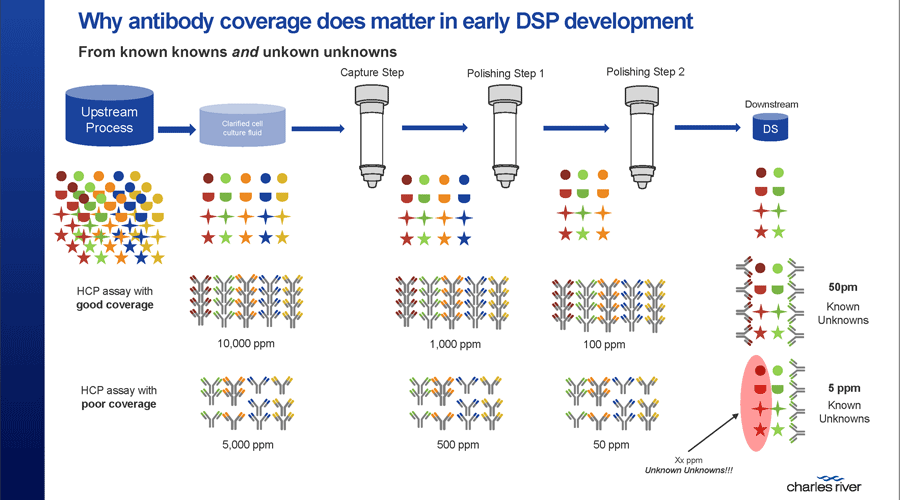
However, such results can be misleading and provide a false sense of security. In fact, there might indeed be HCPs which are co-purifying with the product but not properly detected by the antibodies of the HCP assays. Think of it as the host-cell protein version of not seeing the forest for the trees.
So, in reality, the higher result of 50 ppm, shown in the second row of figures, might actually better reflect the actual situation as these results were determined using an assay with much better coverage.
The lesson here is that it is crucial to understand the performance of the assay used for HCP detection with respect to coverage as this will be critical for the performance of the downstream processing process and the quality of the drug substance.
The following case study demonstrates how commercial kits can underestimate the actual HCP load.
The blue bars show the HCP content measured with a commercially available ELISA kit (anti-HEK293) and the orange bars show the actual HCP load measured by the shotgun proteomics approach.
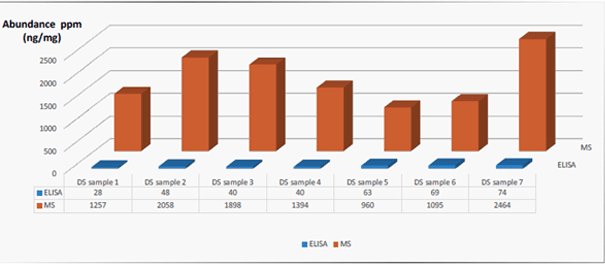
The reason for this big difference is an in-sufficient coverage of the kit antibodies, which is demonstrated by the coverage experiment below.
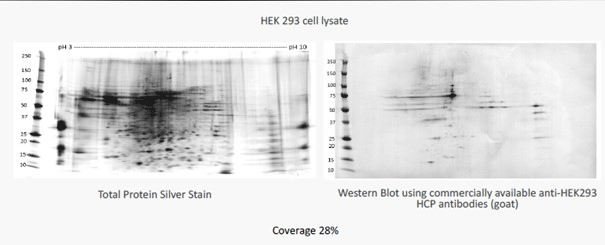
In consideration of these and similar findings, my team of experts recommend labs double check the HCP content in the early stages of their projects using mass spectrometry (MS). Due to the advance in MS technology the amount of information about a products HCP content is tremendous and worth the investment.
Quite often, only a few HCPs account for most of the HCP load in the drug substance. Once those proteins are known, the purification process can be optimized at an early stage, and potentially save money over the long run.
Of course, for process development and optimization the ELISA remains the workhorse.
To address the coverage challenge, Charles River has developed a proprietary reagent/assay development platform based on Immunoglobulin Y antibodies. This approach does leverage the phylogenetic distance by immunizing a mammalian antigen such as the Chinese hamster ovary (CHO) cell line into a non-mammalian immune system (birds).
The immune response in chickens against CHO HCPs is much stronger and more comprehensive, as you can see below in these data charts created using 2D-SDS-PAGE and Western-Blot techniques.
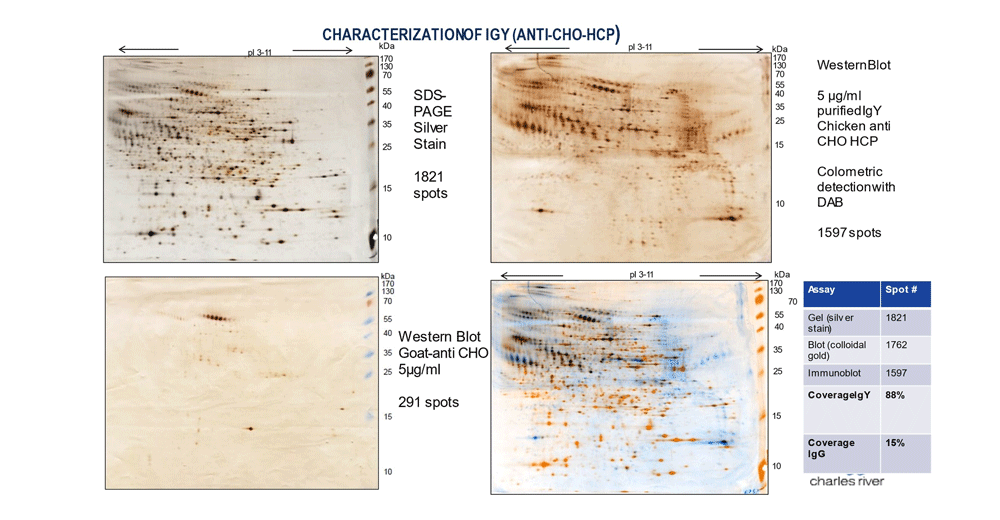
The findings demonstrate the superiority of the chicken immunization compared to the conventional goat/rabbit immunization. Importantly, the approach has been confirmed by multiple client projects that were successfully filed with either the European Medicines Agency or the US Food and Drug Administration.
In conclusion we would suggest the following steps for a holistic HCP control strategy:
- Double check with MS on the HCP content measured with ELISA methods.
- If there are differences, try the new Charles River anti-CHO-HCP kit.
- Plan early for a project-specific or platform assay to fast track your project. My team is happy to share more information on the pros and cons for platform assays and advise on antigen. generation (null vs. mock cell line, fermenter scale etc.).