
Research Models
|
Regina Kelder
Handle with Care: The Case for Refined Mouse Handling
Refined methods of handling mice reduce stress, so why haven’t more laboratories adopted this practice?
Fourteen years ago, two scientists from the University of Liverpool were the first to publish data showing that picking up a research mouse by its tail during cage cleaning or experiments, induces stress and aversion to human contact. Since then, researchers from multiple institutions have provided plenty of evidence that tail handling upsets the mental well-being of mice, with some studies suggesting it can also impact the reliability of behavior studies.
So why haven’t institutions been quick to give up this practice? Elizabeth Nunamaker, PhD, DVM, the Executive Director of Animal Welfare at Charles River Laboratories who has championed this strategy for about a decade, says there are multiple reasons for the hesitancy, but the biggest, she believes, is resistance to change. “We have been picking up mice by their tails for 100 years and change is hard,” she said. “What if someone came and told you, a right-handed person, that if you wrote with your left hand your writing would be much clearer and you would be healthier and live longer. It still might be a hard sell because you have always used your right hand.”
Though the percentage of laboratories using refined methods of handling mice is still quite low, Dr. Nunamaker says the trend among commercial and academic labs is upward. This includes Charles River, where 40% of sites use some form of low stress handling with most of their mice and rats, and the remaining sites are moving in that direction. “I would say that all sites are somewhere on the journey of making the transition. We have created an incredible amount of training materials, and there is some really great information sharing happening. It is taking time, but our goal is to be 100% by the end of the year."
What are the main methods for refining the handling of mice?
There are two main refinement methods that labs use to lower the stress of the animals during handling. One involves the use of polycarbonate tunnels that measure five centimeters wide by 10-15 centimeters long. The tubes are held alongside of the cage wall. Often, since mice prefer tight enclosed spaces, the mice run straight in the tube. If not, the handler can use their other hand to gently guide the mouse in the tube. Once the mouse is inside, the tube is lifted, and the mouse is transferred to its next location. This method is generally easy for less-experienced handlers to learn and better for jumpy or aggressive mice.
Another technique is more low-tech—picking up mice with cupped hands. This approach does not require any equipment, but it does require some training. It is best for somewhat calmer mice as well as for pups, young weanlings, older or larger mice or mice with delicate implants. Researchers who have studied these refinements have found that animal handlers can quickly adapt to tunnel handling, and after a few short training sessions to cupping.
The evidence supporting refined mouse handling in Europe has had a major advocate and supporter among the UK-based NC3Rs. More recently, the US-based non-profit 3Rs Collaborative (3RsC) is working to increase implementation in North America. In partnership with the NC3Rs, the 3RsC offers an e-learning course that teaches handlers refined methods of picking up mice, and in November it is sponsoring a hands-on 3Rs workshop on refined mouse handling at the AALAS meeting in Nashville.
The 3Rs Collaborative says it is focusing on refined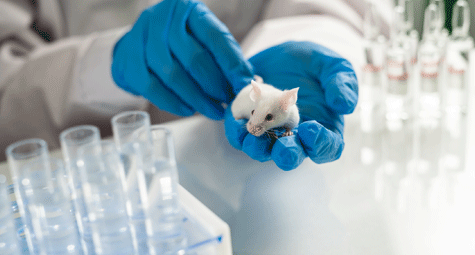 mouse handling because it is backed up by a lot of peer-reviewed literature. They believe it is a change that can be truly impactful. “Refined mouse handling really jumped out at us because it’s going to impact an incredibly large number of animals. It has a ton of evidence behind it, and it is really changing how the mice view the people that they see and work with every day. As a bonus feature, we already had the subject matter expertise in this area because Liz Nunamaker was already involved in our refinement group,” says Megan LaFollette, PhD, Executive Director of the 3Rs Collaborative.
Dr. Nunamaker, who is the past president of the 3Rs Collaborative, began her quest to get laboratories to adopt refined methods of handling mice at the University of Florida (UF), where she spent 7 years. After reading the findings from the University of Liverpool paper, whose research was recognized by the NC3Rs, Dr. Nunamaker, at the time the Associate Director of Education and Outreach for Animal Care Services at UF, broached the idea with veterinarians and operating staff about embracing some form of refined mouse handling. ” When I first introduced the idea, it was like no, not right now,” says Dr. Nunamaker. “But the literature continued to grow, and I kept bringing it up, and being the squeaky wheel….”
Dr. Nunamaker convinced her veterinary colleagues to support a pilot study looking at how long it would take to change out 100 cages using the refined methods. She then pushed for a much larger controlled pilot study involving 2,000 cages, comparing the tunnel and cup methods with conventional methods. Eventually, she and her research collaborators at UF published a 2022 study in PLOS One that was the first to show the positive effects of refined mouse handling on breeding mice. The study showed that more litters were successfully weaned with tunnel handling in a C57/BL6 mouse colony, and that welfare benefits associated with tunnel-handling primarily “accrued through reduction in preventable pup deaths prior to weaning.” In other words, the refinement led to a reduction in litter loss compared to mice lifted by their tails with forceps. The data and projected cost savings persuaded management at UF to incorporate tunnel handling as a standard of care across the institution. Two months after this transition was complete, Dr. Nunamaker headed to Charles River.
Education is key to expanding refined mouse handling
How widely used refined mouse handling is depends upon geography. A recent survey of all UK licensed establishments, which included both commercial and academic institutions, found that 68% were using refined methods of handling mice, 59% using them exclusively. But despite significant adoption in the UK – where the practice has been studied the longest and advocated for years by the NC3Rs—the percentages don’t come close in other regions.
A recently published online survey of 261 participants in 2021, primarily from the US, reported low levels of refined handling implementation. Baseline data from the survey found just 10% used refined methods exclusively and the researchers calculated that a median estimate of only 10% of institutional mice were being handled with refined methods. The survey, created by the 3Rs Collaborative’s Refinement Initiative four years ago, found that at that time, although most participants understood the benefits of refined mouse handling, they (incorrectly) believed that mice were too jumpy or that the refined methods were incompatible with restraints for exams, research, and procedures. Other concerns were that the refinement took too much time or materials (like tunnels) that weren’t available in their labs.
The longitudinal survey was conducted yearly for 3 years and preliminary analysis shows that implementation rates are improving, with more education and training, and addressing common misconceptions. “We define success in that more institutions will be using it at least 75% of the time,” she said. “It’s unrealistic to expect, especially large institutions, to right away get to 100% adoption in every single cage of mice with every single person handling mice, but if they can make change for the majority of mice, then that’s a win.”
While there is limited evidence that using traditional methods of picking rats up by their tails negatively impacts study outcomes, the impact on mice is clear. “They tend to be very fearful and view all of the interactions as negative,” she said. “There's a really convincing video of mice in what's called a radial maze, which is a standardized psychological test that scientists use to study anxiety in mice. If you put a tail-handled mouse in the maze it is completely frozen initially, too scared to move just because of how you picked it up. It usually urinates, defecates, and takes a long time for it to explore its environment. On the other hand, if you put a tunnel-handled mouse in a radial maze it starts moving and exploring immediately. It’s at ease because of how it was handled.”
There are already plenty of examples of institutions using refined mouse handling, says LaFollette. “AstraZeneca has fully transitioned for some time, as has University of Florida. Other institutions we know that are listed on our website such as University of Ottawa, University of Kentucky, Xenon Pharmaceuticals - they have fully switched -and a number of others, like GSK are in the process of switching.”
Is refined handling better for rats?
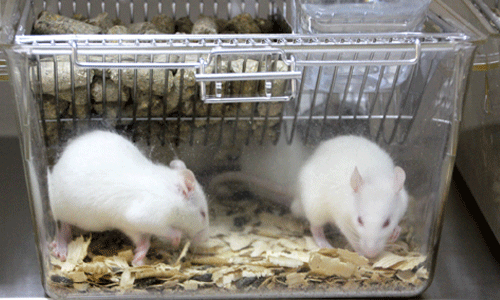 Mice have been the focus of refined handling research, but what about rat models? While the data is much more limited, a study published this year in the Journal of the American Association of Laboratory Animal Science (JAALAS), suggests that refined methods of handling commonly used in other species may actually be more stressful for rats. The study, conducted by scientists from Charles River Laboratories’ Mattawan, Michigan site, looked at three refined methods – the tunnel, protective gloves, and the use of a soft paper towel —and one conventional method—the standard thoracic hold.
Findings showed this latter method caused the lowest incidence of stress in rats. However, the study had some limitations. Only one stock of rat– CRL: CD(SD) rats—was studied, and due to the need to perform animal evaluations in association with handling in most cases, evaluators could not be blinded to treatment conditions. Lastly, because the study was directed toward stress reduction in specific toxicology protocols, the novel handling methods using protective gloves, paper towels, or tunnels needed to be compared only using singly-housed rats; the standard thoracic hold was used for both singly- and pair-housed rats, with pair-housing also resulting in reduced stress.
In contrast, Charles River’s Canada site in Senneville found refinement rat handling with some modifications to be impactful. They recently explored using chain glove handling for its aged rat population, particularly aggressive males who they dubbed grumpy rats because they were particularly resistant to being picked up, says Lucia Amendola, PhD, Regional Head of Behavioral Enrichment in Canada. She said they zeroed in on their 2003 colony of male rats, which are used for reproduction purposes, because they were responsible for about a third of the injuries among technicians during the first half of 2022.
Anecdotally, they found the chain glove with a plastic glove used over it to be safer and less stressful for technicians scooping up the rats, although the technician’s dexterity could be impacted when using the gloves. They also found that using positive reinforcement training with a food reward improved human-animal interactions with older male rats. “And rats do way better when the techs are doing better,” she says, adding that no injuries to techs were reported during the last half of 2022 in this colony.”
In 2025, once they move to bigger, modular cages for their rat colonies, the Behavioral Enrichment Team plans to do a more formal study on rat handling, said Lucia.
(Video courtesy of the University of Liverpool)