
Cell & Gene Therapy
|
Alex Sargent, PhD
The High Cost to Manufacture Cures
From the Model T to CAR T, technology and scalability are crucial to cutting costs and delivering products to the masses
2023 brought seven approvals by the FDA for new cell and gene therapies to treat diseases ranging from childhood muscular dystrophy, to sickle cell anemia and Type 1 diabetes.1 These therapies have brought new hope to patients around the world, but the challenge and the cost of making these drugs can be formidable to patients. The list prices range from $338,000 to an astounding $3,200,000, and the wait time to receive some of these life-saving therapies is currently more than two years.2
Unfortunately, such figures are typical in the emerging cell and gene therapy market, where a lack of availability and affordability often stems from how these therapies are made. (Other reasons driving up the pricetag: Companies will incorporate the lost investment form failed drugs into a successful drug’s price tag, while R&D expenses for rare and ultrarare disease drugs must be recouped from a small number of patients, resulting in high drug treatment costs per patient.)
Cell therapies: One for all or all for one?
Most commercially approved cell therapy products are classified as autologous, meaning that the cells used to make the therapy for a patient are donated or collected from the same patient.2 From a biological perspective this has several advantages. One, if the cells were to come from someone else, then the immune system of the patient who receives them would recognize them as foreign and destroy them. Second, the cells used in the therapy could be immune cells themselves, like for CAR T-cells, which is a type of cellular therapy used to treat cancer.3
CAR T-cell therapies are autologous because if the T-cells came from different donor than the patient receiving them then those cells would react against the patient receiving the transplanted cells.
Where autologous therapies excel biologically, they falter financially. This is driven by the immutable economics of supply and demand. For a desired product to be inexpensive it needs to be mass produced – be it an autologous therapy or an automobile. Much like the assembly lines that enabled mass production and revolutionized the automobile industry a century ago, a similar breakthrough is needed for cell and gene therapy.
Mass producing autologous therapies can be especially challenging, as the material from each patient must be manufactured separately. This would be like if each person in the world required a specialized car to be built unique to them, with the steering wheel in a different place, the pedals a custom length from the driver, and the windshield its own shape. Just as custom-tailored pants are much more expensive than the mass-produced blue jeans bought off the rack, so too are autologous therapies more expensive because they are tailor-made for each patient.
This has led to interest in a more cost-effective alternative: allogeneic cell therapies.4 Here cells are collected from a carefully screened donor or pool of donors and expanded to large numbers using an industrial process that enables the production of hundreds or thousands of doses for hundreds or thousands of different patients.
Each dose of the cellular drug product is the same, but it has been designed so it can safely be delivered to many different patients. This often involves genetic engineering using systems like CRISPR to remove genes involved in immune rejection or immune reaction.4 Genetically engineering the cells as part of the manufacturing process ensures the cell treatment is not rejected by a patient’s immune system and it does not mount an immune response against any patient it is transplanted into.
This “one therapy for all” approach can significantly lower the cost of producing cell therapies by as much as 80-90%, according to some estimates.5 But allogeneic therapies can also have significant disadvantages. One, allogeneic therapies may be riskier from a safety perspective compared to autologous cell therapies. This is because the process to genetically engineer these cells could introduce harmful mutations to their DNA, and genetic engineering may not be 100% effective, so the risk of immune rejection or immune reaction can exist.6
Another area of concern is the efficacy of allogeneic therapies compared to autologous therapies. Autologous therapies such as CAR T-cell therapies can persist in the patient for years or even a lifetime, whereas allogeneic therapies tend to only persist in the body for weeks or months.4,6 Whether this is sufficient to fight off cancer or prevent it from reoccurring is an important question that researchers are still trying to address. With the effectiveness of autologous cell therapies, drug developers are also exploring how to effectively produce more of these tailor-made doses of personalized medicine. The answer there may well lie in another important aspect of mass production: automation.
Automation for Advanced Therapies
Many may well imagine that cell and gene therapies are manufactured using cutting-edge technology. However, commercially approved cell and gene therapies are less than ten years old in the US and Europe, and the technology to make these products – the machines that make the medicine – is still in its infancy.
Most cell and gene therapies are currently manufactured by hand, using methods and systems that are decades old.7 Drug developers are increasingly exploring how new technologies and systems can automate this process, thus reducing labor and costs while increasing production.
Beyond savings in labor and cost, automation may also be instrumental in reducing inherent risks involved in making cell and gene therapies.
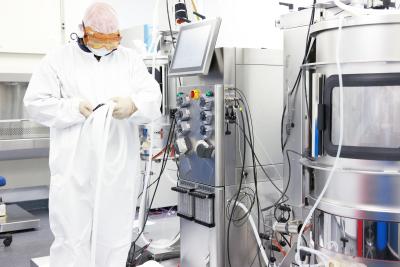
Conventional pharmaceuticals like pills, liquids and powders can be sterilized at the end the process by special filtration methods or by using heat and chemicals.8 These methods would instantly kill living cell or gene therapies, and so the entire manufacturing process for these treatments must be kept sterile from start to finish. This means manufacturing occurs in tightly controlled environments operated according to Good Manufacturing Practices (GMP) set forth by the FDA.9
Operators that work in these environments must wear biohazard suits that cover every square inch of skin, and the air in the facility must be constantly monitored and decontaminated to reduce the risk of even a single microorganism making it into the process. This makes manufacturing autologous and allogeneic treatments both burdensome and expensive, as they require specialized facilities and a lot of personnel working in very elaborate environments.9
With newly emerging automated platforms, the manufacturing process for cell and gene therapies can be performed in a sterile, closed system. Since the system is closed to the outside environment, the room or facility is easier to maintain, and the staff is less encumbered. Operators can trade biohazard suites for lab coats, as the therapy being made is now protected within a closed, automated system.
Despite their advantages adoption of these new technologies can be slow, as they are just beginning to emerge on the market. The systems can also be quite expensive, requiring a considerable up-front investment.7 In the long term though, automation and assembly line manufacturing can help drive cell and gene therapies to patients, making them both more affordable and more accessible.
From the Model T to CAR T, technology and scalability are crucial to cutting costs and delivering products to the masses. For cell and gene therapy achieving these goals involve shifting not just how these medicines are manufactured, but also which treatments drug developers prioritize and invest in.
When developing and producing life-saving therapies must be balanced against budgets and profitability, difficult moral and ethical issues can emerge. Perhaps nowhere is this more apparent than with diseases which affect not the many but the few. If only a handful of people on the entire planet are stricken with deadly disease, who pays for the cost to find a cure?
References:
1. Gene Therapy Approvals Expected to Ramp Up in 2024 Amid Manufacturing, Cost Challenges. BioSpace. (2024, January 9). https://www.biospace.com/article/gene-therapy-approvals-to-ramp-up-in-2024-amid-manufacturing-cost-challenges/
2. Sabatini MT, Chalmers M. The Cost of Biotech Innovation: Exploring Research and Development Costs of Cell and Gene Therapies. Pharmaceut Med. 2023 Sep;37(5):365-375. doi: 10.1007/s40290-023-00480-0. Epub 2023 Jun 7. PMID: 37286928.
3. De Marco RC, Monzo HJ, Ojala PM. CAR T Cell Therapy: A Versatile Living Drug. Int J Mol Sci. 2023 Mar 27;24(7):6300. doi: 10.3390/ijms24076300. PMID: 37047272; PMCID: PMC10094630.
4. Caldwell KJ, Gottschalk S, Talleur AC. Allogeneic CAR Cell Therapy-More Than a Pipe Dream. Front Immunol. 2021 Jan 8;11:618427. doi: 10.3389/fimmu.2020.618427. PMID: 33488631; PMCID: PMC7821739.
5. Graham C, Jozwik A, Pepper A, Benjamin R. Allogeneic CAR-T Cells: More than Ease of Access? Cells. 2018 Oct 1;7(10):155. doi: 10.3390/cells7100155. PMID: 30275435; PMCID: PMC6210057.
6. Depil S, Duchateau P, Grupp SA, Mufti G, Poirot L. 'Off-the-shelf' allogeneic CAR T cells: development and challenges. Nat Rev Drug Discov. 2020 Mar;19(3):185-199. doi: 10.1038/s41573-019-0051-2. Epub 2020 Jan 3. PMID: 31900462.
7. Moutsatsou P, Ochs J, Schmitt RH, Hewitt CJ, Hanga MP. Automation in cell and gene therapy manufacturing: from past to future. Biotechnol Lett. 2019 Nov;41(11):1245-1253. doi: 10.1007/s10529-019-02732-z. Epub 2019 Sep 20. PMID: 31541330; PMCID: PMC6811377.
8. Hussong D. Sterile products: advances and challenges in formulation, manufacturing and regulatory aspects--a regulatory review perspective. AAPS PharmSciTech. 2010 Sep;11(3):1482-4. doi: 10.1208/s12249-010-9503-z. Epub 2010 Sep 16. PMID: 20845091; PMCID: PMC2974144.
9. Bauer G, Fury B. Challenges of translating a cell therapy to GMP. Int Rev Neurobiol. 2022;166:207-234. doi: 10.1016/bs.irn.2022.09.002. Epub 2022 Oct 18. PMID: 36424093.