

|
Anne Lodge, PhD
What is a Leukapheresis Procedure?
As a lab scientist, you appreciate the access leukapheresis offers to high volumes of cells for your experiments all at once. Even if you don’t need a whole leukopak or you work with cryopreserved PBMC, it is incredibly handy to have a source of cells that is consistent and always ready to go.
Scientists don’t always have a clear understanding of how cells are collected through leukapheresis, but it can be useful to expand your knowledge in this area.
How Does Leukapheresis Work?
The principle of leukapheresis for collection of mononuclear cells (MNC) is separation by specific gravity.
Red blood cells have the highest specific gravity followed by granulocytes, then lymphocytes and monocytes, with platelets having the lowest density. During the leukapheresis procedure, whole blood is centrifuged to separate the cells and collect the cell type of interest.
Sounds easy, right? Of course it isn’t that simple in practice.
Cell Separation during Leukapheresis
The separation of the cells is dependent on many factors, some of which can’t be controlled. The size of the donor’s veins is not going to change, for instance. Their blood pressure and heart rate can also have an impact.
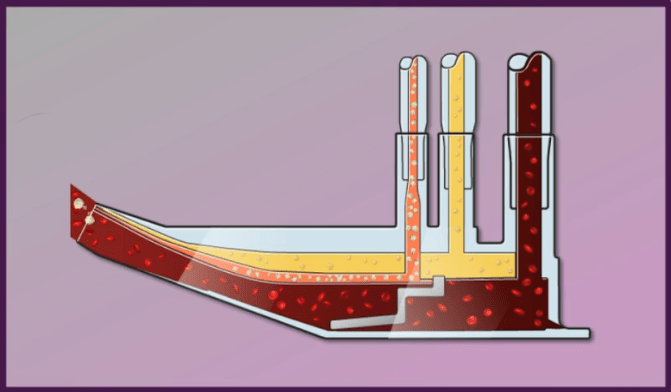
The separation of blood fractions during leukapheresis, showing the three different cell layers and outlets for each layer. Source: Terumo BCT
Blood Volume
The donor’s total blood volume is a reflection of their body size, so it’s not surprising that a 220 lb man will have a greater blood volume than a 130 lb woman. The donor’s blood volume will also affect the amount of anticoagulant used. Because the anticoagulant is mixed with the blood as it enters the collection set, the ratio of anticoagulant to whole blood needs to be balanced. In practical terms, this means that the rate of separation will be faster for larger donors and slower for smaller donors.
Don’t expect 10 liters of blood volume to be processed from smaller donors. Only the big guys will be able to sustain the necessary flow rates.
Final Cell Product
Despite controlling for anticoagulant, cell packing, and fluids, there’s no predicting what the final makeup of the collection will be ahead of time. In theory, collection of cells at a lower percentage of RBC (lower hematocrit) should result in a higher proportion of monocytes, but that degree of control is not possible.
Even when we keep all variables consistent, the results from one collection to the next may be different, even for collections from the same donor. All the more reason to appreciate the careful work of our apheresis staff.

How Much Do You Really Know About Leukopaks?
Find out what they are and why they are important for immune research and cell therapy development. Our comprehensive guide covers best practices, considerations, applications, and in-depth characterizations for leukopak collections. Download Guidebook
From Our Lab to Yours
Knowing what’s in your blood products is just as critical as on-time delivery and reliability. Every one of our leukapheresis products comes with comprehensive documentation of donor screening, product collection, and processing.
See all of our fresh and frozen leukapheresis blood product offerings.