Discovery
|
Julia Schueler, DVM
The Irascible KRAS Oncogene is Finally Druggable
What does the future hold for lung and colon cancer patients whose tumors contain the KRAS oncogene
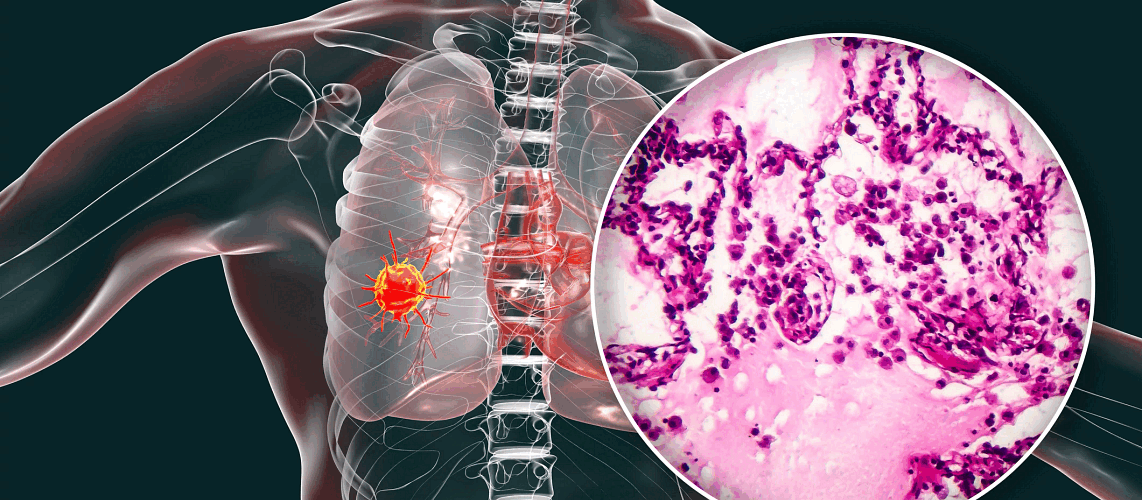
The KRAS oncogene is one of the most frequently mutated oncogenes in cancer being constitutively active in 15% of all human tumors. It is also one of the most elusive, that is until researchers finally succeeded in switching it off. Last year, the first KRAS inhibitor reached the market, improving treatment options for non-small lung cancer (NSLC) patients.
What is a KRAS oncogene?
In its active state, KRAS transmits signals from the cell membrane to the nucleus, activating numerous signaling pathways like EGFR, ALK or cMET. Eventually it leads to the activation of transcription factors positively regulating cell proliferation and differentiation. Interestingly, the prognostic value of KRAS mutations is somewhat variable. Patient prognosis appears different depending on which KRAS mutation a patient has. Patients with KRASG12C mutation seem to have longer survival rates than those with other types of KRAS mutations.
Why are KRAS oncogene mutations so hard to target?
Efforts to directly target the KRAS oncogene had been largely unsuccessful due to the lack of an identifiable binding site. Unlike other cancer-causing mutations, the KRAS oncogene directs production of a protein that is mostly on, causing cells to keep growing. Finding a drug that could latch onto the KRAS protein and turn it off proved elusive.
But in 2013 it became apparent that it was possible to stop KRAS signaling, specifically in the G12C-mutant version. A newly-discovered small molecule drug—screened from hundreds of compounds--was able to trap the KRAS protein in an inactive state and bind to a pocket that inhibits the binding of KRAS G12C to GTP. The drug attached itself to cysteine, an amino acid that occurs in the groove only because of the KRAS oncogene mutation.
What does the future hold for KRAS inhibitors?
The second generation of those irreversible covalent inhibitors of the KRAS oncogene mutation G12C displayed an increased potency and therefore were developed until clinical stage. Last year, Lumakras (sotorasib) was approved as a first- in- class drug for the treatment of adult patients with KRASG12C- mutated locally advanced or metastatic NSCLC. Clinical trials demonstrated high response rates in NSCLC. On average, tumors stopped growing for an average of seven months, an encouraging sign given the low survival rates for this disease—and tumors disappeared in a handful of patients. However, patients suffering from colorectal cancer (CRC) harboring the same KRAS oncogene mutation did not benefit to the same extent. Preclinical work from different groups elucidated that the signaling in the two tumor types is different although based on the same mutation. Amodio et al showed that one escape mechanism in CRC is the reactivation of the EGFR pathway when KRASG12C is blocked1. Thus, the combination of KRAS G12C and EGFR blockade was effective to overcome the adaptive resistance in a preclinical setting. Based on this knowledge next generation KRAS inhibitors like Adagrasib will be tested in different combinations and regimens including checkpoint inhibitors, CDK4/6 or SOS1 inhibitors.
Following the development of those promising two drug candidates elucidated once again the importance of truly translational work in the drug development space when preclinical work is based on patient population data and results from preclinical studies shape the design of clinical trials. In the end, although still a challenging target, treating cancer by modulating KRAS is no longer unattainable.
Reference:
1. Amodio V, Yaeger R, Arcella P, et al. EGFR Blockade Reverts Resistance to KRAS(G12C) Inhibition in Colorectal Cancer. Cancer discovery 2020;10(8):1129-39. doi: 10.1158/2159-8290.cd-20-0187 [published Online First: 2020/05/21]