
Our Heroes
|
Deborah Dormady Letham, PhD
Mentors and Training Matter: Science Stands on the Shoulders of Service
Why I am looking forward to working in the lab when I turn 90 years old!
Our Methods Development group is expanding, which means we are getting new laboratories. I am so excited to help the lab technicians move in - but my favorite memory trigger to my own past is seeing all THE DRAWERS! Endless drawers upon drawers. It brought me back to my own lab start, 30 years ago, in the Plant Biology labs of Dr. André Jagendorf at Cornell University as his summer Lab Assistant.
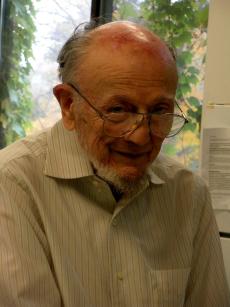
Most likely my biggest small contribution to science in 1989, at age 19, impacting hundreds of future workers, was that I got to be the one who redid and relabeled and cataloged all the contents of all the LAB DRAWERS. Equipped with a clipboard, one computer for the whole lab (a luxury), a dot matrix printer, and clear tape, André and lab manager Bruce opened up each of the drawers in five different rooms with me, one by one, and explained the unusual scientific stuff stuffed in them. It was the Summer of '89, maybe $4 an hour, but the experience of a lifetime.
Every future scientist starts like everyone else in life, by getting their foot in the door, then using their skills and network to slide further in. It’s not about moving UP in science but for us to be circulated around like a Brownian Motion of ideas, SHARING science and techniques. TRAINING. How crucial for us now to do the same for new scientists. We WON’T have science (and all the crucial advances) if we don't TRAIN scientists, keep scientists, and support scientists.
Finding the right scientific mentor is key
I walked into my future over 30 years ago, home for summer break between sophomore and junior years, by starting purposefully in a newly expanding scientific focus: using Molecular Biology tools to study Plant Physiology. I walked through lush Minn's Gardens into Cornell's Plant Science Building to meet Dr. André Jagendorf, the chairman of the Department of Plant Biology, at just at the right time. I landed not just one but three part time jobs in three different labs combined.
Just putting my foot in the door as lab glassware washer, solution maker was great, but André also led me to starting experiments in Dr Peter Davies' lab growing beans in the dark and measuring growth expansion after auxin and gibberellin plant hormone treatments; and helping the scientists doing electron microscopy with Dr. Mandayam Parthasarathy. It may seem unusual for the Chairman of the department to also be involved in the hiring of the summer help, but that is how hands-on Andre’s mentoring was. At the time, I had no idea that Andre had prestigious honors, including being one step away from a Nobel Prize, was president of the American Society of Plant Physiologists two years before I was born, was a member of the National Academy of Sciences, or was written up in one of my class’s text books (Stryer, Biochemistry 3rd edition, page 527) for the experiment that showed the pH gradient-mediated mechanism of ATP synthesis across plant chloroplast membranes. He even has a Wikipedia site now.
With such scientific knowledge, André made me feel like the MOST important member of the laboratory, the LAB ASSISTANT. He and the lab members treated me like GOLD. I can still remember Andre standing next to me teaching me how to use the sink – REALLY – he taught me the science and math of rinsing lab glassware: a small volume of residual solution or soap diluted however many fold by the clean water would reduce the fraction of contamination. And then rinsing 3 times (not just once) with distilled water (or de-ionized) would bring the material even more clean.
Why is the Lab Assistant so important?
Because any experiment will be successful or not by quality of the materials used – one wants to trust the cleanliness or the purity or the formulation of solutions. Control over materials is a Lab Assistant’s role, as well as the opportunity for the scientists to not do some of the time-consuming preparations and move onto to other projects. Time is money in every field. André had a fortune cookie saying taped to the lab door: “If you want to get something done, give it to someone busy.” This means that people who know how to organize their time are SO VALUABLE.
André, one year later then offered me an NSF summer undergraduate research fellowship. Not just my foot in the door, but my whole hands and head too. That summer was when Andre really impacted my scientific skillset by simply doing one thing: SITTING DOWN TO EXPLAIN THE MATH OF MAKING SOLUTIONS. It was Andre's willingness to sit down and teach me solution preparation that put my college lab experience to the test. He did not pawn me off on a graduate student or anyone else, he taught me himself. Then I started to open those nicely labeled drawers (my previous summer’s accomplishment) and start my own science experiments: ATP phosphorylation buffers for chloroplasts, testing CF1 CF0 molecular transportation in thylakoid membranes. I grew pea seedlings, used buffer solutions to grind up both spinach leaves and pea cotyledons, and learned how to use a plate reader and spectrophotometer with a “super-sipper” attachment. Real Science. I also trained the NEW summer lab student.
30 years later the memories are fresh as I am now moving into my new office in our new labs, I amazingly unpacked the box of my 1990 science notes, a 5-inch floppy disk, and a couple letters from André stood out: “I wish you were here! – things are falling apart.” Awww… I also have a letter offering me a position as a graduate student for my PhD program a couple years later and a copy of the 1993 paper where they included me as an author for my smallest set of work using Venturicidin to block/modulate the ATP-synthesis in those chloroplasts, a project later finished by a graduate student. And in my three summers, I remember those graduate students and postdocs getting daily feedback on their experiments because André was in the lab doing experiments too. Seasoned scientists need to keep their hands fresh in the work – how else can we better relate to the ins and outs of lab life.
Science is a team effort – from the bottom to the top
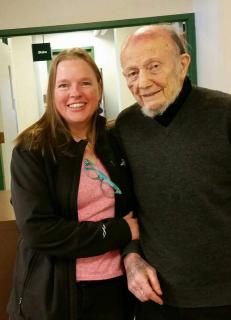
I revisited my friends and mentors many times over the years and was blessed to see André one more time in 2017 (photo attached). It was just one month before he passed away at age 90. He was still working in the lab! at age 90. He still remembered my name as I ran into him in the lab hallway and he told me a GOOD joke. He still asked me if I was working in science, glad I was still in the field that I had studied. I was and I am, thanks to him and many who encouraged me.
Mentors mean everything. We stand on the shoulders of giants in science, and, if we are lucky, we get to take a peek in their well-cataloged drawers.