
Discovery
|
Melvin Lye, Christoph Eberle, PhD
Precision-Driven Biomarker Validation: A Biotech Perspective (Part II)
Why prioritizing precision over sensitivity in biomarker validation ensures that assays are robust and capable of generating reproducible data for time critical decisions
Precision in biomarker assays is inextricably linked to the specimen handling. Pre-analytical variables play a crucial role across many assay formats. Encompass all steps from sample collection to preparation for analysis, these can introduce significant variability, compromise assay results1 and complicate data pattern interpretation. Therefore, key considerations include:
- Sample Collection: Utilizing standardized collection tubes and procedures to minimize variations in sample composition, including proper handling during collection, such as gentle mixing and prompt processing.
- Sample Processing: Adhering to standardized protocols for serum and plasma preparation, including centrifugation speed and time, as well as consistent aliquoting methods. These steps must be carefully controlled to minimize variability2.
- Sample Storage: Storing samples at appropriate temperatures and for defined durations to prevent degradation or alteration of the target biomarkers. Freeze-thaw cycles should be minimized, and storage conditions carefully documented3.
- Biospecimen Handling: Implementing effective washing and detection steps to enhance assay precision. Techniques like Laminar Wash technology can improve cell surface marker staining and minimize sample loss, contributing to more accurate and precise measurements4.
- Automation and Reproducibility: Minimizing human error and variability by implementing automated washing, preparation, and analysis methods. Automation enhances consistency and throughput, particularly for large studies5.
- Technological and Methodological Limitations: Low volume sampling technologies, while advantageous for reducing patient burden, present challenges such as interference from extraction buffers, which can affect biomarker detectability. Understanding these limitations is crucial for integrating such technologies into clinical study conduct6.

eGuide: Biomarker Solutions from Discovery to Clinical Trials
Learn how strategic biomarker integration can accelerate research & de-risk pipelines to bring life-saving therapies to patients faster. This guide helps you uncover smarter ways to de-risk studies and accelerate timelines, without compromising scientific rigor.
Read the Guide
DropArray Technology: Advancing Kinetic Measurements
DropArray technology has emerged as a valuable tool for advancing biomarker validation, particularly in the context of kinetic measurements of immune responses. This microfluidic technology accelerates biological sample testing by automating the analysis of tiny liquid droplets on a small surface. Its application in measuring kinetics of interferon-gamma (IFN-γ) and IP-10 production within peripheral blood mononuclear cells (PBMCs) exemplifies its potential. Studies using DropArray have revealed distinct kinetic profiles for these two cytokines. IFN-a2 production typically peaks within 24 hours of stimulation and then gradually declines, while IP-10 levels continue to rise over time, reaching a plateau at around 72 hours. This underscores the importance of carefully selecting optimal sampling time points for biomarker assays to capture accurate and reproducible measurements. Achieving precision in IFN-a2 and IP-10 assays using DropArray technology is contingent upon several factors:
- Standardized Stimulation Protocols: Employing uniform antigen exposure to PBMCs to minimize variability in cellular responses. This includes controlling factors such as antigen concentration, incubation time, and cell density.
- Minimizing Variability in Sample Handling: Maintaining consistent storage and processing conditions to prevent degradation or activation of biomarkers7. This requires meticulous attention to detail in every step of the pre-analytical process.
- Automated Washing Methods: Utilizing laminar flow-based washing technologies to reduce background noise and enhance signal detection. This improves the signal-to-noise ratio and enhances the sensitivity and precision of the assay.
Integrating DropArray technology with optimized workflow parameters enables researchers to generate reliable and reproducible data, thus supporting applications in immune profiling, disease diagnostics, and therapeutic monitoring.
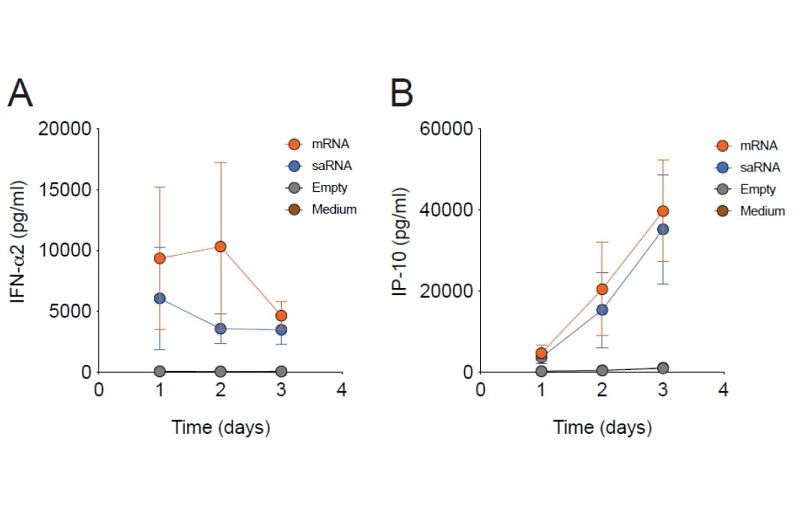
Kinetics of IFN-α2 and IP-10 production in PBMCs. Apparently healthy donor PBMCs were incubated with mRNA-native (mRNA), saRNA-native (saRNA), or empty LNPs (Empty) at 50 ng/mL. Culture supernatants were harvested 1-3 days post initiation of culture, and (A) IFN-α2 and (B) IP-10 production in the supernatants were quantitated with a multiplex cytokine assay (Luminex)8.
Cytometric Bead Arrays: Expanding the Scope of Biomarker Research
The field of biomarker and cytokine research has expanded rapidly, fueled by advances in multiplexed detection technologies like Cytometric Bead Arrays (CBAs). Immunoassays like LEGENDplex offer robust solutions for simultaneously quantifying multiple biomarkers in small sample volumes, significantly increasing assay throughput and efficiency. These multiplexed panels deepen insights into complex biological processes, such as immune responses, inflammation, and disease progression, by analyzing panels of cytokines, chemokines, and growth factors in a single experiment9.
To fully realize the potential of these high-throughput systems, automated sample preparation is becoming an indispensable component of biomarker validation. For that matter liquid handling options, such as those offered by Tecan, Opentrons, and Pluto, enhance workflow standardization, minimize pipetting errors, and improve reproducibility. These automation platforms ensure:
- Consistent Sample Preparation: Standardized liquid handling procedures reduce inter-operator variability and enhance assay precision. This is particularly important for multiplexed assays where even small variations in sample preparation can significantly impact results.
- Higher Throughput Capabilities: Enabling large-scale studies with minimal manual intervention, significantly reduces processing time and increasing efficiency. This facilitates the analysis of large sample cohorts, which is often necessary for robust statistical analysis.
- Reproducibility Across Experiments: Automated platforms eliminate inconsistencies in biomarker quantification, ensuring data reliability and facilitating comparisons across different experiments. This is essential for generating consistent and reliable data over time.
By integrating automated liquid handling technologies with Cytometric Bead Arrays, researchers can significantly enhance the efficiency and reliability of biomarker discovery and validation, accelerating the development of more accurate diagnostics and targeted therapies.
Partnering for Success in Biomarker Validation
Biotech companies must strategically invest in technologies and partnerships that optimize their biomarker validation workflows. A comprehensive understanding of the entire value chain, from sample collection to assay execution, is crucial for maximizing efficiency and precision. Collaborating with specialized organizations like Curiox Biosystems and contract research organizations like Charles River Laboratories offers access to:
- State-of-the-art Immunoassay Platforms: Platforms specifically designed and optimized for precision-driven biomarker validation. These platforms incorporate advanced technologies and features to enhance assay performance.
- Expertise in Assay Development: Access to experienced scientists specializing in preclinical and clinical assay development, providing guidance and support throughout the validation process. This expertise is invaluable for navigating the complexities of assay development and regulatory requirements.
- Scalable Solutions: Solutions that can be readily scaled from pilot studies to large-scale research programs, ensuring a seamless transition from initial validation to clinical implementation. This scalability is crucial for supporting the growing demands of biomarker research.
Prioritizing precision over sensitivity in biomarker validation ensures that assays can be robust, and capable of generating reproducible data to support time critical decisions. Establishing a seamless workflow, from meticulous sample preparation to accurate analysis, ultimately drives better outcomes in immunological research, drug development, and personalized medicine. By embracing these strategies and forging strategic partnerships, biotech companies can accelerate the development and validation of valuable biomarkers that contribute to improved healthcare outcomes, which should be everyone’s goal to raise and to reach.
References:
1. Agrawal L, Engel KB, Greytak SR, Moore HM. Understanding preanalytical variables and their effects on clinical biomarkers of oncology and immunotherapy. Semin Cancer Biol, 2018, 52:26-38. doi: 10.1016/j.semcancer.2017.12.008
2. Luque-Garcia JL, Neubert TA. Sample preparation for serum/plasma profiling and biomarker identification by mass spectrometry. J Chromatogr A, 2006, 1153:259-276. doi: 10.1016/j.chroma.2006.11.054
3. Valo E, Colombo M, Sandholm N, et al. Effect of serum sample storage temperature on metabolomic and proteomic biomarkers. Sci Rep, 2022, 12:4571. https://doi.org/10.1038/s41598-022-08429-0
4. Lye M, Eberle C, Wang A, Feld, GK, Kim N. Semi and fully automated immunostaining sample preparation platforms improve live leukocyte recovery, reproducibility, and cytometry data quality. Cancer Res, 2022, 82(12_Suppl):1885. https://doi.org/10.1158/1538-7445.AM2022-1885
5. Whiteaker JR, Zhao L, Anderson L, Paulovic AG. An Automated and Multiplexed Method for High Throughput Peptide Immunoaffinity Enrichment and Multiple Reaction Monitoring Mass Spectrometry-based Quantification of Protein Biomarkers. Mol Cell Proteomics, 2009, 9:184-196. https://doi.org/10.1074/mcp.M900254-MCP200
6. Yang X, Logis E, Williams K, et al. Evaluation of low volume sampling devices for a pharmacodynamic biomarker analysis: Challenges and solutions. J. Pharm. Biomed. Anal., 2024, 251:1164454. https://doi.org/10.1016/j.jpba.2024.116454
7. Selby PJ, Banks RE, Gregory W, et al. Methods for the evaluation of biomarkers in patients with kidney and liver diseases: multicentre research programme including ELUCIDATE RCT. Southampton (UK): NIHR Journals Library; 2018 Jun. (Programme Grants for Applied Research, No. 6.3.) Chapter 13, Exploring technical aspects of biomarker assays: verification, validation and pre-analytical variables. Available from: https://www.ncbi.nlm.nih.gov/books/NBK513094/
8. Komori M, Morey AL, Quiñones-Molina AA, et al. Incorporation of 5 methylcytidine alleviates innate immune response to self-amplifying RNA vaccine. bioRxiv. https://doi.org/10.1101/2023.11.01.565056
9. Manglani M, Rua R, Hendricksen A, et al. Method to quantify cytokines and chemokines in mouse brain tissue using Bio-Plex multiplex immunoassays. Methods, 2019, 158:22-26. https://doi.org/10.1016/j.ymeth.2019.02.007