

Laboratory Sciences
|
Romesh Collins, MBA, MSc
PROTACs™, A Promising Class of Novel Therapeutic Modalities
These bifunctional molecules are opening new doors in the treatment of multiple disorders
Proteolysis targeting chimeras (PROTACs™) are a new class of small molecules that target specific proteins for degradation. They work by recruiting an E3 ligase, which is a protein-degrading enzyme, to the target protein, leading to its degradation and elimination from the body. PROTACs™ have the potential to treat a wide range of diseases, including cancer, autoimmune disorders, and neurodegenerative diseases.
How are PROTACs™ structured?
PROTACs™ were first described in 2001 by Kathleen Sakamoto, et al., but since then dozens of laboratories and companies are developing new drugs using PROTAC™ technology.
PROTACs™ are heterobifunctional molecules that clutch different proteins with each arm. They contain three components:
1. The protein-of-interest (POI) binding moiety
2. Linker
3. E3 ubiquitin ligase-binding moiety
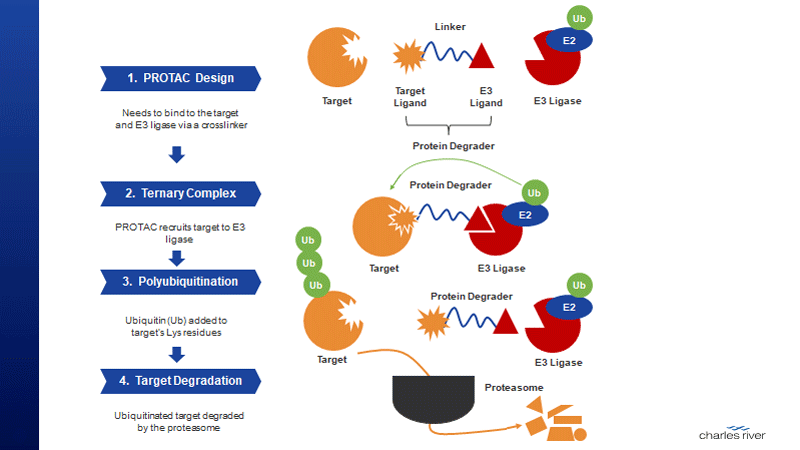
As shown in the image above, these degraders can bind with the E3 ligase and the target protein to form a POI-PROTAC-E3 ligase ternary complex. PROTACs™ rely on the ubiquitin-protease system (UPS), a kind of biological “Terminator” that eliminates misfolded, damaged and overabundant proteins with a cascade of steps that ultimately involve the E3 ubiquitin ligase enzyme. The UPS causes the target protein to be polyubiquitinated—the binding of many ubiquitin molecules to the same target protein—followed by the proteasomal degradation of protein.
The UPS is the primary mechanism for maintaining protein homeostasis, removing defective and damaged proteins in eukaryotic cells. The UPS system degrades proteins by substrate-specific ubiquitination and recognition, meaning that one PROTAC™ molecule can flag multiple copies of its target for disposal.
How are PROTACs™ beneficial in drug development?
PROTACs™ have several advantages over small-molecule inhibitors. They are more selective and target “undruggable” targets. They also offer a prolonged action time, demonstrate activity in smaller doses, have a good safety profile and can overcome drug resistance. The molecularly targeted drugs currently used in the clinic are mainly small molecule inhibitors and monoclonal antibodies. These drugs bind to the active sites of the target proteins as competitive antagonist ligands to hinder the target protein’s ability to bind to their downstream targets.
However, gene mutations or changes in the conformation of the target protein can cause changes in the binding sites which in turn can cause drug resistance. Since 80% of the total number of human proteins have no enzymatic function rendering them “undruggable”, PROTACs™ can be used to overcome this challenge as a therapeutic modality. PROTACs™ are also pharmaceutically active in picomolar doses due to their catalytic mechanism of action and can be reused to further degrade the target.
What are the bioanalytical challenges of PROTACs™?
Yet PROTACs™ are not the perfect molecule. They present bioanalytical challenges during development because their pharmacokinetic properties and pharmacodynamic impact are difficult to evaluate. The recommended bioanalytical strategy is initially similar to small molecules, though can evolve if needed. Also recommended are toxicology studies similar to small molecules. These studies measure typical toxicokinetic markers and toxicology readouts (e.g., histopathology). If there are significant findings, mechanistic studies such as off-target activities may be needed.
PROTACs™ are analyzed using LC-MS using low ionization energy to ensure that in-source fragmentation doesn’t occur. Because PROTACS™ are high molecular weight small molecules (900 to 1,100 Da) they are prone to non-specific binding to glass and plastic. When measuring a PROTAC™ (free of mechanistic studies), total and bound complexes that are dynamic are recommended to measure target knockdown in tumor tissue from an animal model. For regulated bioanalysis, it is recommended that you measure the total PROTAC™ concentration in plasma or accessible tissues (e.g., tumor biopsies).
How many PROTACs™ are in clinical testing?
In 2019, Arvinas Therapeutics entered two heterobifunctional degraders into first-in-human trials: the PROTACs™ ARV-110 and ARV-471. They are now in Phase II clinical trials, and they are not the only PROTACs™ in the clinic. Others include BCL-xL, IRAK4, STAT3, BTK, BRD9, MDM2, as well as targets from Bristol Myers Squibb, Nurix Therapeutics, and Kymera Therapeutics.
PROTACs™ have garnered a lot of attention from academic scientists and biopharmaceutical companies, and interest in these versatile compounds continues to grow as a promising novel therapeutic modality. But there are also hurdles associated with PROTACs™ both in the discovery phase and clinical application. These challenges include off-target effects, cell permeability, stability and larger molecular weight compared to traditional small molecules. Additionally, PROTAC™ drug development needs to overcome issues of oral bioavailability and drug integrity.
As scientists begin to solve some of the challenges, we could, indeed, see some exciting developments in the PROTACs™ arena, and hopefully new drugs for patients.
References
- An overview of PROTACs: a promising drug discovery paradigm
- Protacs: Chimeric molecules that target proteins to the Skp1–Cullin–F box complex for ubiquitination and degradation
- Recent Advances in PROTACs for Drug Targeted Protein Research
- 2019 White Paper on Recent Issues in Bioanalysis: Chromatographic Assays (Part 1 – Innovation in Small Molecules and Oligonucleotides & Mass Spectrometric Method Development Strategies for Large Molecule Bioanalysis)
- PROTAC targeted protein degraders: the past is prologue
Laboratory Sciences
Quality, scientific integrity, cost-effectiveness and regulatory compliance are essential considerations when selecting an outsourcing partner. Charles River is adept at balancing these key values within the most stringent of time frames to deliver comprehensive laboratory services from early screening through preclinical and clinical support.
Romesh Collins is the Global Marketing Manager for Laboratory Sciences at Charles River Laboratories. His focus is on the design, development, and implementation of global marketing strategies. Romesh grew up in Colombo, Sri Lanka. He graduated from The City College of New York, NY with a bachelor’s in Chemical Engineering and The University of Pennsylvania with a master’s in Chemical and Biomolecular Engineering. He received his MBA from Monroe College, NY. Romesh has held various product management and marketing roles in the life science industry and is passionate about data-driven decision making.