
Laboratory Sciences
|
Rebecca Paterson
Psychedelic Drugs: The Analytical Challenges
Psychedelic drugs could be the next big thing in mental health treatment, but to get there, developers must overcome these hurdles
The use of psychedelic drugs for therapeutic purposes is increasingly of interest, with over 800 clinical trials currently ongoing globally. This resurgence is largely due to an increasing focus on identifying effective treatments for mental health conditions, aligning with the gradual relaxation of the rules surrounding their clinical use. The potential for psychedelic-assisted psychotherapy is an intriguing area of research that offers opportunities to treat conditions like PTSD, alcoholism, and depression. As these conditions afflict millions across the world, and currently have limited treatment options, the benefits of identifying a successful candidate would be highly significant.
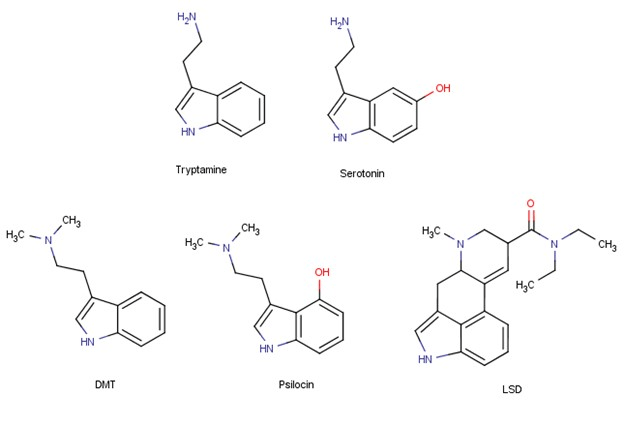
Many psychedelic drugs of interest, like dimethyltryptamine (DMT), lysergic acid diethylamide (LSD) and psilocybin, contain a tryptamine backbone. Although the exact mechanism of action of these molecules is not fully understood, it is thought that it is this component’s similarity to the endogenous neurotransmitter, serotonin, that results in a desirable clinical effect.
Why analysis of psychedelics presents so many challenges
This increase in psychedelic pharmaceutical research has consequently led to a corresponding increase in the need for analytical support for these molecules. Although they are essentially traditional small molecules, an area the industry has robust guidance for and decades of experience with, their analysis does provide the potential for additional challenges.
One challenge that is consistent for all studies and trials of these psychedelic drugs is the additional legislative hoops that must be jumped through to move a study or drug forward in the clinic. Due to decades of being associated solely as drugs of abuse, additional licenses are required to conduct the pre-clinical and clinical testing necessary to get a pharmaceutical product to market. There are consequently significantly fewer providers available to work with psychedelic drug designers to get their product to market. Although this does reduce the options available to the drug developers, it does provide the advantage of concentrating experience in those that do have the licensing capabilities.
A further challenge, that is common across most psychedelic pharmaceutical research, is the number of analytes requiring measurement, either bioanalytically or in formulation analysis. The mechanism of action of psychedelics are not fully understood. This combined with the fact that many are natural products, lead to many metabolites, potential metabolites, degradants, and impurities requiring measurement. Doing this efficiently often requires analytical methods with significantly more than the one or two analytes that are more routinely included in a single analytical assay. Creating these multiple analyte methods, for compounds with often diverse physiochemical properties, can be a significant challenge. It is therefore an aspect where the concentration of experience across a limited number of providers is particularly beneficial.
Additionally, stability can often be a challenge for reliable quantitation of psychedelics. Many of the common psychedelics require additional measures to prevent interconversion between parent, metabolites, and degradants. This can have a knock-on impact on the simplicity of sample handling, with temperature control and addition of stabilising chemicals a routinely required control measure. This aspect therefore makes it critical for accurate data generation to not only have well trained sample collection and analytical teams, but also that the communication between them is clear and effective.
There is also a new challenge developing for psychedelic bioanalysis, thanks to the increasing interest in the psychedelic prodrugs. Prodrugs are pharmacologically inactive compounds, which are designed to be converted in the body by metabolism to the active drug. They are often designed to improve the absorption of the active drug, to enable it to reach the in-vivo target more effectively, or to extend the drug release period and consequently time between doses. These prodrugs offer great opportunities for improving the practicality and effectiveness of treatments; however, they do come with additional analytical challenges.
Prodrugs by design are normally unstable, their mechanism of action being to breakdown and release the active component in-vivo. This adds an extra layer to what is already a non-standard sample handling procedure, further increasing the relevance of an experienced analytical team. The prodrug aspect also provides additional challenges for sample extraction and chromatography, as prodrugs are frequently designed to have significantly different chemical properties to the active. This can make quantification in a single assay, alongside the active drug and often it’s many significant metabolites, very challenging. Using high quality MS systems that can quickly change between polarities and UPLC systems that allow for efficient resolution, often prove essential in this balancing act.
Overall, these psychedelic drugs offer great opportunities for a range of therapeutic purposes, and it is this vast potential that makes the challenge of finding the experienced analytical teams worthwhile.
References:
1. US National Library of Medicine Clinical Trials. (n.d.). Retrieved from https://clinicaltrials.gov/ct2/home
2. Tullis, P. (2021). How ecstasy and psilocybin are shaking up psychiatry. Nature, 506-509.
3. Peritore, C. S. (2022). The promise of psychedelic research. Future Drug Discovery.
4. https://www.technologynetworks.com/drug-discovery/articles/the-pulse-psychedelic-news-from-technology-networks-issue-2-371474
Rebecca Paterson leads the method development team, within the Chromatographic Bioanalysis department at Charles River Laboratories Edinburgh.