Industry Focus
|
Mary Parker
Rising Temperatures, Lowering Energy
How to save money, energy, and the environment one facility at a time.
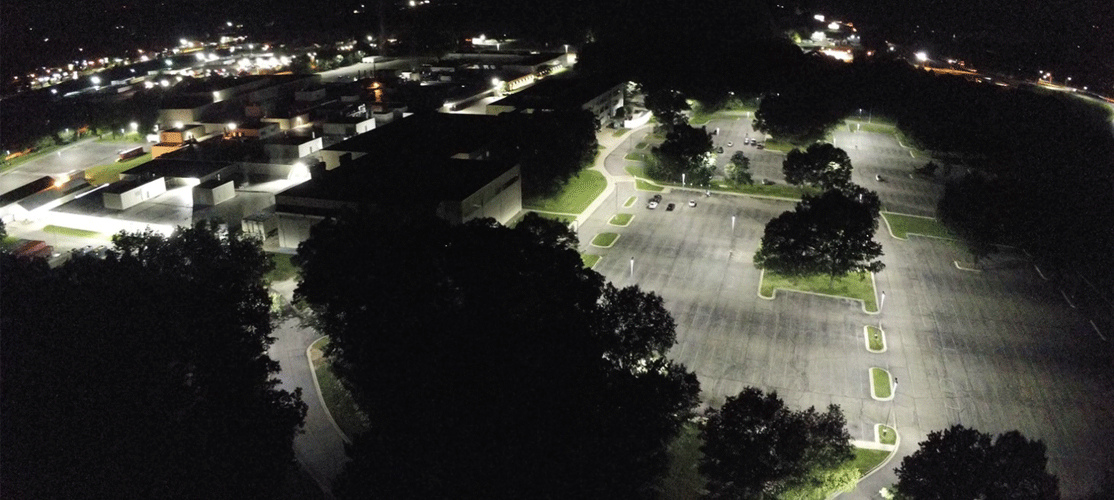
Image above shows the nightscape of Charles River's Mattawan facility after conversion from HPS to LED.
As many countries battle through record breaking heat waves, many companies are looking for ways to cut costs and avoid brownouts. For Charles River’s Mattawan site, this is a crucial issue of concern. After all, vivarium facilities need to be strictly environmentally controlled for the health and safety of the animals, as well as for the viability of the science being conducted within the labs. So how can a facility that needs to maintain a base level of environmental control avoid issues with losing power during heat waves?
Enter Duane Hagen, Mattawan’s Facilities Energy and Systems Optimization Project Manager. Duane recently came on to Charles River full time after working as a contractor for us for years, so he knows this facility like the back of his hand. From new lighting to old trees, there is nothing he won’t try to not only save money, but also improve his facility’s Sustainability.
Eureka: What do you do for Charles River?
Duane Hagen: My focus is at Charles River's Mattawan site in MIchigan, the largest facility in the CRL family at a million plus square feet of contiguous buildings. The Mattawan facility began in the 1960s, so we've got a lot of older infrastructure that needs to be upgraded and we're working toward that. We've got newer buildings since 2007, which were built and designed as efficiently as possible but there have, of course, been tons of optimization changes since then so we're retrofitting and rectifying that as well. My chief function has been to be involved in all the utility functions for the site, look for ways to improve all dimensions of the energy or the utility factors from electricity to natural gas to water and wastewater. I have also been involved with our Team on biowaste management and recycling initiatives.
For example, I’ve been involved in instituting metering projects for our site because if you don't meter you can’t control what you're using. The idea is that we're in very tight control over our electricity costs. From our site standpoint, for every penny of cost increased per kWh, it amounts to about $320,000 dollars of additional cost. As our Team drives down the cost by each penny relative to the monopoly cost, what I'm effectively doing is being able to save over a half a million dollars of cost in just electricity alone. Our site has also been purchasing 100% carbon neutral electricity, since 2019, by taking advantage of Michigan law that allows for Alternative Electric Supplier (AES) vs. Utility only procurement.
We also carefully watch our natural gas usage. We're 115 acres of site, and 40 acres of it has been developed but we've got a lot of green space. I've just kicked off an initiative with Michigan State University to develop a profile of carbon sequestration using the green space. We've got trees, we've got grasses, we've got lagoons, we've got all kinds of stuff that has carbon sequestration potential. The idea here is to offset as much of the natural gas load as possible using natural carbon sequestration.
Eureka: How does load shedding/demand management work?
DH: So, demand management is a program where you calculate your peak demand that your facility runs off of, and if you go over that peak demand, you can incur some hefty costs that drastically affect operational expenses. The AES will send out an alert when the Grid will be at peak load. We then initiate our action plan that drives our demand down during high peak hours. We send out our employee alert that notifies everyone to assist in the implementation of our demand load shedding strategy. Shedding load lowers your demand kW, therefore, keeping you under that peak demand threshold and reduces kWh that also saves energy costs. The result is usage reduction, cost reduction and increased Sustainability.
Vivarium and lab spaces will not be adjusted. We don't mess with anything there. Lighting, HVAC, it's all critical to science so we don't touch that.
But human spaces – areas where you have concentrations of people in office spaces, open spaces, our cafeteria, anything that we can control that is human based – we will reduce lighting and raise temperatures when we get an alert, especially in offices where the first shift leaves around 3pm. Below is a typical response that the team gets on a regular basis on review of our efforts.
.png)
Eureka: How many alerts do you typically get?
DH: That's weather dependent – we usually get 15 per season. What they do is take the highest 5 peak days of those and that is what sets up next year's demand. We could see up to 15, we could see up to 20, or if the weather were to become moderate, we may not see any for some period of time and it can go on through September.
Eureka: How does Sustainability factor into your job?
DH: We have Sustainability Guidelines that the Corporation has set. Everything we design now factors in energy efficiency, heating and cooling recovery, LED lighting, everything that we upgrade or modify. But one of the key things that we've had for some time is an Energy Conservation Committee charter and specific design goals for what we do. We're very specific about it.
You're looking at energy efficiency, Sustainability. OPEX (operating expense) reduction, and operational optimization. All four of those are key. All of them are going to drive down OPEX. They're going to increase sustainable operations. They're going to reduce carbon footprint. All buckets are getting checked.
Eureka: You’ve been in the energy management business since the 80s – what have you seen change in that time?
DH: In my career I’ve been in power management in the paper industry. I’ve audited paper mills, hospitals, universities, manufacturing and government facilities. I am a technical expert in steam and condensate systems and traveled the nation assisting them in maintaining and optimizing their systems, which is sort of a lost art now. There's always been an impressive diligence for corporations to drive down costs, and whether they knew it or not, when they were driving down costs, they were driving down usage. When the focus got into the factors of Sustainability and looking at that standpoint, most of the mechanisms were in place. They just had to be codified.
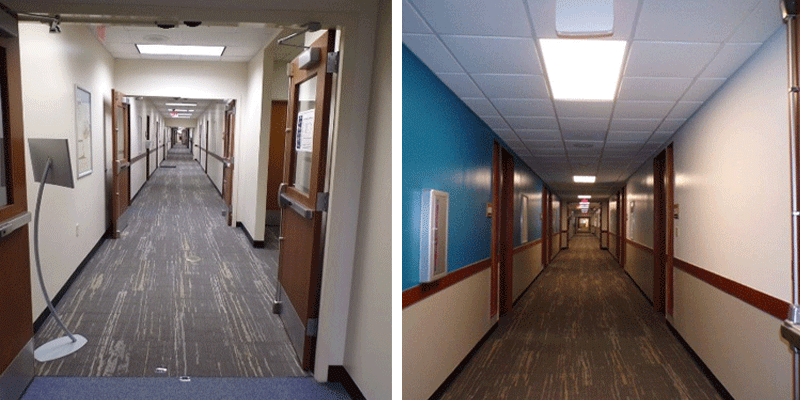
I think the biggest overall change is in relationship to the technologies that finally caught up with some of the dreams, specifically in lighting. LED has a huge impact. As an example, we have this quarter mile hallway at our facility that we brought down from 84 fixtures to 43 (see below).
Eureka: It looks a lot better, too,
DH: Oh, it does. the lighting is balanced and not intensely bright. It highlights the facility. It's a nice showcase when the sponsors walk into it and see a hallway that looks this nice and is sustainable.
(L-R) Before hallway remodeling T8 fixtures and after hallway remodeling LED fixtures
.jpg?crop=false&position=c&q=80&color=ffffffff&u=8anjqk&w=230&h=130)