

Research Models
|
Lindsey Cable
Small Investment, Major Gains
A cage washer static immersion method helps reduce the threat of lime deposits and biofilm and elevates biosecurity standards in research facilities.
Cage washers are an integral part of the production process and are crucial for minimizing potential biosecurity risks. Regular cleaning of floor grids is essential for the biosecurity and operation of sterile production environments. Over time, biofilm ― a colony of microorganisms, such as bacteria, fungi, or yeast, encased by an extracellular polymeric substance ― and lime deposits may begin to form on the surfaces, particularly in areas that are difficult to clean thoroughly using traditional manual methods. This leaves behind inadequately disinfected spots, increasing biosecurity risks, and accelerates equipment deterioration due to residual lime scale deposits. This is a common issue in many production processes, but the recent Charles River Biosecurity SPOT award winner, Hang Xu from the Wuhan, China site, developed an innovative solution.
Chlorine bleach ingredient to the rescue
To address this problem, Hang Xu leveraged the strong oxidizing properties of sodium hypochlorite (also the active ingredient in chlorine bleach) to develop a static immersion method. He then performed an initial test by submerging floor grids in concentrated sodium hypochlorite to assess corrosiveness and the contact time needed for minimal impact and maximal effectiveness. The process is based on the recommended 500 parts per million (ppm) sodium hypochlorite soaking standard (1:200 dilution ratio) for proper disinfection and sanitation. During immersion, the solution fully penetrates irregular surfaces and accesses narrow gaps, where the sustained oxidative action of sodium hypochlorite can effectively remove biofilm while simultaneously removing stubborn lime scale deposits.
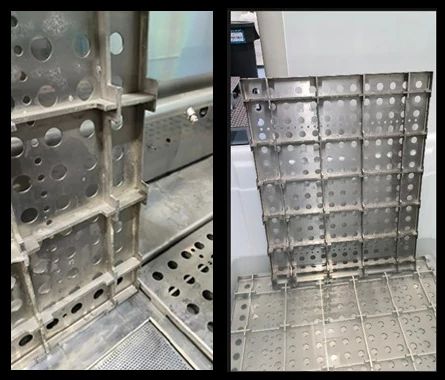
Before and after of the static immersion method.
After implementing this technique, technicians observed significant improvements without needing to alter the original cleaning process or inspection standards. These improvements include:
• Biofilms and lime scale deposits are removed entirely, showing enhanced cleaning and sanitizing effectiveness.
• Biological and mineral deposits became easier to remove manually, resulting in quicker disinfecting than traditional scrubbing methods.
• The material cost for a single use is less than ¥100 ($14), showing the ability to substantially improve cleaning efficacy at minimal expense.
• Greater longevity of equipment due to the absence of lime scale on stainless steel surfaces and the limited opportunities for biofilm to form.
Overall, regular immersion in 500ppm sodium hypochlorite solution provides a practical, economical, and reliable solution to the long-standing challenge of cleaning and maintaining cage washer stainless steel floor grids. Lime scale and biofilm removal enhance cleaning, extend material lifespan, and bolster biosecurity.
This method is simple to implement, low-cost, and highly effective, making it worthy of adoption in cleaning procedures for similar equipment. When potent oxidizing agents are used for immersion and cleaning, attention should be paid to the quality of the material and its chemical resistance to corrosion. It exemplifies how meticulous management can elevate biosecurity standards. For a small investment, the site is already witnessing significant gains.