

Our Heroes
|
Regina Kelder
Stories of Science and Survival in Cancer
Advances in ovarian and breast cancer have saved lives. Meet some of them.
For the past eight years, Eureka’s amazing breast cancer roundtable of women eloquently shared a myriad of stories about living with cancer. This year, they are being featured in several small vignettes that showcase how new classes and generations of drugs are improving the odds of survival even more. The story also features an ovarian cancer survivor’s story.
Overcoming the Steep Odds of Ovarian Cancer
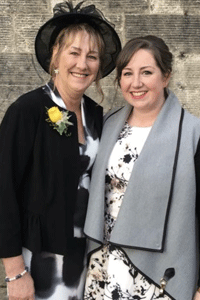
In 2014, the same year Louise Scott’s mum relapsed for the third time, the first in a new class of cancer drugs called PARP inhibitors hit the market. It proved to be the weapon that finally kept Patricia’s aggressive ovarian tumors at bay, and today she is remission. But the road to recovery was not easy.
The inhibitor given to Patricia blocks the action of an enzyme called poly (ADP-ribose) polymerase or PARP, which helps repair DNA. Without the ability to repair their DNA, tumor cells can die or more easily succumb to chemotherapy. Not only did Charles River’s Edinburgh site work on Patricia’s drug, but multiple sites also performed studies on all of the subsequent PARP inhibitors approved by regulators.
Louise, a Team Leader in Reporting at Charles River, first shared the story of her mum in 2018. As Louise explained, what had been a stubborn and growing cyst on her mother’s ovary, turned out to be an ovarian tumor that carried a BRCA1 mutation—one of two BRCA mutations that account for 10% to 12% of ovarian and breast tumors. BRCA1 mutations can be inherited from either parent, so it was not surprising that genetic testing confirmed most of the females in Louise’s family carried them.
Chemotherapy didn’t work, and surgery wasn’t an option, but Patricia’s doctor, Professor Charlie Gourley from the University of Edinburgh, suggested they try a PARP inhibitor. It was so new, they originally faced resistance from the National Health Service (the UK’s publicly funded health care system). “Professor Gourley refused to give up and the drug maker agreed to pay for my Mum to receive the drug on compassionate grounds as she was the perfect candidate,” Louise told Eureka.
Nearly a decade after starting on the PARP inhibitor, Patricia was told by her doctors that she is in remission, and therefore no longer needs to stay on the drug. “It has all been so surreal," said Louise recently. "Because it was part of her life for so long, we all went through so much of the emotional journey with her. During COVID we had to make sure she was OK, because she was immunocompromised due to her cancer. Now I feel I can relax a little bit.”
Pushing Back a Triple Threat
In 2008, Nancy Sullivan, a Senior Executive Assistant at Charles River Laboratories, found a breast tumor about the size of a pencil point during one of her routine breast self-exams. It turned out to be triple-negative breast cancer, a particularly nasty and aggressive form that gets its name because the cancer cells don’t have any of the estrogen or progesterone receptors that most breast cancers latch onto, or make any or enough of a protein called HER2.

Most cases of triple-negative cancer occur in women under 40. Nancy was 38 at the time and the cancer had already spread to her lymph nodes by the time doctors diagnosed it. In a 2019 video interview with Eureka’s breast cancer roundtable series, Nancy, a mother of three and avid kickboxer, recalled the grueling cancer treatments that miraculously set her on the road to recovery and remission 10 months after diagnosis.
“I always had chemo on Thursdays, and Friday was when I would go for my Neulasta shot [a bone marrow stimulant.] The minute I had the shot it was head to toe pain and I was non-functioning for 12 hours. But I remember being in the moment, just lying in my bed, listening to my kids outside playing and hearing their laughter. It was one of those things that you grasp and just hold on to.”
While triple-negative cancer remains one of the most difficult to treat, the therapeutic options are expanding in exciting ways, including a targeted drug that combines a monoclonal antibody with a chemotherapy drug to seek out and kill the cancer in much the way heat-seeking missiles destroy their targets. Immunotherapies that harness a patient’s own immune cells to fight cancer are also now an option for women with triple-negative cancer. Charles River sites have tested many of these options.
Putting a Target on Breast Cancer
It cannot be overstated how the approval of Herceptin in 1998 transformed breast cancer treatment. Not only was it the first monoclonal antibody (mAb) approved for the treatment of breast cancer, but it was also only the second mAb ever to reach the market. It opened the door to a new era of drugs that took precise aim at proteins lurking on the surface of tumors.

One of those women who benefited from Herceptin is Jilliane Molloy, Supervisor of Operations at Charles River’s Shrewsbury, MA site. In 2016, when she was just 24, an age when breast diagnoses are quite rare, Jilliane found a lump in her breast that turned out to be cancerous. Though it wasn’t the first cancer drug she was given, it was Herceptin that saved her.
“The first month or two after I learned I had breast cancer, I kept thinking ‘Why me, why is this happening to me. I’m so young. That’s not really an age that anyone expects it’ ” reflected Jilliane during Eureka 2021 breast cancer roundtable. Indeed, only 5% of breast cancer cases occur in women in their 20s and 30s. However, according to Cancer Network, part of the journal Oncology, among females ages 15-29 diagnosed with breast cancer, close to 30% had HER2-positive breast cancer; in those aged 30 to 39 years, the rate was 25.5%, while it was 18.6% in those aged 40 to 49 years.
“Bad things happen,” said Jilliane. “You just have to find the good.”
When she joined Charles River Laboratories, Jilliane was surprised to learn that Charles River had worked on some of the early studies leading to approval of Herceptin. Since then, three other monoclonal antibodies for breast cancer have been approved, as well as more complex drugs called antibody drug conjugates that combine the action of an antibody with the power of a chemotherapy drug. A new class of drugs have also been added to the stockpile that block a protein HER2 tumors rely on to grow.
“Every cancer is different, and what might work for some people might not work for others,” says Jilliane. “It’s important to have the best possible drugs in the market so everyone has a fighting chance.”
An Evolution in Hormonal Therapies for Breast Cancer
For many women diagnosed with breast cancer over the past 30 years, anti-estrogen therapy is an essential part of the treatment plan, with tamoxifen the more commonly prescribed drug. That certainly was the case for Charles River employees Susan Desmond, a Director of Event Management, and Rachel Kiserow, an HR Business Partner. Both are also members of the Eureka Breast Cancer Roundtable.
 Susan Desmond, diagnosed in 2014, and Rachel Kiserow, diagnosed in 2012, both took oral tamoxifen to suppress the effects of estrogen on tumor growth; Susan is now taking one of the newer aromatase inhibitors and Rachel, 10-years cancer-free, is no longer on any treatment.
Hormonal therapies like tamoxifen have been a lifesaver, but women can develop resistance to them. In the last few years, the emergence of new generations and new classes of drugs—some of which are already on the market—provide a potential workaround to the inherent problem of resistance to estrogen therapy.
There are new generations of selective estrogen receptor modulators other than tamoxifen, and a different class of drugs called estrogen receptor down regulators or ERDs, that fill estrogen receptors and downregulates, which allows for control/reduction of tumor growth and proliferation. There are currently two different ERDs on the market, an injectable drug and most recently an oral form.
There are also other novel anti-estrogen drug classes in development, including proteolysis-targeting chimerics (PROTACs), complete estrogen receptor antagonists (CERANs), and selective estrogen receptor covalent antagonists (SERCAs) that target estrogen receptors.
"I remember vividly the conversations I had with my oncologist about potential treatments for my cancer and how we continued to have these conversations throughout the 10 years I was on treatment, because he was always looking for a way to give me the best chance of surviving,” said Rachel. “He relied on the latest research and treatments, like the ones noted here, to determine the best care for his patients and without that, people like me may not be here today. I am forever grateful for my doctor’s diligence and for the continued advancements in cancer treatments.”
Susan concurred. “I’m so appreciative of the advances and development of new treatments,” says Susan. “I am grateful for each year that gains a new treatment because it correlates to each year, I am NED (no evidence of disease), which allows another year of potential new treatments. If I should become resistant to my current treatment, there may be a new option for me. We need to continue supporting oncology research till the day we don’t need a new treatment.”