
Microbial Solutions
|
Ryan Cox, BS
Three New Microbial Entries From Around the World

Accurate microbial identification depends entirely on whether the reference libraries behind an ID system reflect current, valid, and traceable taxonomy. Accugenix® puts massive emphasis on this alignment for several reasons that directly impact QC labs, contamination investigations, EM trending, and regulatory compliance. In the ever-living world of microbiology, the Accugenix® Sequence Database recently added these microorganisms to join a library of over 14,000 species – all with their own unique story.
Aestuariimicrobium ganziense
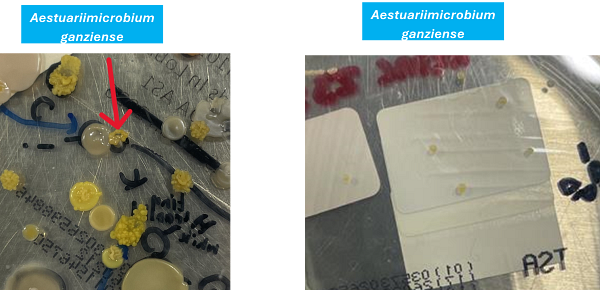
Figure 1: Aestuariimicrobium ganziense identified and photographed by Accugenix® Dublin lab
Isolated from soil in the Ganzi Tibetan autonomous prefecture, China, at elevations exceeding 4600 meters, in an environment marked by cold temperatures, high UV exposure, and limited nutrients, Aestuariimicrobium ganziense is one of the 3 only species belonging to the Aestuariimicrobium genus.1 The genus Aestuariimicrobium is named after tidal flats (aestuarium = tidal flat) + microbium (microbe), referring to microbes from tidal‑flat environments – so what gives? A microorganism found thousands of meters above sea level belonging to a Genus referencing sea-level microbes. The first species belonging to this Genus, Aestuariimicrobium kwangyangense, was isolated from tidal flat sediment in Kwangyang Bay, South Korea. The bacterium was specifically obtained from an enrichment culture involving diesel-contaminated coastal sediment.2 Despite their very different environments of isolation, these organisms converge across polyphasic characterization (16S rRNA gene sequencing, DNA-DNA hybridization, molecular marker analysis, and morphological/biochemical tests) to the point of seeming like they are twins separated at birth.
Hannaella theobromatis
See header image: Hannaella theobromatis identified and photographed by Accugenix® Écully lab
The genus Hannaella is named in honor of W.F. Hanna for his pioneering study on ballistoconidium-forming yeasts (ballistoconidium is a type of fungal spore that is actively and forcibly shot into the air by a droplet mechanism).3 Meanwhile, theobromatis refers to its epiphytic ecology on its host Theobroma cacao.4 Do not fret about this yeast appearing on a cacao leaf - the species was isolated during a survey of native fine‑aroma cacao in Peru without any mention of pathogenicity. This suggests its role is commensal or beneficial, not harmful to the plant. Fascinatingly, the original publication describing this species states “The fact that H. theobromatis was previously found in hummingbird saliva and on the phylloplane of flowers suggests that its ecology may be much more dynamic than a strictly epiphytic ecological role on cacao fruits and leaves, and may also be a flower-nectar associated yeast.”4 From cacao leaves to hummingbird saliva, Hannaella theobromatis certainly has a taste for the sweet things in life.
Sagenomella oligospora

Figure 2: Sagenomella oligospora identified and photographed by Accugenix® Delaware lab
The name Sagenomella is derived from Sagen- (likely from the Greek sagenē), meaning a seine or fishing net, and -ella (Latin), a diminutive suffix meaning "small." The species name oligospora is derived from Greek roots: Oligo- (from oligos), meaning few, small, or scant. and spora, referring to spores. Sagenomella oligospora was first reported in 1978 as a strain isolated from agricultural soil in the Netherlands, while more recently being discovered living inside potato leaf tissues in Korea without causing symptoms, demonstrating a symbiotic or neutral endophytic lifestyle.5, 6 This microorganism is part of the Trichocomaceae family along with other important Genus of molds such as Penicillium. While this particular species once was overshadowed in headlines from the darker notoriety of Sagenomella chlamydospore (now currently Aspergillus chlamydosporus) association in causing mycoses (fungal infections) in canines, there is a quiet sense of relief and satisfaction getting to see these small, fuzzy, spores in person.
- Geng, Y., Zhao, JY., Yuan, HR. et al. Aestuariimicrobium ganziense sp. nov., a new Gram-positive bacterium isolated from soil in the Ganzi Tibetan autonomous prefecture, China. Arch Microbiol 203, 2653–2658 (2021). https://doi.org/10.1007/s00203-021-02261-2
- Jung SY, Kim HS, Song JJ, Lee SG, Oh TK, Yoon JH. Aestuariimicrobium kwangyangense gen. nov., sp. nov., an LL-diaminopimelic acid-containing bacterium isolated from tidal flat sediment. Int J Syst Evol Microbiol. 2007 Sep;57(Pt 9):2114-2118. doi: 10.1099/ijs.0.64917-0. PMID: 17766882.
- Qi-Ming Wang, Feng-Yan Bai, Molecular phylogeny of basidiomycetous yeasts in the Cryptococcus luteolus lineage (Tremellales) based on nuclear rRNA and mitochondrial cytochrome b gene sequence analyses: proposal of Derxomyces gen. nov. and Hannaella gen. nov., and description of eight novel Derxomyces species, FEMS Yeast Research, Volume 8, Issue 5, August 2008, Pages 799–814, https://doi.org/10.1111/j.1567-1364.2008.00403.x
- Llanos-Gómez, K.J., Aime, M.C. & Díaz-Valderrama, J.R. The surface of leaves and fruits of Peruvian cacao is home for several Hannaella yeast species, including the new species Hannaella theobromatis sp. nov.. Antonie van Leeuwenhoek 117, 43 (2024). https://doi.org/10.1007/s10482-024-01936-2
- Yokota, Akira. “Phylogenetic Analysis of Sagenomella and Relatives Based on Nuclear 18S Ribosomal RNA Gene Sequences with the Determination of Ubiquinone System.” N.T. Thanh, M. Endo, A. Yokota, W. Gams, and J. Sugiyama: Ann. Rep. ICBiotech., 21: 307-318, 1998.
- Moon, Jeong-Su, et al. “Unreported Endophytic Fungi Isolated from Potato (Solanum Tuberosum L.) Leaves in Korea: Didymella Sinensis and Sagenomella Oligospora.” Korean Journal of Mycology, Korean Society of Mycology, 30 Mar. 2024, doi.org/10.4489/kjm.520404.