

Laboratory Sciences
|
Bartek Ciszewski
Trifluoroacetic Acid (TFA): A Small Molecule with Big Analytical Challenges
The smallest member of the PFAS family, TFA is drawing increasing environmental attention while testing the limits of analytical laboratories
Concerns around environmental contamination with per- and poly-fluoroalkyl substances (PFAS) have been a major focus for regulatory bodies for a decade now. These, however, have usually focused on longer chain molecules such as perfluorooctanoic acid (PFOA). The smallest member of this family, trifluoroacetic acid (TFA; CF3OH), has largely escaped the same level of scrutiny. Whilst the exact extent of its impact on the environment and human health is not yet fully understood, its frequent detection in drinking water sources and its association with the PFAS family have sparked growing interest from the scientific community and the public. The exact sources of high TFA levels in the environment are not known, as it is a ubiquitous and likely terminal metabolite/transformation product for any compound containing a -CF3 group. This includes many of the pharmaceuticals and agrochemicals that are critical to our health and food industries.
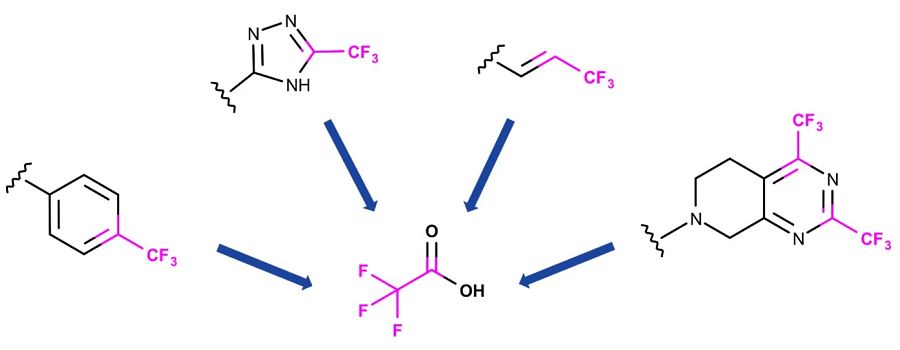
All compounds containing CCF3 groups, classed as PFAS, are considered as potential sources of TFA contamination
In 2025, Denmark became the first EU member state to impose a blanket ban on agrochemicals that use one of six active ingredients that contain -CF3 groups, as they were believed to be potential sources of TFA contamination. Growing political pressure to ban further PFAS-linked pesticides across many of the member states has resulted in significant pressure on registrants to demonstrate whether their products could be contributors to the increasing TFA concentrations in the environment.
Why is TFA so challenging for analytical chemists?
Traditional metabolism and environmental fate studies utilise strategically localised radioactive nuclei (e.g. 14C and 3H) in the structure of test substances. This allows for the total radioactivity to be traced throughout various transformative processes, ensuring that the most abundant degradants are identified. The limitation of this approach is that the labelled atom from the test compound must be incorporated into the newly transformed product for it to be observed. In the case of possible TFA formation, for the TFA metabolite to be detected, the labelling site would have to be very specific and include one of the two carbon atoms that make up the CCF3 moiety. Historically, this was often not performed as the specific label site may not be the best suited for accounting for other relevant metabolites, creating a data gap that has only recently become of significant interest. Additionally, for many compounds, the formation of TFA as a terminal metabolite is likely to be an extremely slow process, only becoming significant far beyond the timeframes of traditional studies.
There is, however, hope that this data gap may be bridged by leveraging the advances in analytical chemistry. Modern mass spectrometers (MS) are often capable of targeted detection of compounds in complex matrices at parts per trillion concentrations. TFA, a strong organic acid, is easily ionised, making it an ideal target for MS analysis. In theory, it should be possible to simply analyse extracts of samples to determine even minimal formation of TFA; in reality, however, this is far from the case.
The most significant challenge when analysing TFA is the extent of its background contamination, not just in the ecosystem, but in the laboratory environment. Fluoropolymers, which can leach TFA at levels detectable by MS, are widely used. From pipette tips, through the lining of solvent bottle caps, to PTFE tape used to seal joints in pipes supplying gas to the instruments, TFA sources are abundant. Ensuring minimal introduction of exogenous TFA into analytical systems is the first priority of the analytical chemist targeting this molecule. Precautions include use of designated clean laboratory spaces, hardware modifications to minimise the use of fluoropolymers, use of PFAS-free certified materials and reagents. Even when the analytical approaches ensure TFA contamination is minimised, test systems consisting of soils, groundwaters, and foodstuffs are unlikely to be TFA-free, complicating the analysis further.
Bridging data gaps with analytical capabilities
Taken together, the growing concerns around frequent detection of TFA in the environment, and the analytical challenges surrounding the determination of its sources, there is significant pressure on the industry to demonstrate the environmental safety of PFAS-linked compounds. Over the coming years, laboratories will need to adapt to perform targeted experiments to determine the possibility of TFA formation, filling data gaps in legacy studies. To achieve this, Charles River is developing robust, contamination-controlled analytical methods, not only to quantify TFA but also to categorically exclude its formation. Novel approaches to quantifying TFA formation using isotopically labelled analogues are also being explored. Ultimately, the ability to measure TFA reliably in complex systems will shape future conversations about the continued use of PFAS-linked compounds.
Bartek Ciszewski is a Principal Research Scientist in Chemistry at Charles River Laboratories. With more than 10 years of experience in analytical method development, his current work focuses on the development of innovative strategies for establishing the fate of environmental pollutants.
Laboratory Sciences
Quality, scientific integrity, cost-effectiveness and regulatory compliance are essential considerations when selecting an outsourcing partner. Charles River is adept at balancing these key values within the most stringent of time frames to deliver comprehensive laboratory services from early screening through preclinical and clinical support.