

Biologics
|
Dr. Anja Tessarz, PhD and Sandra Zucchet, M.Sc
Viral Clearance Studies: A Multi-Spike Approach
This cutting-edge process can dramatically reduce needed test material, time and cost for viral clearance studies by spiking two viruses in a single run
Viral clearance (VC) studies are mandatory for biologics, which are pharmaceutical drugs derived from human and/or animal sources such as cell line-derived recombinant proteins, adeno-associated virus vectors, blood products, vaccines, or critical medical devices. The purpose of VC studies is to address the potential of adventitious and endogenous virus removal and/or inactivation of specific steps of the manufacturing purification process. These studies are part of the package required for a biologic to enter clinical phase I and later in its lifecycle for market authorization. Are there ways to accelerate these studies to make them more cost-effective? Read on!
What is being tested in a viral clearance study?
First of all, a virus panel is chosen that will be tested based on the risk assessment of the human/ animal material being used in the manufacturing process and of course taking into account current guidelines and recommendations.
EXAMPLE 1: CHO-cell line derived products
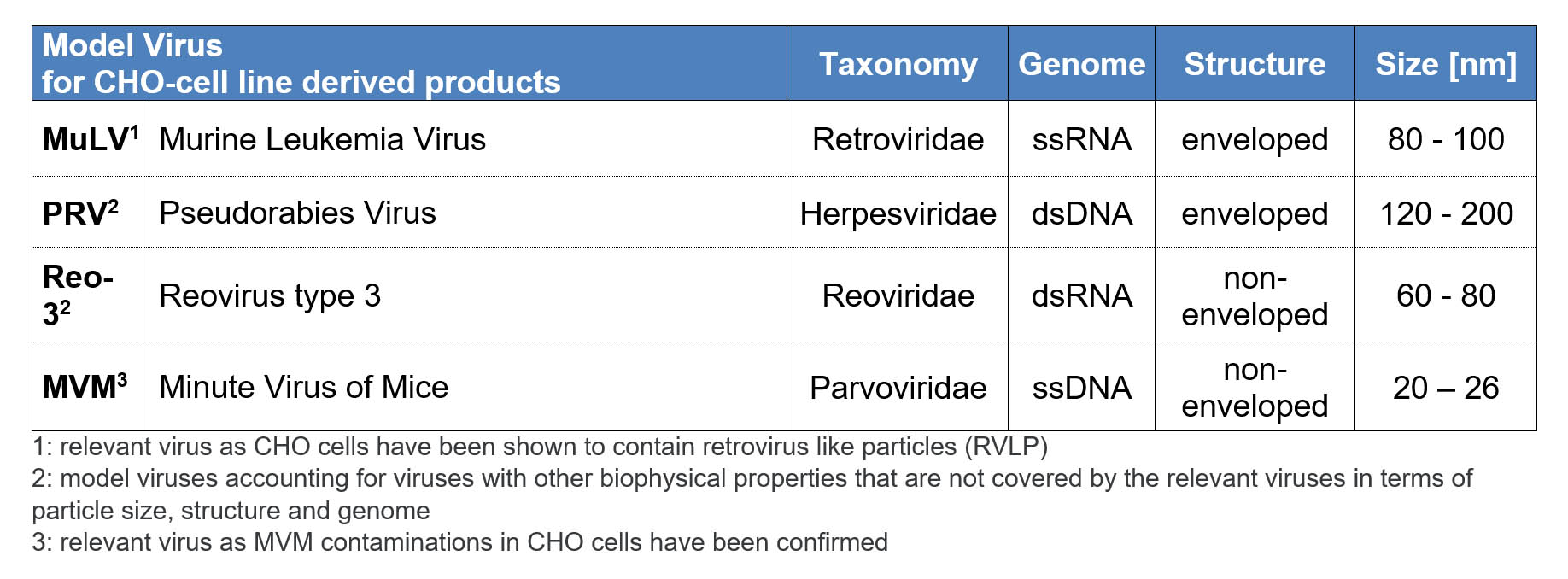
For CHO-cell line derived products for Market Authorization Application (MAA) / Biologics License Application (BLA) one commonly tests the following virus panel:
EXAMPLE 2: Advanced therapy medicinal products (ATMPs) produced using baculovirus-insect cell systems
Gene therapy products likewise carry the risk of endogenous and adventitious virus contamination and, besides strengthening the pillars of prevention and detection, manufacturers must implement and test for viral clearance, if feasible and as outlined in ICH Q5A (R2).
Addressing cell- and production virus related risks:
Baculovirus-driven protein expression in insect cells has become a popular choice for biomanufacturing, and baculovirus can be used as a helper virus for production of gene therapy AAV vectors. In each case, clearance of the production virus should be demonstrated by viral clearance evaluation
And what about the production cell line? Unlike mammalian cells, insect cells do not replicate human viruses and can be cultivated serum-free, but some insect cells such as those from Spodopera frugiperda (Sf9) have been shown to harbor endogenous Sf-rhabdoviruses. To show that the manufacturing process can eliminate substantially more Sf-rhabdovirus than is estimated to be present in a single-dose-equivalent of unprocessed bulk material, a specific Sf-rhabdovirus model should be addressed in the viral clearance study, e.g. Vesicular Stomatitis Virus (VSV).
Model Virus for Baculovirus/Sf9 derived products | Taxonomy | Genome | Structure | Size [nm] | |
VSV1 | Vesicular Stomatitis Virus | Rhabdoviridae | ssRNA | enveloped | 45-100 x 100-430 |
AcNPV2 | Autographa californica multiple nucleopolyhedrovirus | Baculoviridae | dsDNA | enveloped | 21 x 260 |
PPV3 | Porcine Parvovirus | Parvoviridae | ssDNA | non-enveloped | 20 - 26 |
1: specific model virus as Sf9 cells have been shown to contain endogenous rhabdoviruses
2: relevant virus accounting for the production virus
3: model virus accounting for viruses with other biophysical properties that are not covered by the relevant or specific model viruses in terms of particle size, structure, and genome
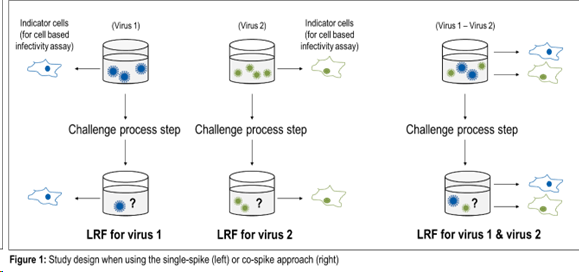
Not every step of a manufacturing process is being challenged with virus. Regulators like to see two orthogonal steps, meaning of different mechanism, for each virus being tested. Once the process steps with potential to remove or inactive a virus have been identified, a laboratory-scale (downscale) version is developed for each of them. Every downscale process is then challenged with a single spike virus performed in a duplicate run.
How are viral clearance studies usually performed?
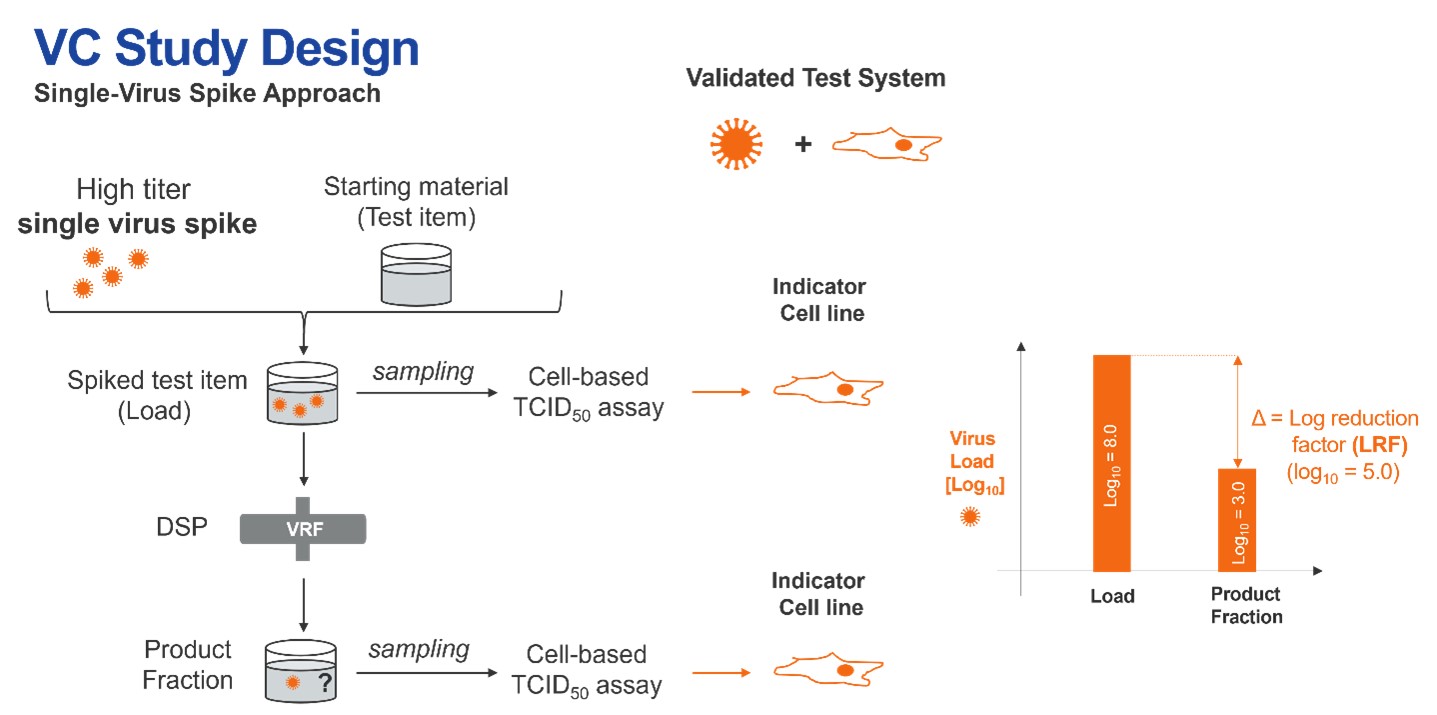
Generally, once pre-test have identified a non-toxic and non-interfering dilution of any process fraction that will be tested in a cell-based end point titration assay (TCID50) or a non-interfering dilution when analysis will take place by quantitative polymerase chain reaction (qPCR), virus-spiked process runs can be performed. In some cases, especially if the process contains virus inactivating ingredients, or the material to be tested is a solid, further pre-tests are required.
From a virus-spiked process run the viral concentrations are quantified by TCID50 (by which infectious particles are being detected) or qPCR (which detects viral nucleic acid) for at least two process fractions: 1. the load material and 2. the relevant product fraction. The ratio of both samples (referred to as log reduction value, LRV or log reduction factor, LRF) defines the reduction in virus and thus is an indicator of this process step to remove or inactivate the type of virus tested. For an illustration see figure below. Note, for product fractions that are being analyzed by TCID50, usually in addition a more sensitive cell-based assay is being employed, called large volume plating.
What is the scope of a VC study?
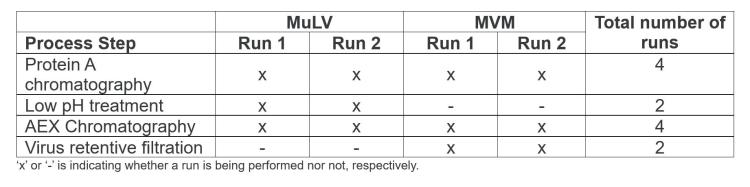
The overall scope on how many processes and process runs are being challenged by virus varies and mainly depends on what the data is needed for. For instance, for a CHO-cell line derived protein in an early phase, meaning the data is required for Clinical Trial Authorisation (CTA)/ Investigational New Drug (IND) filing, testing two viruses MuLV and MVM is sufficient. A frequently performed scope of a VC study is indicated below.
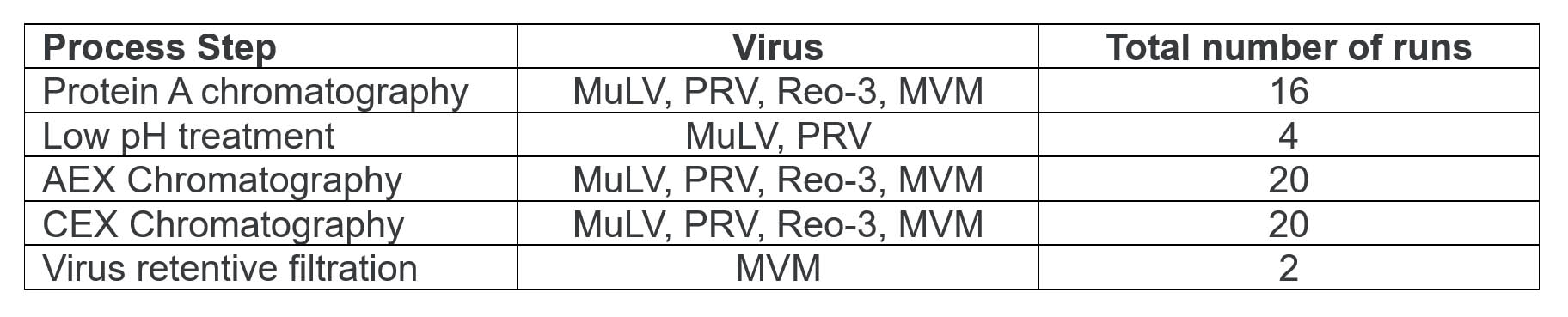
For the same product later in its lifecycle for MAA/ BLA, the VC study scope to be tested is enhanced. The testing laboratory will evaluate more viruses to cover additional biophysical virus properties, perform used (end of lifetime) chromatograph resin runs and also so-called carry-over runs which address whether the cleaning procedure in between two runs is efficient enough to inactivate virus. Therefore, a usual VC study scope would look like this:
How can viral clearance studies be accelerated and made more cost effective?
Viral spiking is at the heart of viral clearance studies. While necessary, the time and resources required for it can often stress deadlines and budgets. An CTA/IND VC study as indicated above might only take 4 days which is little time when compared to a MAA/BLA VC study which easily can take 3 weeks and more depending on the durations of the process steps and how many chromatography runs can be performed in parallel.
For a viral clearance study a lot of process runs need to be performed as indicated in the table above. And even though they are performed in a downscaled version, precious starting material needs to be made available. This is especially a challenge for newly emerging biologics used in gene therapy, because the production batches are rather small and cost intensive as of low product recovery, and often one entire batch would be needed to cater for a VC study alone.
And of course, besides buffers and pre-filter, other more costly consumables are required for a VC study, like chromatography columns for the MAA/BLA VC or used resin and virus retentive filter.
We have accepted the challenge to accelerate and to make VC studies more cost effective while providing large LRF by cell-based assays and came up with a new cutting-edge co-spike approach. In the co-spike approach despite performing single spike runs we can now spike with two viruses in a single run, therefore combining the testing for both viruses. Available co-spikes at CRL are:
• MuLV and MVM (for CHO-cell derived products)
• VSV and AcNPV (Baculo) (for Baculovirus/Sf9 produced products).
This allows us to shorten the hands-on time in the laboratory to up to 30 or even 50% in a MAA/BLA or CTA/IND study, respectively. This is than reflected in lowered study cost as well. Other cost as for starting materials, chromatography columns and resins as well as the virus retentive filter can be saved up to 50%. And of course, the required volumes of precious starting materials drop by about 50%.
We are very excited to our contribution to deliver required data faster and cheaper in order that patients receive more affordable treatments faster.
Anja Tessarz, PhD, is a Study Director and Study Director Supervisor obtaining profound knowledge of setting-up, planning, and performing viral clearance studies. Sandra Zucchet, M.Sc, is a scientist in our viral clearance R&D team which is focusing on viral clearance study design improvement and automation.
Viral Clearance Validation Services
Cell line-derived biopharmaceuticals come with an inherent risk of viral contamination. So, it is critically important and mandatory that viral clearance studies are undertaken to ensure patient safety. Our labs in Europe and the US can help you design and perform custom studies. Learn more here.