

Microbial Solutions
|
Jon Kallay
When Advanced Therapies Meet Innovative Test Methods
New therapies are pushing the boundaries on what is possible with medicine. Shouldn’t Quality Control test methods keep up with them?
Medicines are getting increasingly complex as health science improves. Hats off to the biomedical engineers working on Advanced Drug Delivery Systems (ADDS), cell and gene therapies, sustained released products, and so many more. Since I work in Microbiology Quality Control labs, I’m curious how standard micro-QC testing keeps up. The compendial microbiology test methods are decades old, but we still need to know these innovative products are safe!
Let’s look at the compendial sterility method found in chapter USP <71>. We will see what challenges laboratories face when using it with these new products. Then, we will see how some of those problems are immediately solved when switching to a newer, alternative test method.
Establishing the Baseline Method
The diagram below highlights the basic steps needed for sterility testing. The steps take place over 2-3 weeks, starting with the product inside of your sterility testing area. This is most likely an isolator in a controlled microbiology laboratory. It could also be inside of a biological safety cabinet or laminar flow hood in a cleanroom.
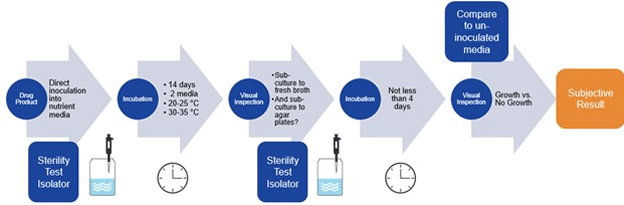
Compendial chapters recommend the use of a membrane filtration method for sterility testing. That method removes product residue that could inhibit or hide growth. It also allows for a greater test volume to be used per incubated media. However, many of the complex products are too large to filter through the standard 0.2 Micron membranes. It is worth noting that many complex formulations, like cell therapies, require a direct inoculation method because they are unfilterable.
At the end of the initial test process, the resulting filters (or the directly inoculated product) are in containers with microbial growth media. That media is transferred to an incubator, where the standard incubation time is 14 days. Intermediate reads are recommended (in some cases mandatory) to prompt an early response to contamination events.
Not-So-Clear Results
Intermediate and Final reads are performed visually. Technicians manually inspect media for turbidity and other microbial growth patterns. Microbes can clump together and settle on the bottom of the container, like pellicle formation or flocculent growth. These patterns allow the media to appear clear at first glance. When I performed these reads, it was tense making the decision between air bubbles and that type of growth. This mentality was universally shared amongst even my most senior colleagues.
In the event of those presumptive positives, a subculture is needed to confirm growth. The subculture requires its own growth period of 4-7 days, then another visual check is required.
I have struggled with products that always appeared positive in the past. With one anti-arrhythmic drug, the product would cling to the membrane filters despite the maximum rinse fluid use. During incubation, the product would be released into the media. The media, which was clear at the time of test, would turn turbid.
I also worked with an injectable anesthetic emulsion. This product experienced the opposite problem. It was particularly prone to contamination due to the natural source of the ingredients and their sensitivity to full heat and radiation sterilization cycles. Regardless of lot quality, the product always appeared turbid in broth. Many advanced, complex formulations appear this way during incubation.
Every time we tested these products, we had to alert manufacturing and open an investigation into the contamination. We’d do the subculture and be stuck waiting for an answer. Overall, the nature of the traditional sterility test made this a very cumbersome process.
A New Way
The most common questions I get about alternative test methods come from QC labs working with those most complex products. There is a sense that the products are so unique that an established alternative method may not be compatible with them.
The entire purpose of this article is to point out the opposite. What makes these products complex poses more problems with the traditional sterility methods.
You can instantly observe how the method is simplified with a rapid, alternative sterility method like Celsis®:
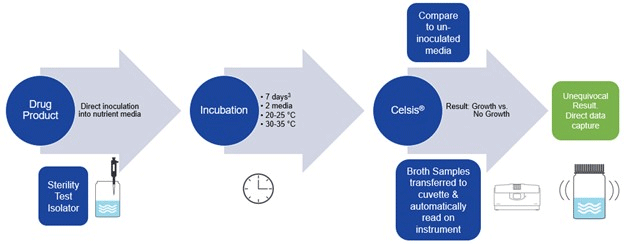
An objective result is generated with instrument technology, removing subjective visual assessments and the need for an extended subculture period.
The final result is established faster, helping you to:
- Release product to patients.
- Maximize available shelf-life.
- Minimize time doing intermediate reads.
In this Charles River Webinar, Miriam Guest outlines her experience using Celsis® technology to replace the compendial test method for complex products. You can immediately see the benefits she experienced by making this switch. Since the technology is based on light generated from ATP (which all viable microbes have), product turbidity does not impact the test.
With the advanced products available today, it makes sense to test to test with corresponding technologies. This will help to expedite delivery while ensuring quality.