
Featured News
De-risking Antivirals Using 3D Human Intestinal Organoids
New research demonstrates the value of human intestinal organoids in antiviral toxicity testing
Ground-breaking research conducted by the OrganoVir Consortium, spearheaded by Charles River Discovery Scientist Fatma Masmoudi, has uncovered a new method for testing and de-risking antiviral agents using 3D human intestinal organoids, prior to in vivo testing.
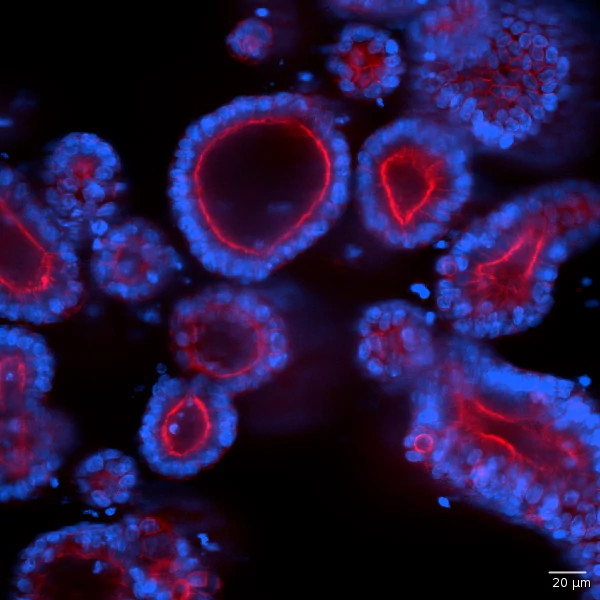
with polarized epithelial cells. Staining for
nuclei (blue) and F-actin (red), with
cortical actin surrounding the lumen.
A leading cause of upper respiratory tract, gastrointestinal, and neurological infections, enterovirus-related diseases have historically lacked specific antiviral treatments; human intestinal organoids present new opportunities to test and advance antiviral agents. Masmoudi’s research focuses on creating a physiologically relevant system in which to test treatments for Enterovirus-related diseases. A recently published paper by Cells (MDPI) details the study methodology and findings.
“Organoids are a new tool for drug discovery programs, that will help to better predict compound behavior and eventually optimize and reduce the in vivo testing,” Masmoudi comments.
Conducted in-house at Charles River in collaboration with KU Leuven (Be) and AMC in Amsterdam (NL), the study included the generation of iPSC-derived human intestinal organoids (HIOs) as a novel model to test antiviral agents against the infection with Enterovirus A71 (EV-A71). The efficacy and compound toxicity of three reference antivirals, of which in vivo and preclinical data were already known, was tested against the organoid model, comparing compound performances between HIOs and a commonly used cell line (RD cells). The study showed that HIOs are more sensitive to the infection with EV-A71 and to the drug treatment, with a strong correlation to the in vivo data.
Masmoudi continues: “With this project, we not only show that we can use organoids for virus and antiviral studies, but we are also showing that we can get much closer, using organoids as a model, to the results we usually expect in vivo and preclinical studies.”
The research, which simulated a pre-in vivo physiologically relevant testing environment, demonstrated that two out of the three test articles were non-viable, where originally advancement to in vivo testing had been required to establish non-viability.
Paper: Evaluation of 3D Human Intestinal Organoids as a Platform for EV-A71 Antiviral Drug Discovery
Learn about the use of human small intestinal organoids (HIOs) as a model to study antiviral treatment against human enterovirus 71 (EV-A71).
Access the paper
To learn more about human intestinal organoids and how organoid testing might be applied to accelerate your research goals, please click below.
OrganoVir is a consortium focused on advancing research around the field of organoids for virology. The consortium aims, through networking and training program, to empower early-stage researchers to lead innovation and pioneer scientific advancement. OrganoVir is a European project funded by the European Union’s Horizon 2023 Research and Innovation Programme under the Marie Sklodowska-Curie Grant Agreement. Charles River joined OrganoVir at the beginning of the program in 2019. Learn more.