
Featured News
Improving the Clinical Relevance of Transporter Studies
The Impact of Time Dependent Inhibition on Accurate DDI Risk Prediction
Accurate assessment of a drug candidate’s in vitro inhibition potential towards clinically relevant transporters is important to ensure safety while avoiding unnecessary follow-up testing. Similar to previous FDA guidelines (20171, 20202), the ICH M12 document3 highlights the importance of pre-incubation for some uptake transporters (e.g., OATP1B1 and OATP1B3) for accurate IC50 and Ki determination.
These guidelines, however, do not offer any details on pre-incubation procedures. They only encourage sponsors to follow current literature for information on transporters of interest and relevant experimental protocols.
Background
Back in 2017, data available on potentiation of transporter inhibition by preincubation (PTIP), often called time-dependent inhibition, for clinically relevant solute carrier (SLC) transporters was very limited, and regulatory agencies recommended a 30-minute preincubation only when investigating the inhibitory potential of a test article against OATP1B1 and OATP1B3 (FDA, 20171).
The ICH M12 Guideline from 20243, the current industry guidance in force, provides even less detail but encourages sponsors to “follow current literature for information on transporters of interest and relevant experimental protocols”, see paragraph 7.4.3.
Time-dependent inhibition (TDI), characterized by a shift in inhibitory potency (IC50) with increasing incubation time, is a well-established phenomenon in CYP inhibition studies. However, little was known about whether, and how commonly, a similar effect can occur in transporter inhibition studies. We hypothesized that large interlaboratory variation in vitro determined transporter IC50 values could be partially explained by differences in incubation times, which prompted us to investigate this effect further.
Results
A peer-reviewed article addressing this phenomenon, born out of a collaboration between Solvo Biotechnology (now part of Charles River as Charles River Laboratories Hungary) and Novartis4, is now also referenced in the ICH M12 guidance3 (reference no. 30). This work provided the first systematic in vitro investigation of the inhibitor pre-incubation effect, also known as potentiation of transporter inhibition by preincubation (PTIP), on multiple classes of clinically relevant transporters. In a follow-up paper published in 20235, we extended the range of transporters examined to include non-clinical SLC transporters and clarified questions around the mechanism and in vivo relevance of PTIP.
The aim of experiments at the time was to understand:
- Is PTIP restricted to OATP1Bs or common to all SLC transporters?
- Could PTIP affect DDI predictions?
- How common is PTIP across the chemical space?
- Could PTIP be an in vitro artefact linked to the lack of extracellular protein?
To address the prevalence and extent of the pre-incubation effect on transporter inhibition, IC50 values were determined using various transporter-overexpressing cell lines, both with and without pre-incubation, with a large set of chemically diverse inhibitors. Compounds with a PTIP greater than 2.5-fold were further characterized by examining the time-dependent changes of transport inhibition potency and cellular concentration. Based on this dataset, potential correlations between the highest observed PTIP for each inhibitor and its physicochemical properties were addressed.
After testing phylogenetically distant SLC transporters and inhibitors with broadly diverse molecular structures, we established that PTIP was common both across the SLC superfamily and the chemical space. Out of 23 compounds tested, 15 compounds exhibited an IC50 shift greater than twofold, and eight compounds exhibited an IC50 shift greater than fourfold upon only 30 minutes of pre-incubation.
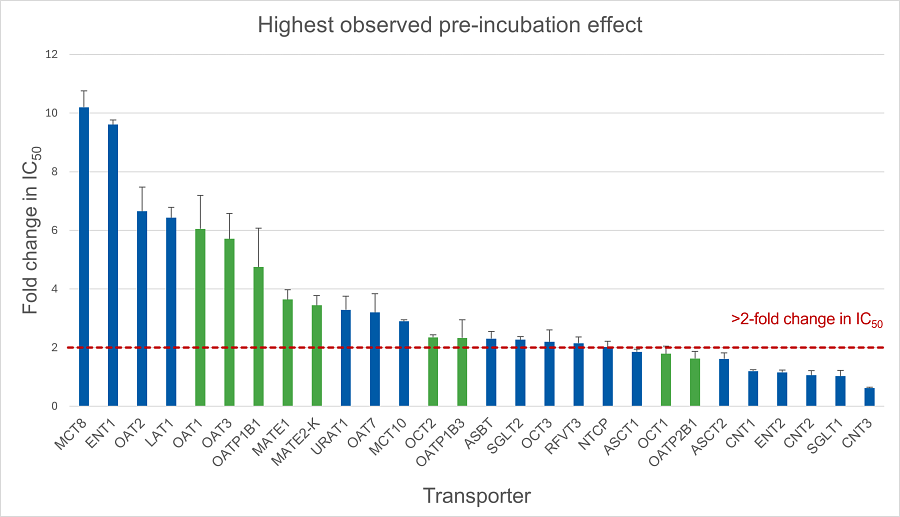
Figure 1. Transporters assessed in the series of experiments to test transporter inhibition potentiation by preincubation (PTIP) [4-5]; rank-ordered from the highest fold-shift in inhibition IC50; values to the lowest (left to right). Where PTIP was tested using multiple inhibitors of the same transporters, only the highest IC50-shift was included in the dataset. The horizontal dashed red line indicates a cut-off of >2-fold change in IC50; values upon preincubation. Drug transporters marked with green columns are included in the ICH M12 guidelines [3]; for inhibition assessment or consideration for DDI assessment.
The scale of the pre-incubation effect appeared to correlate with inhibitor properties, including plasma protein binding, aqueous solubility, and MW-normalized polar surface area. Our data showed that PTIP was more common among hydrophobic, highly protein-bound drugs.
The effect of adding extracellular protein in SLC assays was also investigated. We found that PTIP partially persisted in the presence of 5% w/v albumin, indicating that the absence of extracellular protein in conventional transporter inhibition assays does not fully explain PTIP. The addition of protein to the assay medium, on the other hand, led to ambiguous experimental results. Preincubating without protein may overpredict inhibitory potency, while adding protein can compromise data reliability, however, omitting preincubation altogether may result in a failure to identify clinically relevant inhibitors.
Summary
When seeking accurate predictions of drug interactions, a key question is whether and how to incorporate preincubation into our in vitro transporter inhibition experiments. If we decide to preincubate, another question arises: whether to do so with or without protein in the buffer?
We found that PTIP, also often referred to as time-dependent inhibition, is ubiquitous across the SLC phylogeny, with just a 30-minute pre-incubation resulting in a tenfold shift in IC50 measurements in some cases. Furthermore, the PTIP phenomenon is fairly common, especially among hydrophobic, highly protein-bound chemicals. While the clinical significance of the PTIP-driven IC50 shift depends on multiple factors, a more conservative approach is usually preferred, where identifying any potential meaningful DDI risk is the most important consideration.
Based on our prior knowledge and research results, we now perform all SLC inhibition assays with a 30-minute preincubation in the absence of extracellular protein. We found this setup to be a suitable compromise that lowers the risk of false-negative predictions while remaining practical.
-
References
- FDA, DRAFT, Guidance for Industry, October 2017, In Vitro Metabolism- and Transporter Mediated Drug-Drug Interaction Studies, FDA-2017-D-5961
- FDA, Guidance for Industry, January 2020, In Vitro Drug Interaction Studies — Cytochrome P450 Enzyme- and Transporter-Mediated Drug Interactions, FDA-2017-D-5961
- ICH, 2024, Harmonised Guidelines, Drug interaction studies M12
- Tátrai, Péter et al. “A Systematic In Vitro Investigation of the Inhibitor Preincubation Effect on Multiple Classes of Clinically Relevant Transporters.”Drug metabolism and disposition: the biological fate of chemicals vol. 47,7 (2019): 768-778. doi:10.1124/dmd.118.085993
- Tátrai, Péter et al. “The Inhibitor Preincubation Effect Is Universal to SLC Transporter Assays and Is Only Partially Eliminated in the Presence of Extracellular Protein.” Drug metabolism and disposition: the biological fate of chemicals vol. 51,8 (2023): 982-994. doi:10.1124/dmd.122.001191