
Featured News
Rapid Sterility and Mycoplasma Testing Techniques Cut Turnaround Times
Accelerating the drug development process with faster results
Mycoplasma and sterility testing are two critically important tests that must be conducted at all phases of the drug development process to ensure the safety and quality of a drug product. However, the incubation periods for compendial test methods can be time-consuming. This can be especially difficult to manage for cell therapies, gene therapies, products with short shelf lives, or those with an immediate patient need.
To help speed up the drug development process, we have enhanced our rapid mycoplasma and rapid sterility testing service offering by reducing the turnaround time up to 50%, thereby providing our clients with preliminary results in as little as 6 days and a certificate of authenticity within 11 days.
Rapid Sterility Testing
The guidelines in USP <71> for evaluating product sterility were originally intended for testing soluble pharmaceuticals, not cellular biopharmaceuticals. This can be a problem because the natural turbidity of high cell density biopharmaceutical products can make it hard to accurately observe microbial growth when testing products according to USP <71>.
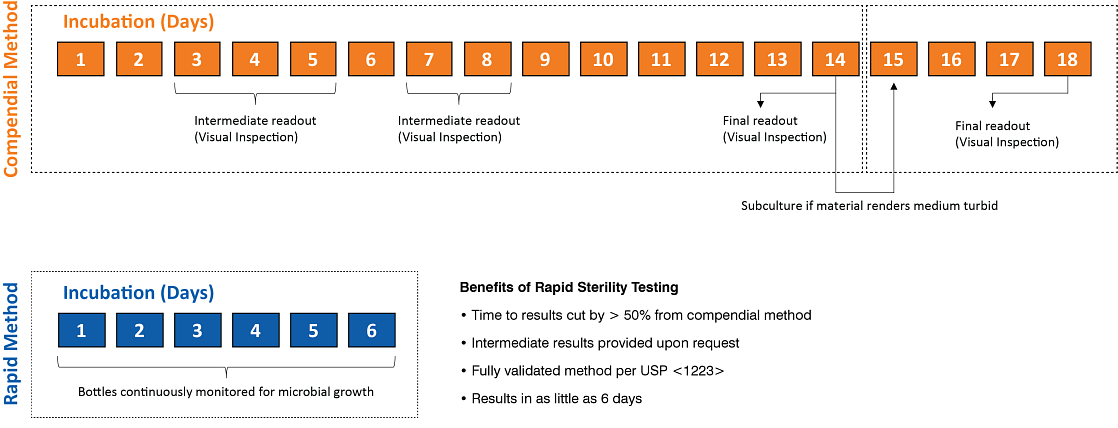
To address this issue, we offer rapid sterility testing using automated microbial detection technology. This rapid test method has been fully validated according to USP <1223> and can provide results in less than half the time of traditional methods with intermediate results available upon request. This approach allows for a more reliable and efficient means of evaluating microbial growth, regardless of culture turbidity.
Compendial vs. Rapid Sterility Assessment
Learn more about sterility testing
Rapid Mycoplasma Testing
Our mycoplasma assay is a rapid and accurate test that uses reverse transcriptase-polymerase chain reaction technology and specialized primers and probes to detect a range of mollicutes, including Mycoplasma and Acholeplasma species.
The assay has been validated based on the guidelines of the European Pharmacopoeia 5.8 and 6.1, section 2.6.7 and has a detection limit of 10 CFU/mL in various sample types. The assay also includes nucleic acid spike controls to check for potential amplification inhibition in the sample, and positive results can be confirmed with traditional culture-based methods if necessary.
Reduced turnaround times have been realized after increasing the PCR footprint at our Malvern, Pennsylvania biologics testing facility and implementing several process improvements to increase efficiency.
Learn more about mycoplasma testing
Still have questions or want more information?
Ask an Expert