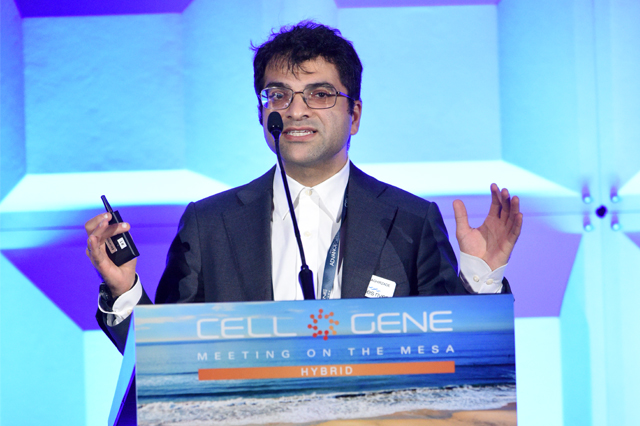
nAAVigation® Vector Platform: Accelerating Your AAV Pathway to GMP and Clinic

-
Transcript
Ramin Baghirzade (00:00):
Hello, everyone. It's my great pleasure to be here today and to share a few words on a new flagship offering which we're unveiling at Mesa. It's our AAV platform which allows our customers to get to GMP within eight months.(00:25):
A helicopter view of Charles River, we are an established company. We were founded in 1947, and we currently operate in 20-plus countries and have 110-plus facilities. A piece of stat that we're very proud of is that we supported the development of 86% of the novel FDA-approved drugs in 2021. We have six divisions in Charles River, and contracts and development, manufacturing and testing are integral part of our biologics solutions.(01:22):
As a bit of a recap to some of the major challenges, and I might be preaching to the choir here, we know that we have a long way to go in terms of probably where the mammalian and the traditional biologics is today. We still have a quite long and costly traditional development timelines. We also know that, since the majority of cell gene therapy companies as small to medium biotech, they tend to go from one round of financing to another, and there is a pressure to show the data sooner rather than later in order to be able to get some funding.(02:16):
We also know that extra process development activities lead to increased costs and impacting timelines. We also know that when you go for manufacturing and if the yield doesn't look great that leads to additional costs because then you know that you need to manufacture another GMP batch where you need to optimize a process before going to GMP again. Load to load consistency is a huge issue and can lead to major challenges from a regulatory and quality point of view.(03:02):
Because plasmid is a starting material of critical reagents, it creates bottlenecks for AAV manufacturing because, if there are some challenges on the plasmid side, it would have a domino effect on everything else. We're still facing capacity and slow shortages, and this is becoming an increasing issue as the pipeline becomes more mature and therapies getting closer to commercialization. We also know that there are raw material shortages, and sometimes what happens is drug developers go to a CDMO and they might get a slot, but they get a message that, yeah, "You might need to wait for six months before we get the materials," which doesn't help.(04:02):
What is also critical here is manufacturing a GMP batch per se doesn't necessarily mean that you're able to release it and use for clinic. It's not uncommon when you manufacture it and then your analytics and then you're stuck with and facing some delays to release a batch and can't use it for clinic. Overall, industry needs an expedited, cost-effective and predictable pass to GMP and clinic. In Charles River, we took those pain points, and there was almost a eureka moment when we realized that we had the ingredients internally to find a solution to those issues.(05:02):
Let me tell you a story about an invention which pretty much revolutionized the travel agency. This is an illustration of a wheeled luggage, a trolley from a US patent in 1972. An inventor had a very simple idea. You take a box and you put the box on wheels. Box and wheels have existed for centuries. Even though the concept was quite simple, it had a massive impact on millions and millions of people.(05:47):
In a similar vein, we realized that, in Charles River, we had all those ingredients available. We knew we're good on plasmid DNA. We've been doing it for decades. We've manufactured hundreds of batches on the AAV site. We are a world leader on testing and, as a large company, we have established global partnerships with procurement and vendors. Taking this four pieces together, we created three pillars of our nAAVigation platform and we integrated them under one roof, pillar one, in-house plasmid DNA a production, pillar two, viral vector production, pillar three, 100% of analytics is done in-house.(07:00):
Thanks to a standardized process, we have a simplified and secure supply chain and, thanks to this three pillars, we were able to cut 18 months to below eight months. In the upcoming slides, I will give a bit more meat on the bone on the three pillars. Going back to pillar one, plasmid DNA, as mentioned, since it's a starting material, it's really important to have it in place before the manufacturing can go any further. It's also very important to plan in advance.(07:52):
We've been manufacturing plasmid DNA for close to two decades. In fact, there is a grand opening of our new sites next week. We have two sites in the UK both for research grades, HQ and GMP grades, and a lot of capacities coming online starting from next week.(08:21):
If we look at the second pillar, here, we focused on standardizing AAV production, and a big part of it was also introducing a templated approach. For us here as well, a starting point was important. Having a high yield cell line is a critical differentiator. We spent a significant amount of effort to optimize our cell line and we're able to increase and boost AAV productivity 20-fold and beyond across serotypes. Relying on a triple transfection process, we also optimized molecular biology of the packaging plasmids, also allowing us to boost titers. Last but not least, we also focused on cell culture media and, the same purpose in mind, to boost titers, hence, increasing the yield. Templated documentation was another integral piece because we know that, let's say, once you have a standardized process, then you're also able to template and standardize documentation, including but not limited to a sampling plan, a master batch record and a product specification, allowing for timely release. Now, going to the third integral pillar of the nAAVigation platform is in-house testing. It's the testing powerhouse of CRL meeting a standardized process, meeting a simplified and secured supply chain.(10:45):
Let me elaborate on what do I mean by that. We have been performing testing for over three decades, and it has been part of Charles River's strategy to rely on our global network of testing facilities to power our contract and development manufacturing in the sites with a hundred percent of analytics performed internally, so sometimes you end up with, as I mentioned in the beginning of my speech, you have a GMP batch manufactured, but then you're stuck because then you rely on sometimes two, three, four other suppliers, and that doesn't benefit your customer and it doesn't benefit the patients.(11:41):
What we've also done by standardizing the process and leveraging Charles River global supply chain, standardized platform allowed us to standardize the bill of materials and, by standardizing the bill of materials, we were able to procure material well in advance and, obviously, leveraging our negotiation power as a global company and existing relationship with global vendors. That means that, when customers come to us, the material is already available on day zero and it doesn't lead to any further bottlenecks.(12:38):
To sum up the key benefits of the platform, when we looked at these three pillars, speed was very critical for us. We're able to expedite development, thanks to, among other things, a hundred percent in-house analytics. Track record is another important element here because we know that speed is not everything. It's not good enough just to get from point A to point B. You need to be able to get to point B in the right manner. If you have poor quality of GMP batch just because got something manufactured, it doesn't necessarily mean that it's a success story. Track record is a critical differentiator in this industry. Last but not least, by putting those three pillars together, it allows our customers to have much better predictability, because no one likes surprises, especially the nasty ones.(13:58):
With this, I would like to thank you for your time and also mention that we have a happy hour later today between 5:00 to 8:00 PM at Post Command, and you're welcome to join us especially if you want to hear the presentation again and have more discussion in this regard. Thank you for your time.