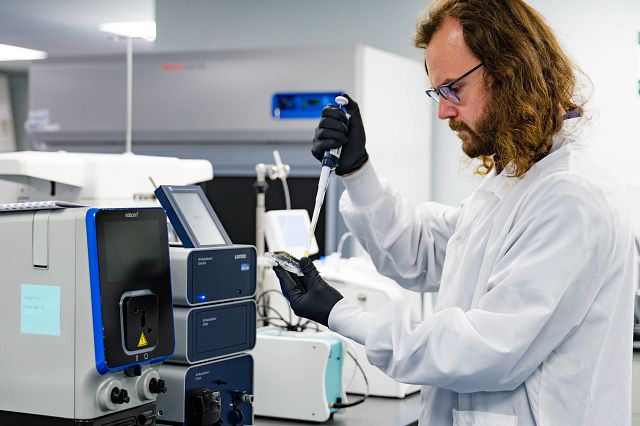

Pain Points to Potential: Positioning Process and Analytical Development for Next-gen Cell Therapies
As the number of cell therapy products in clinical development increases, so does the need for cell therapy developers to efficiently establish a robust, reliable, and commercial-ready GMP manufacturing and control strategy for their program.
This webinar aims to guide cell therapy developers along their commercial pathway starting with key considerations in development through to IND/CTA filing and lot release.
Explore:
- Scale-up decisions: how and when to scale-up or scale-out
- Regulatory considerations in setting up an effective phase-appropriate testing strategy
- Process development and analytical development approaches to future-proof early programs and CMC
About the Presenters
Sarah Campion
Director, Analytical Development, Cell Therapy CDMO Services

Alex Sargent, PhD
Director, Process Development, Cell Therapy CDMO Services
-
Transcript
Abigail Pinchbeck (00:00:10):
Hello, and a very warm welcome to today's Cell and Gene Therapy Insights webinar, titled Pain Points to Potential: Positioning Process and Analytical Development for Next Generation Cell Therapies. I'm Abby Pinchbeck, an editor at Bioinsights, and joining me today at Alex Sargent and Sarah Campion, who will aim to guide cell therapy developers along their commercial pathway, starting with key considerations in development through to IND and CTA filing and lot release.(00:00:39):
After the presentations today, we'll have a live Q&A session. So do feel free to pose your own questions to our speakers using the ask a question box at the bottom of your screen. We'll try to get to it during the session.(00:00:52):
I'd also like to draw your attention to the resources tab on the right of your screen, where you can find more information on the topics covered today. I'd now like to introduce our presenters.(00:01:05):
Alex Sargent, better known as Sarge, is currently the director of process Development at Charles River Laboratory. He obtained his PhD from Case Western Reserve University in Cleveland, Ohio, where he studied the challenges and promises of stem cell biology, neuroimmunology, and Cleveland sports teams. He's especially passionate about the challenge of curing cancer, working on CAR T and CAR NK-cell therapy process and analytical development, from discovery through regulatory submission, manufacturing, and pivotal clinical trials.(00:01:40):
Sarah Campion is currently Director of Analytical Development at Charles River Cell Therapy CDMO Services. Starting with an education in microbiology and immunology, she now has almost 20 years of experience in vitro diagnostics and cellular therapies. In her current position, she leads both the analytical development team, where assays go from ideas to a defined purpose and procedure; and the GMP analytical testing lab, where the developed assay is qualified for its purpose and used.(00:02:13):
So without any further ado, I'll hand over to Sarge, who's going to kick us off with today's presentation.Alex Sargent (00:02:28):
Hello, everybody. Thank you for that very kind introduction, Abby. Again, my name is Alex Sargent, better known as Sarge. I'm the director of process development here at Charles River Laboratories, and today I'm going to talk to you about some of the pain points, and really the potential to get round those, in cell therapy process and analytical development.(00:03:00):
So an overview of the agenda, what we'll try to cover here for you today. I will go ahead and give a brief introduction to Charles River, especially focused around our new CDMO services. I'll talk about the growing cell and gene therapy CDMO network. We'll go ahead and talk about sort of the meat of the presentation, the pain points in process development, before handing it over to the best analytical director I know, my colleague, Sarah, to talk about overcoming pain points and analytical development. And hopefully, if we don't talk too much, we'll leave some time for you at the end for any questions that you might have.(00:03:42):
So just a bit about Charles River. Our mission here is to create healthier lives for our patients, and for people all across the globe. And to do that, we are truly a global organization. We have 110 different facilities in greater than 20 countries across the world.(00:04:00):
In 2021, we supported the development of 86% of novel FDA-approved drugs and therapies. And to do this, we have many different divisions providing many services in the biopharmaceutical industry, all the way from research models and services, which a lot of people are familiar about; to discovery services; safety assessment; laboratory sciences; our QC and microbial testing; and sort of our newest member of the family, where Sarah and I sit, our CDMO and testing services.(00:04:39):
I don't need to tell anybody on this call how fast the cell and gene therapy market is evolving, and how explosive that growth has been. Ideas and dreams five years ago are really realities today. Like I said, our purpose here at Charles River is to really accelerate this growth, and to keep the momentum going for cures and for treatments for our patients.(00:05:05):
And to do this, we have the expertise, and the people to really help you accelerate your CGT journey, as well. So we've conducted over 1000 studies in cell and gene therapy in 2021 alone, supported the development of 10 FDA approved cell and gene therapies that year. And looking across, we have over 100 years of scientific experience just within our CDMO services here at Charles River alone.Sarah Campion (00:05:37):
Alex, I've been asked to ask you to remove the hide from the bottom of your screen.Alex Sargent (00:05:41):
Ah. Thanks, Sarah.(00:05:50):
Part of the way that Charles Rivers does this, and what really helps sets us apart from a lot of other companies, is we take a complex fragmented network in cell and gene therapy, and really provide services and support through all paths and all phases of development; all the way from discovery or antibody discovery and engineering to toxicity and safety testing for new therapies.(00:06:14):
We're really known for our research model services and In Vivo studies to write the ability for plasmid and viral vector manufacturing, as well as, finally, where Sarah and I sit are CDMO activities, especially for cell therapy to get clients into the clean rooms through Phase 1, Phase 2, Phase 3, all the way to commercial manufacturing, and out the door to save and enrich lives.(00:06:43):
As I mentioned, we have a real global presence, and just focusing on the US and the UK, we have sites all across the East coast. I, myself, and Sarah sit just outside of Baltimore, Maryland. Our manufacturing services and centers for cell therapy sits in Memphis, Tennessee, down the road from some global hubs, in terms of transportation.(00:07:07):
And then we also have sites over in the UK for plasma production, as well as sites scattered across the country, and really the world, for cell solutions, sourcing cellular material for our clients, as well. So we have five CDMO locations, over 800 employees, 400,000 square feet primed for cell and gene therapy manufacturing, and a litany of employees waiting to do all of the testing and analytical work that goes along with that, as well.(00:07:45):
So here at Charles River, we really take an integrated approach to analytical and process development work with the end in mind for our clients. And so our expertise is here to help you de-risk scientifically complex cell therapies, and move them into a GMP fashion.(00:08:03):
And we do this moving all the way from feasibility to cell therapy ideas that are written on the back of a bar napkin, so to speak, through optimization of those ideas, confirmation of your process and your analytical methods, and all the way into a GMP readiness space for clinical trials.(00:08:23):
And we can take, like I said, things that are purely idea stage, all the way to cell therapies that are commercial, and simply need A CDMO to expand capacity. And so we use the latest technologies in the industry, the best platforms, and we really work together to make a seamless transition from process and analytical development into GMP manufacturing.(00:08:52):
So now really to get the heart of the matter today, right? How do you overcome some of the key pain points in cell therapy process development? And yes, that is me on the right there, pretending to take a sample from a rocking back bioreactor. I'll touch on sort of three key points for my portion of the talk.(00:09:14):
The first is the power of automation to help you overcome manufacturing hurdles, both for autologous and allogeneic processes. And I'll focus on how automation can help reduce costs, improve robustness for your process, and allow you to integrate inline analytic technologies, which can also be beneficial for a cell therapy process.(00:09:37):
I'll touch on one of my favorite topics, the pitfalls and potential of genetic engineering, viral versus non-viral approaches, especially the challenges in non-viral approaches, and some of the solutions we, here at CRL, are working on in this area.(00:09:53):
And last, but never least right, is fill finish. Oftentimes this can be the last thing on somebody's mind, but it shouldn't be. It's one of the most important aspects in unit operations in cell therapy manufacturing. And I'll speak a little bit on when and how to bring in automation for fill finish unit.(00:10:18):
So speaking about cell therapy market in general, and where we are now, right? We really subdivide it into autologous and allogeneic cell therapies. And if you look at the market over the past few years, autologous therapies still dominate, but allogeneic cell therapies are rapidly growing, particularly in the immuno-oncology and cancer field, as well. So if you look at the more late phase cell therapy programs, they tend to be autologous, but the allogeneic cell therapies are moving further and further into Phase 1, and from the idea phase.(00:11:00):
Each of these present their own unique challenges, and their own approach to how you would scale out an autologous cell therapy or scale up an allogeneic cell therapy. So for an autologous therapy, where you would want to scale out, oftentimes the challenge is going from flasks, or some kind of manually manipulated, poorly controlled environment, into an automated system that allows for better process control, reduce labor, and hopefully, functionally close parts, of if not your entire process.(00:11:38):
And I should mention here, I have on the right a number of different technologies and platforms that can enable closing and automation of cell therapy processes. I have no favorites. I'm sure I have lots of friends in the audience who work for all of these companies. And each of these technologies can be the right platform for your particular product, and for your particular process. Here at Charles River, it's all about finding the best technology, the best platform, for each customer's process.(00:12:14):
Oftentimes, one of the biggest arguments made in terms of why somebody should automate is reduction in cost of goods and overall cost of a cell therapy product. And this is true depending on the models you look at, but especially for autologous cell therapies, there are some limitations.(00:12:34):
So if you look at two different models, published models, on the effects of automating cell therapy processes, one is an autologous DC like process, the other one is an autologous or scaled out stem cell-like process. Cost savings for automation can be anywhere between 10% on the low side, up above, to as high as close to 50% for the bottom model on below.(00:13:00):
So the key takeaway here is how much automation is going to save you in your process, depends on your process, and also depends on key factors, like how many batches you plan to produce, how many patients you plan to dose, and other important information really dependent on each company and sort of each mission.(00:13:20):
An important thing to note with automating autologous processes is that the cost reductions can be limited due to high cost of capital investments. You have to buy this machinery, especially if you're doing manufacturing in-house; the number of batches per year, makes a lot more sense to automate for say, 100 or 1000 batches per year than one or two.(00:13:44):
And something that's often neglected is the analytical and QC testing costs for autologous cell therapies. So even if you have a fully automated process for an autologous therapy, if at the end of the day you need a small army of flow cytometrists to run your QC testing on all of those samples you're generating, that can still create a lot of cost.(00:14:09):
Now, beyond simple cost reduction, there are other benefits to automating autologous process. The closed processing is going to help reduce the risk, in terms of say a sterility failure, or sort of any kind of process failure. And by closing the process and moving to an automated system, you can better control key process parameters, and hopefully reduce subjectivity and variability in your process.(00:14:33):
And one of my favorite topics is with these automated systems, oftentimes they have the ability to have inline analytical technologies. And I'll talk about how that can be important in a few slides.(00:14:49):
For an allogeneic cell therapy, the challenge here is scaling up. So moving from often lots of small individual manual units, hundreds of flasks, dozens of flasks, into a system and platform that you can really scale up your therapy to tens of liters. And I hope one day, perhaps, even hundreds of liters.(00:15:17):
Automation really shines in allogeneic cell therapies in terms of reducing costs. So a lot of the public models state that with an allogeneic therapy, you can get the cost of goods for, say, an allogeneic T-cell therapy to at or below $5,000 per dose. That's a 20 fold reduction.(00:15:38):
Now, there's a lot of debate around how accurate this is. This might be a bit of a dream, but I do think if you can leverage automation and close processing with allogeneic therapies, there is tremendous opportunity to reduce cost, in what can be a very expensive segment of the pharmaceutical industry.(00:15:59):
And part of that has to do with in allogeneic therapy, the cost benefit savings you're going to see in reductions to labor, and analytical and QC testing, and capital investments, those tend to be greater than the cost savings you would see in an autologous cell therapy.(00:16:18):
Further with allogeneic cell therapies, you can also further minimize the risk and variability in your process by having a defined donor pool, with very stringent criteria. And again, with these allogeneic cell therapies, automation allows for inline process analytic technologies that can further help you understand your process and reduce variability.(00:16:43):
Why is this important? I had to plug one of my recent graduate students, who published a paper last year looking at say the effects of pH and DO CAR T-cell phenotype. And controlling pH, for instance, could create a pronounced shift in CAR T-cell phenotype, from an effector memory phenotype to more of a central memory or stem cell phenotype, that may be more desirable for a given process in product.(00:17:15):
Similarly, looking at DO set point, being able to control and monitor the dissolved oxygen in your culture can dramatically influence the transduction efficiency in a typical CAR T process. And so his data, and our data, really helped to underscore how being able to monitor very simple things, like DO and pH, can really help you get more control in your cell therapy process.(00:17:41):
And today it's exciting to see new technologies where you can monitor things like metabolites, viability, cell density in real time, allowing you to make better process decisions as your process is happening. And in the future, I think we're all excited about technologies which may give us the ability to monitor things like phenotype and functionality of our cell therapy products, things like inline sensing technology, raman spectroscopy, all of these begin to become a reality when we talk about automating our autologous or our allogeneic cell therapies.(00:18:20):
One of the key unit operations that has a lot of challenge in cell therapy is genetically engineering cell therapies. How do you introduce your gene editing systems into cells. For non-viral approaches, probably, the most popular is electroporation, the standard on the market.(00:18:41):
This can be challenging, as I'm sure some of you know, electroporation can have a pronounced effect on cell function, cell viability, and cell health. One of the unknown, or I should say underappreciated, aspects with electroporation and genetic engineering is the high costs. So oftentimes when we look at genetically engineering a small number of cells, the cost of goods for those reagents is relatively small.(00:19:09):
But as we scale that up and look at genetic engineering of larger and larger number of cells, a billion, 10 billion for instance, the cost can go exponentially higher, and really drive higher COGs in a cell therapy process.(00:19:24):
I should mention too that this is only for one edit. If you're looking at a cell therapy where you're editing multiple genes, multiple reagents to do that, the cost can really rise dramatically. So this creates an interesting dilemma and problem, is it possible to get better gene editing efficiency without necessarily increasing the cost by using more reagents?(00:19:53):
And this is something we've been working on, for instance here at Charles River. Obviously, for an electroporation, you can look at optimizing voltage, electroporation parameters, to try to get better results in genetic engineering. You can optimize your cellular input, try to get a better cell starting population to favor more genetic engineering approaches.(00:20:13):
But one of the novel sort of ways that we're looking at this is optimizing cell recovery post electroporation. And so this is my second shameless plug in this talk. Forgive me. Look for us at ISCT, because there myself and some Charles River folks will be presenting some new data about a novel cell culture supplement that can be added to cultures post electroporation to improve transgene expression in electroporation type setup. And this supplement works across different cell types, T-cells and HSCs, and perhaps some others that we'll be talking about at ISCT.(00:20:57):
And last, but not least, we've talked a bit about automation, we've talked a bit about genetic engineering, but what about fill finish. When and how do I bring in automation for this particular unit operation? Again, a lot of technologies on the right of my slide, I have no favorites. I love all of them, and each one might be right for a particular process or product.(00:21:25):
But why should I bring in automation for a fill finish operation? Similar to the other unit operations, automating fill finish can reduce costs that reduces labor, space requirements, and the COGS reductions is especially apparent for large batches, say allogeneic therapies, where you got to fill hundreds of bags, thousands of vials, what have you.(00:21:49):
But why might we want to bring in automation per say, even an autologous process, where you're only filling a small number of units. This can really minimize risk for your fill finish operation. A lot less risk in terms of sterility failure. And these automated platforms have the ability to be augmented with bar coding and high throughput labeling systems, LIMS systems, that better make your therapy more compliant in terms of FDA guidance and regulatory considerations.(00:22:22):
So the key takeaway here is, even if you have a small number of outputs that you're looking to fill finish, using an automated approach can be beneficial, because it can reduce risk and bring you into a more regulatory compliant process.(00:22:41):
So just to summarize a bit what I've gone through here today, what are some pain points in cell therapy process development, and how can you really come over them? Do not neglect the power of automation in cell therapy processes, both for an autologous process and for an allogeneic process. It can help you dramatically reduce the cost of your process, and when leveraged with process analytical technologies can allow for better control of your process, and a better understanding of what you're putting out into the patients.(00:23:13):
Now, there are unique challenges associated with genetic engineering, as I've mentioned, and I'm sure some of you know; process optimization for this unit operation is key. And there are new strategies, new technologies emerging in-house at Charles River and beyond, to also help make this challenging unit operation better, especially in terms of non-viral approaches for potential customers.(00:23:36):
And never neglect, or never forget, about fill finish. There are extreme benefits to automating and closing the downstream process and fill finish operation, whether you're looking at filling 1000 units or one or two units.(00:23:57):
And just to iterate again, one of the challenges when we think of automation, or bringing in these technologies, is that require a lot of costs in terms of capital, and they require a lot of expertise. Using A CDMO like Charles River, you can help leverage us so that we take on the cost, we have the expertise to move clients into say an automated system, or into a fully automated process.(00:24:25):
And just speaking of the CDMO services, looking beyond the Charles River, we have the technology and expertise in design, in vitro studies, in vivo research model service, and our CDMO services, to really help make it sort of seamless for clients to navigate what can be a very complex and fragmented network.(00:24:48):
And I believe with that on time, I will hand it over to the best analytical director I know, Sarah Campion, take it away, Sarah.Sarah Campion (00:24:59):
Thank you for that, Alex. So yes, Sarah Campion here, director of analytical testing at CRL at the CDMO sites. Today I'd like to discuss some of the pain points and possibilities in analytical development. One second.(00:25:21):
So some of the points I would like to go over today is the definition, or availability, of the product test material for development work, identifying suitable controls, transferability of method, and the method development timeline.(00:25:39):
So the first pain point that we experience a lot in analytical development is the definition, or the availability, of product or test material, for developing our methods. So in many cases we've either not defined, or we don't have material available, because the client coming in is either coming out of an academic center and can't access that material, or it hasn't been produced yet. And many times the analytical side is waiting on the process development side to make material.(00:26:13):
This does make it difficult to set method specifications, or acceptance criteria around that material, because we don't really have it defined yet. We haven't run fully developed methods on the material to know if we have the identity purity, viability we want coming out of our analytical methods.(00:26:33):
This leads to a challenge with the separation of process and method issues. So if you don't have an assay that you know is working correctly, how do you know have a process that's working correctly? So sometimes troubleshooting is difficult when we're in the very early stages of development.(00:26:51):
And sometimes appropriate material is not available for development. So we have not fully defined product, as said before, or we don't have product, because we're working on a unique autologous material, and there isn't a good healthy donor representative of that material. So we don't have say some of the key targets we're looking for in analytical method development.(00:27:16):
We also have to consider the client's clinical trial phase, and whether we're using the appropriate material for that phase. So an example for that is a flow method for identity that's not fully characterized, because we have limited or undefined test material. So we don't have a method yet that we can say is ready to go into qualification or such.(00:27:39):
So some of the solutions that we come up with in my lab here, we, very early on, when we onboard the client, we make sure that we have either client sourced or PD produced material. Or we see if we can go internally in CRL, say our cell solutions group, and find the right example material that will work for assay development.(00:28:03):
We want to ensure that the test sample is robust, that it's coming from a process that is fairly well-defined, so that we know what we're getting handed off for method development, is what it's supposed to be in some regards. And like I said, we do use characterized cell materials. We'll use cell lines, or characterized PBMCs, MNCs that are produced using standardized protocols that, at times, come in with at least some level of characterization, so we know what we're working with.(00:28:33):
We will use isolated cells of interest, so say CD3s or CD34 cells depending on the process. And then we will use immortalized cell lines. And there is a large advantage now that we have our cell solution group in CRL, we have this material readily available to us. We can go out, and we can get characterized donors, we can get very specific cells fairly rapidly.(00:29:00):
We need to make sure that the method controls are appropriate for the method. That we have cells and reference materials, which I'll hit on as another pain point, specific to the method we're trying to develop, whether it's a PCR method, a flow method, that it is representative.(00:29:16):
And then that we perform methods as FIO until a suitable body of data is created. Many methods early on for clients in early phases, Phase 1, pre-Phase 2 are pushing for release methods that are not necessarily ready for use yet.(00:29:34):
They should be run as FIO until we have enough data around them to say that they are robust methods. And then I will always hit on retains. Throughout the process, we should always retain material. We can always go back and test it if needed, but we can't always go back and collect it if needed.(00:29:53):
So following our example here for a flow method for identity that was not fully characterized, because we had limited test material or non-reproducible test material, meaning the process wasn't able to make the same material over and over; we went ahead and used cell lines with characterized markers to set up and go through the design of experiments for and the analytical method, which then allowed us to have a robust assay for helping define the process.(00:30:22):
We use cells, in this case, either CD3 or CD34, that were isolated using a similar process to the cell production, or the final product process, to test that final proposed method of production. And then when possible, we use the manufactured product. This isn't always possible in autologous, before the assay heads down into the GMP environment, but to finalize the analytical method assessment before it heads into qualification.(00:30:54):
The next pain point I would like to hit on is control or reference material. So robust methods obviously require proper controls for cell therapy products, especially autologous. Availability and suitability of those controls can be limiting.(00:31:08):
So I generally tend to have method controls fall in two categories; what I consider reference material, and what I consider control material. So reference material more closely mimics, and is generally a production lot, if possible, of the final product. So it should mimic in both collection, manufacture and storage, the final product that you are trying to make.(00:31:33):
Control material is defined cellular material. It can be cell lines, it can be characterized primary cells, or something that mimic one or more of the attributes of the final product. We use both to develop the method. In some cases they will replace the sample in developing the method, and then we try to incorporate these into the method.(00:31:54):
We prefer reference material when possible, obviously, because it mimics more the product, for method transferring and qualification. So some of the pain points we've had with this is we had a autologous prostate tumor derived therapy. Obviously, healthy donor material is very limited in this case, and generally not suitable. And there's limited disease state donor material available.(00:32:20):
Just a quick stop here. Some of the pros and cons of reference and control material. So reference material, representative product, like I said, generally a manufacturing lot, or designated part of a lot of product, it is difficult to characterize, because sometimes you don't have your assays yet.(00:32:38):
There may be lack of reproducibility lot-to-lot. So if it's autologous, you're obviously going to have a lot of variation lot-to-lot. If it's allogeneic, it's going to be very donor dependent. Again, it may not be possible with an autologous product, or a product that doesn't produce a lot of material, and it does require call qualification, characterization, and stability studies.(00:33:01):
Controlled material is generally much more easier to obtain and produce. Think of purchasing something from say ATCC or CRL. It is more reproducible because it is usually made from banks. It's not generally directly representative product, and it also requires qualification and stability testing.(00:33:20):
So some of the solutions we've come up here, back to that autologous prostate tumor derived therapy. We identified appropriate cell lines for use in flow panel development that were indicative of the markers we expected to see. When we were attempting to develop a cell viability, and count procedure, we used cell lines that harvested similar to the autologous product. So that product happened to harvest very clumpy.(00:33:51):
So we needed to make sure that the cell counter we were using would mimic, or had product to mimic how that would work. And then we use materials simulate to the prostate tumor to stimulate, or excuse me, simulate particles observed in cell counting.(00:34:06):
So some of the solutions here are identify and sourcing appropriate control and reference materials. This should be addressed early on in method development. You should not wait until you head into GMP to start looking for your potential candidates.(00:34:19):
We are also starting to explore the use of non-cellular materials. There are companies out there that provide gel-like particles for use in flow cytometry that any essentially antibody or antigen can be bound to. So this could replace a cell, or multiple cells, used in an assay.(00:34:41):
And then inclusion of that control reference material in the method, included in, we do a fit-for-purpose test here. When assays leave as acid development, it needs to be included in, that and it needs to be appropriately validated later on when the assay is validated.(00:34:56):
So my favorite pain point here is the transferability of the method. So my biggest challenge in assay development is making sure the method is robust and reproducible, and can survive in the QC environment. So the method needs to be understandable, it needs to be written in a way, and developed in a way, that anybody can essentially run it that has the appropriate scientific background.(00:35:22):
It needs to be robust. It needs to be able to stand up to an environment that we do control, but we don't maintain all of the control over. And we don't know how each analyst is going to interpret it from run to run to run. Obviously, we put a lot of training in that.(00:35:42):
The method should also be phase appropriate. Are we using just for FIO? Or will this be qualified? Will this be validated?(00:35:51):
Hopefully, we can start at the FIO stage, when we're early phase with the client, which is for information only. And we have some time to run it in the QC environment to see where the pain points are in that method, before we head into qualification. Because trust me, qualification is going to show you where those are.(00:36:09):
And then hopefully by the time we head into validation where we're Phase 3, we are at that point quite robust and reproducible.(00:36:17):
The other thing we need to consider when we transfer a method, and we develop a method, is that the sample quantity used in that method, obviously, this won't be the only method to release the product. So we need to make sure that the overall cycle of testing does actually leave some product left to dose.(00:36:35):
If we go back to that autologous prostate therapy that I was mentioning before, our original sampling plan actually used almost the entirety of the product. So there was not enough left to dose, so that was another challenge that we had to overcome.(00:36:52):
And lastly, don't forget your CQAs when you're developing a method, make sure that you know what your critical quality attributes are, you know that your method is going to identify those and test for those.(00:37:07):
Also make sure that the instruments that you are developing to, are going to be either 21 CFR compliant, which is best or validatable, and made to mimic compliance, essentially. We do have instruments that we know we cannot move away from that are not yet 21 CFR compliant, but they are validated pieces of equipment. We have to take into account data integrity, computer system validations and all of that. And we have to have a way of making sure they meet compliance.(00:37:41):
So some of the solutions around making sure the method is transferrable is using, obviously, design of experiment. When you're doing your assay development, making sure the parameters are robust, you've identified the critical points, you've identified the weaknesses. Make sure you build in appropriate controls. Keep it simple, keep it clear, and keep it repeatable.(00:38:02):
A lot of the assays that we work with here are coming out of the academic center. They are very understandable to the development team, but we have to digest them, and turn them around in a way that we know they're going to be run the same way every time.(00:38:15):
And then do a test. What we call here is a fit-for-purpose test to make sure that assay is ready to leave development. So we do what looks like a pre-qual, or a minute qualification, and the very least we look at precision. We will look at intra and inter assay precision, we will look at linearity. And then we will look at accuracy and specificity as appropriate to the method. This gives the validation team some set points to start the qualification protocol. And it gives us in development a good idea at where that assay is ready to go.(00:38:48):
So for an example here, we develop a full method to determine enumeration impurity of a CD34 product. And this obviously had a very complicated, if anybody knows ice age gating, flow gating hierarchy. And this was the first time our QC team was going to see ice age gating. This was more obviously than one or two gates that they were going to have to deal, with one or two plots.(00:39:09):
So in our fit-for-purpose tests, we included reproducibility, not just analyst to analyst, we include performance to performance, and we were looking at day-to-day, to make sure over multiple an analysts over multiple iterations of this assay, we got the same results.(00:39:25):
We also had to have a very clear explanation of the gating hierarchy, and the purpose of each gate. We gave clear visual examples of where to set the gates in critical populations. In many cases in flow, it is not possible to lock down the gate, donor to donor, patient to patient variability doesn't allow that.(00:39:46):
It would be wonderful if we could, but we cannot. So we have to use clear examples, pictures, what you want to do, what you don't want to do, when we write our flow methods. And last but not least, make sure that there's training and time to perform the assay before competency testing in QC.(00:40:04):
And the last pain point I want to hit on briefly is the project timeline, because this, I think, is most critical to clients, and there is insufficient consideration of analytical method development and validation time requirements, I would say, in most cases when we're transferring a process and an analytics through here.(00:40:24):
So method development is generally done during product development stage, in an ideal world, with full validation during the Phase 3 or clinical beyond. Method development tends to be either ahead or more often behind because lack of that product availability, process development.(00:40:42):
So we will get timeline creep. We will get timeline creep related to product or manufacturing processes. So sometimes they're not necessarily ready for the assay, or the assay is not ready to be transferred down. And also resource related. Sometimes we will not have the people or material needed to run that assay.(00:41:03):
We need to also make sure that method changes are appropriately managed. It's going to undergo many iterations before validation, and it needs to be appropriately tracked so that we know what the changes after development, so while it's going through its GMP lifecycle, what changes are occurring and how to appropriately manage those changes.(00:41:27):
So as the solutions for here, the analytical development team here, should work closely with the cross-functional team. So that is MSAT, that is project management, that is QC. They need to actively participate in any relevant discussion regarding the timeline, and they need to work with the project managers and other team members to make sure that they are aware of where that assay is in its development, and what key pain points it may have once it hits the GMP facility.(00:41:53):
So the success of a project here comes down to communication. Communication of expectations, of the goals, the scope of the project, and within the project team. Analytical and process of development are closely tied. So that is one of the advantages we have here at this site, is that both Sarge and I are at the same facility working in the same labs, and dealing with very similar problems.(00:42:18):
So if there is a process problem, that an analytic person can help with and vice versa, it's very advantageous to have us both in the same building. We're not waiting for results, we can run the results, or the assays he needs results on right away. Also, it gives us a chance to see all iterations of the product. So we get to see it when it's pretty, and we get to see it when it's ugly.(00:42:45):
So some closing thoughts. Again, the need for robust, efficient, and thoughtful analytical method development is critical to cell-based therapies. These methods are what define and release your product. We accomplish this through a well-defined project scope that is executed by a communicating cross-functional team that of knowledge of both process and analytics interaction.(00:43:07):
A successful method will have an understandable and reproducible procedure, clearly defined and characterize controls. It will be able to pass qualification and validation, and it will provide relevant information to product release or characterization. I believe that is all. Thank you very much for your time.Abigail Pinchbeck (00:43:29):
Great, thank you so much, Sarge and Sarah, for that great presentation. We're now going to move on our Q&A, and we've had a few really great questions come in, and please do keep them coming. Any that we don't manage to get to today, we will reply via email.(00:43:49):
So we've got our first question here, and this one is for you, Sarge. This viewer's experience has been that many of the automated systems are not Part 11 compliance. How would you approach this?Alex Sargent (00:44:02):
Yes, if I had a nickel for every time that happened, I would be a very rich man. So I would say the first challenge is to identify if a system really is 21 CFR compliant, and to take the due diligence to do that, because it could be a company makes a claim, but further along in development, you realize there are potential holes in that claim that you need to mitigate.(00:44:31):
If you have identified a technology that you need that isn't 21 CFR compliant, are there alternatives? And given the new technologies that are rapidly emerging every day here, there could be something that you haven't heard about, or known about now, that just came on the market say a few months ago, a few days ago.(00:44:49):
And at the end of the day, if you truly need this technology for your process and it isn't 21 CFR compliant, then you have to do the due diligence and the risk assessment. What is the risk of bringing in this technology, even though it doesn't meet regulatory requirements versus what are the risk of not having this technology?(00:45:06):
So the good news today is that there are so many technologies emerging, this is becoming less and less of an issue as the industry evolves. And Sarah, I don't know if you have anything to say on this, because you deal with this a lot, too.Sarah Campion (00:45:19):
Yeah, definitely on the analytics side, 21 CFR compliance is very important, especially around data integrity. There are, fortunately for us, we don't have to change equipment as often as Alex does, but we do have to take that into consideration. I have many pieces of equipment in my analytical lab that I would love to have in my GMP lab, but are not there yet, because they don't reach that compliance level needed around data integrity.Abigail Pinchbeck (00:45:47):
Great, thank you, [inaudible 00:45:48]. That makes a lot of sense. And back to you with this one. Sarge, what unit operations are most critical for automation?Alex Sargent (00:45:57):
This is an excellent question. And it really depends on your process. Sometimes it makes sense to try to fully automate a process. Sometimes you might only automate a given unit operation.(00:46:10):
Oftentimes when breaking that down and trying to make those decisions, what unit operations are the most labor-intensive? What involves the most people? What involves the most manual manipulation? What involves the most time? There the impact of automation can be really felt in those unit operations.(00:46:27):
Another thing to take into account when looking at unit operations to automate is which ones present the biggest risk to a process. If you have a unit operation that is especially critical, or poses high risk to process success or failure, automation can help significantly de-risk that, de-risk the overall process.Abigail Pinchbeck (00:46:47):
Great, thank you. And Sarah, how do you test accuracy? For example, do you do spiked recovery, and if yes, how do you do this?Sarah Campion (00:46:58):
So that's very process dependent. Yes, we do test accuracy, yes, spike recovery is the way we do it. Ideally, if you're going to test, let's just pick on a flow cytometry method. If you're going to test accuracy, you would have a gold standard.(00:47:13):
You would have, say for a CD34 project, you'd have a characterized CD34 cell line that you knew performed as expected, and you would compare your product back to that. But I would say, yes, for most cases when we're doing qualifications and accuracy, it's spike recovery.Abigail Pinchbeck (00:47:32):
Great, thanks for that answer. And another one for you here, Sarah, for the gel particle cell mimics, you mentioned for flow cytometry AD, what do you see as the main challenges and barriers to routine adoption of these controls?Sarah Campion (00:47:48):
Acceptance by the regulatory agencies, for sure, making sure that they actually perform the same way. Whether they carry antibody antigen, that they're going to present that, and that we're going to detect that the same way cells would present and detect.(00:48:03):
Obviously, there's no functionality aspect to those, so they're really just a carrier to present something. I do think we are going to at some point head that way just because I don't want to say that they're so much better, but they are much cleaner, and they do give a much more accurate picture of what is happening in the place of flow cytometry. So just a lot more data really.Abigail Pinchbeck (00:48:30):
Yeah, that makes sense. And Sarge, you mentioned a media that could be used in gene editing post electroporation. Can you repeat the name of this media?Alex Sargent (00:48:41):
So unfortunately, that media doesn't have a name just yet. I believe our marketing department is working on that. So if you have any suggestions, feel free to drop it in the chat box, for instance. But it is something that is an internal development here at CRL, and we'll be presenting more information about it, and who knows, perhaps even a name, by the time we talk about it ISCT in May.Abigail Pinchbeck (00:49:03):
Great, thanks, Sarge. And Sarah, which quality status of a test method for Phase 1 is recommended?Sarah Campion (00:49:10):
For Phase 1, for your release assays, they should at least be qualified. You don't necessarily need to have a potency assay at this point. You need to have an idea of a potency assay. Here, we call them functionalities at that point. So you should be looking at an method that will describe the functionality of your product, but it does not necessarily need to be a true potency assay qualified and validated as such.(00:49:39):
I also see in a lot of Phase 1 clients, there are a lot of assays that will not make it to releasing the product, but a lot of FIO assays are used to characterize the product. And I don't want to say that we shouldn't use assays for characterization of product, but make sure we're not making data for data's sake, too, is important.Abigail Pinchbeck (00:50:02):
Thanks Sarah. Staying with you here, how do you typically set up spike recovery tests? What's your control? And do you set recovery between 60 to 140%, or 70 to 130%? And is that phase dependent?Sarah Campion (00:50:17):
Someone really likes accuracy testing here. So spike recovery, how we look at it in our FIO, how we look at it in our qualification, how we look at it in our validation, is very product and process dependent.(00:50:34):
So yes, 60 to 140, 30 to 170. Very common ways to look at it. We need to decide what are we intending to prove, other than the accuracy of that assay. Are we trying to say that it's a particular marker we see? It's a particular number of cells we see?(00:50:56):
So we really depend on the actual metric we're trying to qualify. And what that metric, is it a release metric? Is it an FIO metric? Is it a metric that we need just for product characterization? So how critical that metric we're trying to measure, how critical that accuracy is, and how precise it needs to be.Abigail Pinchbeck (00:51:19):
Great, thank you. And another one for you here, Sarah. Do you envision measuring potency in line, IE cytokines or cell killing in process development? And do you see the movement to use cell killing as a release assay?Sarah Campion (00:51:34):
Yes. So cell killing is used as a release assay here at Charles River. So potency functionality as an assay, heads from functionality to potency, which is really just a matter of gathering enough clinical data to show relevance.(00:51:50):
Yes, cell killing is a very, very critical assay for many cell types. It is usually used in conjunction with another metric, such as looking at cytokine production, and not just cell killing. And sometimes looking at identity, so we can say which cells are doing the killing, and what they're killing.Abigail Pinchbeck (00:52:12):
Thanks. And back to Sarge, now, what are the challenges in switching process development platforms, or technologies?Alex Sargent (00:52:21):
I think one of the key challenges is showing comparability. It can make sense to make a switch, in terms of a financial regulatory assessment. However, being able to show comparability if you already have data, especially already clinical data saying Phase 1 and Phase 2, and you're making a switch at Phase 3 can be a challenge.(00:52:39):
And that is something that has to be undertaken both at the process scale, and sometimes even at the clinical scale, as well. So comparability, I'd say, is key there.Abigail Pinchbeck (00:52:51):
Thanks, that's good to know. And Sarah, what potency methods do you employ? And how are you addressing the recent FDA potency guidance?Sarah Campion (00:53:02):
So we have, since we are a CDMO, we develop methods that are very client and process specific. There isn't a necessarily an off-the-shelf potency assay that we use. Most of the potency assays that we are using are cytotoxicity, proliferation, looking at one or two cytokine production.(00:53:25):
Our challenges around that are making sure it's not just non-specific cytokine production, or non-specific cell killing. And then for addressing the current regulations around that, we just try to make sure what we are developing is relevant given the client's phase, given the client's clinical endpoint, as well.Abigail Pinchbeck (00:53:56):
Thanks. And Sarge, what are the different challenges for scale up versus scale out?Alex Sargent (00:54:03):
That's an excellent question. When talking about scaling up a process, I would say do not underestimate the logistical challenges of that. I can remember back in the day calling up someplace, and trying to get a couple hundred [inaudible 00:54:17] of a cell therapy media and getting laughed at on the phone, because they just don't make that much.(00:54:22):
So when you're going large scale in a single batch, the ability to get all of those materials in place can take a lot of time, effort, and money. Whereas for autologous you get more of a runway, because you can start with a few batches, and then scale up gradually into the hundreds or into the thousands, for instance.(00:54:40):
For autologous and scaling out, that approach, space is a big limiting factor. You may need dozens, hundreds of machines, in order to scale out to the scale you wish to do. And also with that, relies the complexity in that operation.(00:54:57):
This is a particularly true in Sarah's domain of analytical development and analytical testing. Perhaps you've automated your entire process, right? It's a very seamless, easy process. But if it's going into a QC lab that's using very labor-intensive manual methods involving dozens, hundreds of people, it still is very challenging to get your product out the door.Abigail Pinchbeck (00:55:22):
Great, thank you. And Sarah, can you elaborate further on what you meant earlier about the characterization testing? How would you handle in process testing for early phase GMP lots?Sarah Campion (00:55:35):
So yeah, so characterization testing around your product, the critical points of that are making sure, one, that you have assays that are actually going to tell you what you want. So they're going to identify your critical attributes of that process.(00:55:51):
And that you're sampling at the right points. So you're pulling product at the points that are actually going to tell you something about your process. And that you're actually pulling those and retaining them in a way that is not going to be detrimental to the assay.(00:56:06):
So a lot of our characterization testing is, even though it's FIO done onsite in QC, because we want to test those materials fresh. They're much more indicative of the process when they're test fresh, whether it be that day or the next day.(00:56:21):
And then when we're developing assays for in process characterization, we do take into account that QC may not have the time, or bandwidth to do that within that first day. So we have to build in some stability around that, whether it's fixing samples, whether it's hold times, or what have you, just to make sure that we don't have say, loss of activity in the assay due to how we've handled the sample. And it's actually something indicative of the process.Abigail Pinchbeck (00:56:50):
Great answer, thank you. And Sarge, how does automation and process technology impact regulatory submission and compliance?Alex Sargent (00:57:00):
I think it certainly helps no matter what phase that you're at. And it certainly helps make a stronger case. I was at a Charles River sponsored event just the other week and Peter Marks, the Director of CBER, was there, and I will never forget his slideshow had several automated instruments, as he was going through cell therapy submissions.(00:57:26):
And I even took a picture of that slide to save, to say that yes, the regulatory agencies, they are looking for automation, and they are looking to see some of these platforms and technologies be adopted, even at earlier stages.Abigail Pinchbeck (00:57:40):
Thanks, Sarge. And one for you here, Sarah. What is the difference between assay qualification and validation?Sarah Campion (00:57:49):
I was wondering if anybody was going to ask that question. It's really, really the phase your product is at, and it's really the rigor in the actual testing. So qualification tends to come before validation.(00:58:02):
The regulatory agencies tend to treat them as the same thing. However, there are less parameters you look at in qualification than validation. You may not necessarily address all the parts of robustness and ruggedness in validation, or excuse me, in qualification where you would in validation.(00:58:21):
You would also probably not address your full range of LLOD, LLOQ, you know, your limits of detection, your limits of quantitation in qualification. Whereas in validation you will have to test everything. You will have to test the full range, you will have to include ruggedness, stability, all of that to validate that your assays are ready to release a product that's heading towards commercialization.Abigail Pinchbeck (00:58:53):
Great answer. Thank you. And staying with you, Sarah, tox material should come from which scale of the process in Phase 1?Sarah Campion (00:59:00):
Was that tox material?Abigail Pinchbeck (00:59:04):
Tox material? Yes.Sarah Campion (00:59:05):
That's a very good question. Which phase of the process?Abigail Pinchbeck (00:59:12):
Yes, that's what they're asking.Sarah Campion (00:59:13):
Okay, because you kind of just said Phase 1 there, that's really something that you need to work out with the regulatory agency. So usually tox material is pulled from your first GMP runs, but I will say we have had tox material come out of our PD lab, as well.(00:59:32):
So it's really where you feel your process is ready to be considered indicative of the process you're going to be sending into GMP, or running in GMP, and what you can get through with the agencies.Abigail Pinchbeck (00:59:48):
Great. Thank you so much both of you, Sarge and Sarah, for answering those questions. That's, unfortunately, all we've got time for today, but any questions that we didn't manage to get to, we will reply via email.(01:00:01):
The webinar will be available on demand tomorrow, so look out for an email from us with a link. All that's left is a thanks, Sarge and Sarah, once more for a great presentation today. And thank you to that audience for listening. We hope you'll join us again soon.