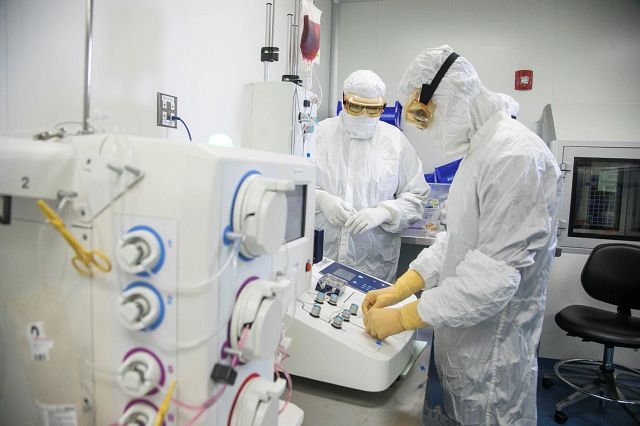

Cell and Gene Therapy Summit Tour | Challenges and Opportunities Commercializing Cell Therapies Panel Discussion
Join expert panelists from Turnstone Biologics, Avenge Bio, and Charles River to gain insights into the challenges and opportunities experienced taking cell therapy products from early phase development through to commercialization.
Discover:
- The importance of starting with the end in mind for GMP readiness and commercialization
- Establishing robust process and analytical development and using phase appropriate, quality starting materials
- The benefits of investing in strong and transparent supplier relationships
- How to minimize manufacturing complexities
- Tips for supply chain simplification
Moderator
Kelley Lancaster
Associate Director MSAT, Cell and Gene Therapy CDMO, Charles River
Panelists
José Manuel (Manny) Otero
Chief Technical Officer, Turnstone Biologics
Manish Jain
Senior Vice President, Technical Operations, Avenge Bio
Sarah Campion
Director, Analytical Development, Cell Therapy CDMO Services, Charles River

New Product Introduction: Harness the Power of Integrated Tech Transfer
Streamline your cell therapy program with a scalable, robust framework incorporating commercial readiness risk management strategies, standardized documentation, and integrated analytics.
De-risk Your Program
-
Transcript
Kelly Lancaster (00:02):
Okay. Hello. Good afternoon ladies and gentlemen. My name's Kelly Lancaster. I'm the associate director for our Manufacturing Science and Technology Team out of Memphis. So, I'm here today with our fabulous panel. This is very much outside of my normal job description, but I'm excited to be here with you guys. And also, to learn wealth of knowledge from our panelists. So our discussion is going to be challenges and opportunities with commercialization of cell therapies. The goal for the next few minutes is going to dive into early-phase development considerations, manufacturing, and regulatory interactions. So, if you would like to go ahead and start off and introduce yourself.Sarah Campion (00:43):
Sure. Sarah Campion. So, I'm the Director of Analytical Services at our Hanover site. I have been with CRL since the acquisition of Cognate two years ago. With Cognate, eight years, seven years prior to that. Prior to the CDMO world, I was in in vitro diagnostics for about 10 or 15 years. And prior to that, I was in biotherapeutics.Manish Jain (01:06):
Hi everyone, my name is Manish Jain. I'm currently heading the Tech Ops organization at Avenge Bio. My background is in CMC development, manufacturing operations, supply chain. Prior to that, I worked at several small, big biotechs previously with the recombinant proteins antibodies, so Amgen, Genocea, Momenta, ImmunoGen.(01:30):
A little bit about Avenge Bio. So, Avenge Bio is an oncology focused startup in Boston area. We are working on our lymphocyte platform, which is to administer precise administration of immuno factor molecules using our leukocyte technology. This is a encapsulated cell therapy. We filed our IND last summer, got approval, and we are in phase one right now. Our primary indication right now is ovarian cancer. So thanks to Charles River for inviting me here, participate in the panel, and I'm looking forward for the discussion.Manny Otero (02:08):
Yeah, likewise. Thank you to Charles River for inviting me. So, I'm Manny Otero. I am a chief technical officer at Turnstone Biologics. I've been with Turnstone for about six years, early days. We are a clinical stage solid tumor oncology company. We're developing a next generation T-cell therapy. Prior to Turnstone I was at Seres Therapeutics, so I was early days at Seres. I was vice president of Bioprocess Development Manufacturing, helped to build that company. It's a human microbiome platform company that is hopefully, going to have a BLA approved very shortly.(02:47):
And then, prior to that I was at Merck Vaccines for 13 years, three years in Merck manufacturing division. I led lifecycle management of the live virus portfolio of vaccines. And then, 10 years in Merck Research labs. I was part of the team that developed Gardasil, which is the human papillomavirus vaccine. So, real pleasure to be here.Kelly Lancaster (03:07):
Thank you guys. All right, let's kick it off. Early phase development. So, what do you see are some of the biggest opportunities for optimization and process and analytical development?Sarah Campion (03:20):
I'll start with that. Or, did you have something? So I'm going to be on the analytic side. I've already heard a lot of what I'm going to talk about be spoken about here. But as the director of the analytical group, some of the biggest things that I deal with are besides having a potency assay. Which everybody wants and it's truly a functionality assay. Are making sure that the methods that come in are robust, they're qualifiable. And most importantly, translatable to the people that are working in a QC environment. That they can one, qualify that assay, and that they can actually perform it in a manner that we can trust the data we're getting out of it.(04:00):
These are very technical assays in many regards. And my challenge is to make them doable in a way that we know that they're going to be performed in a very robust manner. The other concerns that I have in developing assays is the materials that are going in the assays, the availability and the quality of those materials. If I'm always going to have the same antibodies, generally I'll go to suppliers like BD or BioLegend, but am I going to be competing with an antibody that somebody bigger is going to have a better chance of getting with. And are they going to have the quality? Are they going to have the IBDASR quality that I need for the phase appropriateness of that assay?Manish Jain (04:48):
Thanks, Sarah. So I can speak from a process perspective. I think automation and standardization, I think those are the two words probably everybody's sick of hearing. So I will not go that route. I think from a process perspective, what is the biggest need for optimize? In my mind process variability is still the biggest concern as far as I have seen in my span of last five years working on cell therapies. So, whatever you can do to understand your process variability, once you've developed your process, the optimization needs to focus on that.(05:24):
And for that, of course there are several ways to deal with it. If you can, you should look into utilizing patient material in addition to the healthy donor material. To understand your process variability, to design your process space. And then using your in-process testing in addition to the release testing, again, focusing on that to design your process. And then specifications, I mean having phase appropriate specification, that's also important. Because at least in my experience I've seen where we believe that okay, these are appropriate specs and let's go find IND. But the time you start in clinical production, you start to see those issues. So that's one piece, understanding process variability.(06:16):
The second opportunity I see is I think we had a lot of discussion this morning and even the panel before this, is the data analytics. Because you're dealing with complex process, it's typically a month long process or 20 days, 30 days, whatever that is. There are so many variables and there's so much interdependency on your raw material, your starting material. So having some sort of way to analyze your data in a more complex way to parse out those interdependencies. And trying to figure out what your critical parameters are and how they're influencing your process. I think that is a space where I think it's a little untapped and the data analytics... And I'm sure I've heard the word artificial intelligence or maybe we'll ask ChatGPT what the solution is, but that's an area.(07:07):
Then I think there are a couple other things. For example, keeping the end goal in mind. I think that's also we hear keeping them. So for process optimization you have to use a technology that you know that you can scale up. If you are going with something that you're not able to scale up, then you're going to be again stuck with your phase one process. Which may be manual, which may be open, and then you have to either completely change your platform and then that has its own issues of process comparability. And so these are the areas that come to my mind from a process optimization perspective, but I'm sure Manny probably has a lot of other ideas.Manny Otero (07:52):
Yeah, no, I agree with everything you shared and maybe I'll just take the conversation in a slightly different direction. So at Turnstone, same was true at series, but at Turnstone I was hired number 17 at this organization. Charged with building a CMC and tech ops team. So we didn't have in-house development and or manufacturing capabilities and or analytical capabilities.(08:19):
So in addition to all the technical work that was just mentioned, which is prudent and important to think about, I think it's important early on to think about building those relationships with who your external provider network is going to be. And we've always done it a little bit differently. And what I mean by that is broadly speaking, and I'm very non-conventional and blunt, so I apologize in advance. But I don't think we do a good job as an industry in really partnering with contract development, manufacturing and testing organizations. I think we see oftentimes people just see that as a service provider type relationship. And I don't know about you, but I've never seen anyone inspired by a legal agreement or get motivated by reading the scope of work. And yet when you look at teams that have actually developed complex biotherapeutics, it has been through the resilience and grit of individual people committed to a mission.(09:27):
And so I just don't subscribe to this idea that because it's an external organization, that you cannot build that same sense of team and mission and engagement. And I'll turn that into very specifics of what that looks like on the ground. When we engage with our CDMO networks early on and it included Charles River who we're working with now for our T-cell therapy. We don't just go in and say here's what we need and here's what we have. We give the exact same presentation that we would give to our internal employees, to our internal stakeholders. Here's the patients we're trying to serve, here's the challenges we're facing broadly as a company. Here's the finances of the company just to be very blunt on reality of what we need to work with and start to build that relationship. And to me that's super critical because it is not a question of whether things will go wrong, it's a question of how many, how often, how deep and what are the problems. And if you can build that relationship early on, it's going to serve you really well.(10:39):
And some of the Charles River colleagues, they're going to laugh. About two weeks ago I hit the freaking roof with Charles River because we reached a disagreement in how we were going to process something. And I was able very quickly to get the right people in the room to talk it out. And you could tell they were willing to solve that problem, because it was their problem as much as it was our problem. It was a shared problem and we totally got there. There's no way you do that if you don't invest in that early relationship. And a lot of CMC groups, particularly small companies, they just don't do that either. They don't have that experience, they don't have that bandwidth, they don't have that time. Sometimes they don't even feel they're empowered to go say stuff that we only say internally at the company. We hide behind things like confidentiality and whatnot. When in reality it's often very little that we can't share, but it makes such an impact. So I think that's particularly an early stage that will serve you well as you go along that journey.Kelly Lancaster (11:41):
Manny, I really do, I resonate with that. Oftentimes I'm in the position of having to speak to prospective clients and that's one of the biggest questions is that what's the biggest hurdle through tech transfer. And I always refer back just having that solid relationship. We want you to understand our processes, let's make sure we have the time for our processes. But we want to learn your science more than anything. And just give us that benefit of the doubt and share everything that we can. Thank you.(12:07):
So through some of that we touched on some of the most important things are what opportunities we have out of ensuring that we have robust processes. Or we have processes that are trainable and we are taking into consideration phase appropriate specifications. What areas of that do you think we should for certain concentrate on for being [inaudible 00:12:28]? Obviously all of them, but what do you think are the most important?Sarah Campion (12:36):
Actually having your analytics in place perhaps? I see a lot of clients come in not only not knowing their drug product very well, but not knowing what analytics that you've probably heard what they need. Having put the proper attention to those, having the proper materials to put into those. So very often the first time we will start working with an assay, it's with materials that my counterpart is working with the first time in the process side of things.(13:04):
So now if I don't have an assay that's working, is it because we don't have a process that's working or I don't have an assay that's working. I don't want to complain the analytics are always forgotten, but they are kind of the second trial to the big process that makes the drug. The analytics are very important. They are what define the drug you make or they are what characterize it. They are what allow you to do stability studies. So please don't forget about the analytics.Kelly Lancaster (13:31):
It's what gets it out the door.Sarah Campion (13:32):
It is what gets it out the door. It's what lets us know everything about essentially what we're doing. If what we're doing in the process side is right. To that end, it is my job and my team's job to provide very strong, very robust analytics that you can trust in. That you know when we give you an answer, it's going to mean something. That it's going to be transferable down into the QC environment either as an FIO or a release assay. And knowing the proper stage of that assay knowing it needs to stay as an FIO for a while. And making sure that we have the appropriate FIO assays in place and that there's a reason for those assays. For your characteristics of your process and your quality attributes and all of that. And that they have value and that they are treated with the appropriate due respect even though we aren't taking them necessarily the full qualification or validation.(14:26):
And making sure that there's a team around those assays that is going to understand why we do them appropriately. We have the right controls in place. One of our biggest pain points would be referenced controls or assay controls, especially working with an autologous project. How do you have a reference material for something like that? We've talked with a lot of companies that provide non-cellular material and it's an interesting approach to take for controls. Being able to develop something that mimics a cell and at least identity to replace something that is precious. Because we get told we use a lot of materials to release products, so trying to solve those problems.Manish Jain (15:12):
So I can add to that, Kelly, I think from a GMP readiness perspective, I mean a few things come to my mind. But I think the top most is still the same. What I said earlier, is your process consistent, reliable and reproducible? If it's not, then you're not ready for GMP yet. And I think as I said, there are so many variables that can influence your variability. So you need to do your homework and all the development work required to understand that variability.(15:40):
Now related to that is your RU material. We talked a lot about the grade of starting material, grade of raw material and a lot of time organizations tend to use material for various reason. Whether it's came from research or it's speed to clinic or it's cutting down the cost, whatever the reason is. But if you do not do your homework to properly do a risk assessment and ensure the safety of your research grade material. If you're using it in your process, then that can become a clinical hold issue and you can file your IND but then be aware that you may not be able to get to GMP as fast if you have not done your risk assessment for RU.(16:26):
Now, from a procedures' perspective for GMP readiness, I think having the right framework for tech transfer with your CMO, that's where your CMO comes into play. Having a well-defined tech transfer procedure will help to assess whether your GNP ready. And I think, I mean I'll just talk about one specific point. I've been involved in multiple tech transfer over the last few years. And most of the time we were able to meet our timelines leading to engineering run and even filing the IND.(17:02):
But where we got stuck was what comes after engineering run. A lot of time that is the piece that gets missed. It's not part of your project timelines, not part of your project scope. It's the documentation piece that comes after engineering run going into GMP, converting all the documentation to GMP going through aseptic process simulation runs. All of that can actually take quite a bit of time if you have not planned for it. And that's where I've seen quarters getting lost because of that. So as you're thinking of GMP readiness, think about what's beyond engineering runs, what's beyond, after you filed your IND.Sarah Campion (17:46):
It's started thinking about the development phase.Manny Otero (17:49):
Yeah, I was going to add this concept of start with the end in mind, which I really love. I hate this notion that we even have to debate that there's a choice between process development and analytics. In the product class that we are broadly all developing and a part of... That's just nonsense. One cannot exist without the other. And even though I'm a process guy by training, I tell my team all the time, "You live and die by the analytics you have in your toolbox. There's nothing more critical and one does not happen without the other."(18:35):
What I've seen be really helpful is this concept start with the end in mind. So at the end of the day, what do we have to produce as CMC organizations in development companies. We ultimately have to produce a set of documents that serve multiple different purposes, some for regulatory purposes. Others to enable routine manufacturing and then we've got to put a drug in a vial or a bag or some other kind of thing. We've got to make a physical thing that a human being entrusts us to make with a degree of quality.(19:07):
So when I think about analytical development, we try to immediately think about that in the context of an IND in the framework of that regulatory language. And every analytical method we develop we think about in terms of SISPQ. Okay, and that's just one framework for thinking about strength, identity, safety, purity, quality. There's other frameworks out there, we kind of like that one. But if you can, before you even put a pipette in your hand, if you can already start to articulate why are we measuring what we're measuring and what purpose is it serving? And start that dialogue virtually on day one and then bring that along to your contract testing organization team, bring that. I find that solves so many issues as you finally get to the point that you're in method development, you've got an IND cleared, you're about to go... Because then everyone understands why we're doing what we're doing.(20:06):
Too many organizations just throw the kitchen sink at it and see what sticks approach. If I was FDA, it would drive me bananas. I don't think that's the intent of what they're looking for. They're really looking for sponsors to think about carefully why they need to measure the things that they're proposing they need to measure.Manish Jain (20:26):
I think this goes back to the collaboration you need between your research organization and your CMC organizations. From the very beginning, having the end goal in mind, understanding what your product needs to achieve. And then what's the best way to measure it.Kelly Lancaster (20:45):
That's actually a really good segue into the next question that I have. And I'm going to use the why as our first answer to this. So you guys will have to challenge with another answer. But how can we minimize manufacturing complexity for reproducible manufacturing? I do think the why, knowing behind all the way from early on in development as you begin training people, that does make a big difference. But what other things should we consider? Should it be automation, should it be something else?Manish Jain (21:15):
I think automation and close processing. I think that those are the two important aspects of controlling your variability or having a reproducible process. You want to minimize your operator to operator variability. And the best way to minimize that is to introduce automation and having a post process.(21:36):
Other than that, I think understanding which raw materials are critical raw materials and then understanding lot to lot variability that's coming from your raw materials as part of the development. You want to understand that. Especially for the critical regions that are touching your cells and that are interacting with your cells. You need to understand the lot to lot variability of that. So I think those are the couple of aspects that you can control or you can understand to develop your principal process.Manny Otero (22:11):
Yeah, maybe building on that a little bit, trying to have a conversation about recognizing that not all variability is created equally and or you necessarily have to minimize. So take our example, we are developing a patient-specific autologous tail cell therapy product. By definition, the incoming material will be variable. There's no way around it. And by definition certain attributes of that final drug products will also be variable.(22:44):
Getting to an understanding of what variability is acceptable and what variability is not acceptable. And trying to have a prioritized focus of where you want to control as soon as possible, I think will help the team. If you tell the team to just reduce variability, that's challenging. So for example, things like closed system processing, which is a priority that we're working on. One of the variabilities that we don't want to have is any breaks in sterile manufacturing or deviations or issues there. But digging in a little deeper to what variability means and where you want to invest time and resources and control, I think it's important especially for this class of products.Manish Jain (23:32):
And I think this goes back to the data analysis that I was referring to, right?Manny Otero (23:35):
Yeah, that's right.Manish Jain (23:36):
There are just so many variables that it's not an easy task to understand where the variability is coming from. And it's a balance how much time you want to spend understanding each and every variable. Or do you want to just have a good enough process and then continue to improve it as you learn more.Manny Otero (23:55):
Yeah, and this is, I'll come back to this building a relationship with your partners being really important. In our case, when I look at our total supply chain and how many different external organizations touches our manufacturing. We're in the 30 to 40 range unique organizations that have to touch our cell therapy before it can be released and ready for infusion.(24:18):
So now you can imagine something as simple as having a comprehensive database to enable data interrogation. Well, if Charles River loves this PDF format and organization X loves in this Excel sheet. And these guys like to give an email update, this is a nightmare that at some point all has to converge into some form of integrated data analysis. So what we did early on, is we developed worksheets and we essentially push a data capture framework to every partner and said, "Would you be willing to adopt this?" Because what the partner doesn't realize is on our end, we've got automated software that receives all of those forms in standard format. Everything gets dumped into a database with choose your favorite statistical program JMP or otherwise. So that very quickly we can get to that data interrogation piece and in real time.(25:14):
That's the other piece I think CMC folks don't want to do. We don't want to go through 30 lots of manufacture and then look at all the data and realize, "Well shoot, we've been at a trend since lot three on this attribute. But we just couldn't figure that out because we don't have the mechanism of looking at the data." And to me that's really critical. So yeah, data interrogation is huge for us.Manish Jain (25:37):
Data is king.Manny Otero (25:37):
Yeah, right on. Data is kingSarah Campion (25:37):
And that does require early interaction because even at the point where we're developing the methods that are still transferring down to the manufacturing and QC site. If we know that's what you're attempting to do-Manny Otero (25:46):
Right on. Sarah Campion (25:48):
... your data.Manny Otero (25:48):
That's right.Sarah Campion (25:49):
We're more than willing to work with you on that point.Manny Otero (25:51):
Right on.Kelly Lancaster (25:52):
So data analytics, definitely something key to manage effectively the program. Let's talk a little bit about supply chain and logistics. And as you mentioned, critical raw materials and ensuring that that's something that you had your eyes on sooner than later. What else?Manish Jain (26:08):
So supply chain and logistics, that's one of my favorite topic in the CDD space actually, because we spend a lot of time understanding the technology, understanding the science. But if you miss the last leg or the initial leg, then we are completely... I don't want to say the word. I mean just think of shipping logistics. We think that okay, you spend weeks and months to make a drug product lot. It's a very expensive drug product lot. And the last part is a one-day shipping to a clinical site.(26:46):
And if something goes wrong with that part, all of your efforts, all of the work that you've done to date is basically for nothing. So to me, ignoring the shipping and logistics piece is not recommended. Please pay equal attention to shipping and logistics as you are to your science. And create your logistics and supply chain team from early on. That would be my suggestion that even from phase one, as soon as you enter clinic, you need a dedicated... It can be a team of one, team of two. But have dedicated people providing oversight to your supply chain and logistics. Because there's just so much from the raw material supply, moving material in and out, shipping, getting opex, all these things, it requires very close attention. I mean if you go back to traditional biologics and antibodies, how often a CMC team interacted with the clinical operations team?(27:45):
I mean I remember I would give them a drug product lot and then I'll say, "Okay, we'll see you one year later." And we are ready with another drug product lot or we are ready to increase our shelf life. That's when you'll talk to clinic ops team. But here, if you don't talk to them on a daily basis, it's not going to work in your favor. And for that you need few dedicated team members whose complete job is to think logistics, logistics, logistics. Supplying the material to the clinic and making sure that you're not ignoring those aspects. So [inaudible 00:28:22].Kelly Lancaster (28:22):
Yeah, and paying close attention to it early on could even make a decision of what equipment do you go with.Manish Jain (28:29):
Yeah, I mean there's just so much. There's raw materials, there's starting material that is part of the product and then you need to work with your clinical sites. There's a lot of aspects that goes in the supply chain [inaudible 00:28:43].Sarah Campion (28:44):
I would say working early on sole sourced materials, especially in assays, we have a lot of assays that have sole source materials. Either in the cells that we're using for them or the reagents we're using and making sure you can get those quality agreements in place. And the vendor quality agreements with those companies early on so that you don't develop an assay. It ends up in QC and oh by the way, you can't actually use that.Manish Jain (29:09):
Yeah, I mean a lot of time when we talk about supply chain of raw materials, we again tend to focus more on process and we forget about the agents required.Sarah Campion (29:18):
But they tend to be a little more specific and it's a little more unique.Manish Jain (29:22):
Yeah, and you equally need to pay attention to the analytical of the agents required for testing.Sarah Campion (29:26):
We don't want to ask the question once it's down in the manufacturing site. Do we start qualifying that vendor then and we find out that that vendor isn't capable of supplying the quality of material consistently that we need.Manish Jain (29:42):
I mean for me we need two bit of materials, one bit of material for manufacturing-Sarah Campion (29:44):
Analytics.Manish Jain (29:44):
... another bit of material for analytical.Sarah Campion (29:47):
And then making sure you have the analytics on board for your raw material qualifications as well. Ones that are important to your product.Kelly Lancaster (29:55):
Okay. Let's move on to regulatory. And just to make sure we have any time for some questions from the audience. So how accepting do you think regulators have been for phase appropriate development?Manny Otero (30:09):
Yeah, I'll take that. I'll take two examples. So when I was at Seres Therapeutics, this was a brand new space, human microbiome therapeutics. No one was really doing that in any meaningful way. And we put what I consider to be one of the very first clinical studies in the US looking at this novel modality. And we had a really thoughtful purposeful interaction with FDA that came in the form of pre IND meetings, subsequent follow interactions discussions. And there was a comment made earlier today in one of the sessions. That FDA very much I think wants to go on that learning journey with you as a sponsor, especially in this early environment. And what I found, which a lot of companies still to this day have trouble with, if you share more than less, provide more data than less and bring them into that conversation. I have found it to actually be super productive. The same were true, I'll bring them back to what we're doing right now in cell therapy.(31:16):
And actually a comment just related to our past discussion, I think the pre IND meeting is one of the most critical regulatory tools we have at our disposal as an industry. And we don't always leverage that to its full potential, especially in the CMC arena. Especially when we think about things like supply chain for critical raw materials.(31:38):
In one of our regulatory interactions, we have a very specific antibody that we use in our manufacturing process and we actually got regulatory feedback that the criteria around the testing for the antibody was not sufficient. And we had to do a bunch of work and we were able to get in front of all of that prior to commencing manufacturing. If we had not gone through that, waited until the IND, et cetera, et cetera, that outcome probably would've looked very different than what it does. So I'm a huge proponent of CMC organizations absolutely leveraging every inch of value in a pre IND meeting as much as possible.Kelly Lancaster (32:21):
And also sharing any of those findings with the CMO is very helpful. Sometimes quite rare that we do get to see a lot of that information.Manny Otero (32:27):
Yeah, and this is a-Kelly Lancaster (32:30):
Can be very helpful.Manny Otero (32:30):
Thank you for saying that. And I'll say this, this is another myth out there in the biopharma industry. We have actually sent the FDA minutes verbatim to our contract manufacturing and testing partners. Most people will tell you super hyper confidential cannot disclose [inaudible 00:32:46]. Again, I put that-Kelly Lancaster (32:48):
That's a major gap assessment.Manny Otero (32:49):
Yeah, I put that in the nonsense category. No one has yet to tell me what the real risk is there. But I have found it to be such an enabler for our partners, because oftentimes they have... One of the cool thing about partners is that if they're a multi-client, multi-product facility, they've seen some stuff. And they've seen some stuff that you probably don't know about. So when they see a challenge or feedback, it's amazing how many times they actually come up with a solution. Because they've had to come up with that solution previously in another setting and you get to benefit from that experience.Speaker 7 (33:21):
Absolutely. Okay. Open it up for any questions from you. Have you also discussed those optimization, those selection of cell therapy with FDA?Manny Otero (33:37):
Yeah, so I'll speak for ours. So in the two examples that I shared today, so from a human microbiome perspective, as you can imagine, the product is a collection of bacteria. Normally isolated from healthy human microbiomes. So you spend a large amount of your discussion around which strains and why, et cetera. In the case of cell therapy, because the starting material is in fact T-cells from the patient, you discuss it in that context. But it's a little different I suppose if you're in an AVA platform and you've got production cell lines, et cetera. So maybe I'll let others speak to that.Manish Jain (34:17):
Yeah, I mean I think you mentioned about pre IND leveraging your pre ID, so those kind of questions from a CMC perspective are relevant to ask during pre IND package when you're [inaudible 00:34:29]. And we recently did one and we had a dosing related query from a CMC perspective, and we got the feedback that we were looking for from the agency.Speaker 7 (34:43):
Selecting the starting for cell engine therapy. CAR T-cell therapy is quite a bit confusing to select sign dose and maximum dose. So I was wondering if you had any experience about that to set up cell dose in clinical trial and having discussion with that.Manish Jain (35:07):
I think I can only speak from specification perspective when you don't know the limits of your dosing and don't know the capabilities of your process, then having a specification that allows you to explore with a minimum bar. That's what we have tried and have been successful in the past. But if there are other safety considerations that you need to take, then I think, again, I'll go back to the asking those questions during pre IND.Manny Otero (35:39):
Yeah, maybe just building on that, I've not worked in a CAR T space but have worked in a space where just general considerations around dosing and how do you think about dosing. I think this is an example where CMC does not live in a vacuum. So the three pillars of any IND is a nonclinical section and then a clinical section. And so often cases you may have a certain strategy within cell dosing where if you're trying to mitigate a potential safety risk, you can mitigate that from a CMC perspective, you can mitigate that in your clinical trial design. You may have some preclinical data that you can generate that helps inform that risk.(36:15):
I think keeping that very integrated view of that entire drug development landscape, is really important. Because there's often more than one way to solve a particular problem or risk. It's not always just CMC. I've solved a lot of CMC issues by actually modifying the clinical protocol. And that's where having that bridge to your clinical team and that partnership is really, really critical.Speaker 8 (36:44):
Okay. [inaudible 00:36:45] excuse me. Once it's finished, please join the main room. Thank you.Kelly Lancaster (36:54):
All right. Well, I do believe we made it to cocktail hour. Sarah, Manish, Manny, thank you so very much for being with us.Manny Otero (36:58):
Thank you. Great, thank you.