
Cell & Gene Therapy
|
Nancy Andon, MSc
How Are Stem Cells Mobilized?
The mobilization of hematopoietic stem and progenitor cells (HSPCs) to the peripheral blood is an essential process enabling the collection of these cells from an easily accessible source. The use of peripheral blood as a source of stem cells has significantly improved donor safety, since it does not require a surgical procedure for cell collection, and it is associated with a significantly accelerated reconstitution of the immune system in transplant patients.
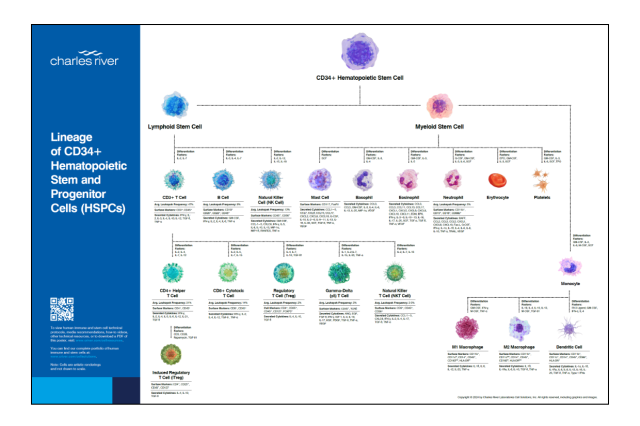
Lineage of CD34+ Hematopoietic Stem and Progenitor Cells (HSPCs)
Receive a complimentary poster to access information on immune cell markers, differentiation factors, cytokines, technical protocols, media recommendations, how-to videos, and more.
Stem cells are primarily found in the bone marrow, but can be recruited into the peripheral blood circulation through the use of chemical factors that disrupt the retention of these cells in the bone marrow. This mobilization process mimics natural physiological mechanisms whereby stem and progenitor cells are released to the bloodstream in response to tissue damage. The design and optimization of mobilization methods necessitate an understanding of how standard mobilization drugs were developed and in which instances they are typically used. [1]
CXCR4 is a chemokine receptor transiently expressed on the surface of HSPCs, which acts as an important tether protein to hold stem cells in the bone marrow. Stromal cell-derived factor 1 (SDF-1) is a ligand for CXCR4 expressed on bone marrow stromal cells. The interaction of these two molecules promotes retention of HPSCs in the bone marrow. Disrupting the CXCR4-SDF-1 interaction helps promote the release of HSPCs to the circulation.
Granulocyte colony-stimulating factor (G-CSF, or Neupogen®) downregulates the expression of SDF-1 on stromal cells and also causes accumulation of neutrophil proteases that cleave CXCR4 in the bone marrow compartment. Back in the late 1980s, clinical studies showed that G-CSF not only stimulated the proliferation of early hematopoietic cells but also mobilized these precursor cells into the peripheral bloodstream. This function has been exploited since that time for the collection of stem cells for research and medical procedures.
Plerixafor (Mozobil®) is another drug used to stimulate the migration (mobilization) of HSPCs from the bone marrow. It is an antagonist for CXCR4, which was serendipitously discovered during the search for anti-HIV agents in the early 1990s. Plerixafor disrupts the CXCR4-SDF-1 interaction by blocking the CXCR4 receptor, thereby promoting the release of HPSCs into the bloodstream.
Studies show that G-CSF and plerixafor may affect different populations of HSPCs in the bone marrow at different developmental stages. [2,3] In situations where G-CSF stimulation results in inadequate mobilization, plerixafor can be given to “rescue” mobilization. This results in HPSC yields similar to those in an average G-CSF mobilization, but does result in an increased content of more primitive stem cell subtypes. Since it was discovered that mobilization of HSPCs into peripheral blood occurs more rapidly with the use of both drugs in combined treatment, stem cell donors may also be given G-CSF and plerixafor in tandem from the outset.
As is nearly always the case in research, there is an ongoing effort to identify new agents or combinations that will lead to the most effective and efficient stem cell mobilization strategies. We are committed to bringing our customers the most up-to-date and effective products to fit their research. Download our whitepaper or view our webinar to learn more about mobilized CD34+ stem cells.
References
Hopman R.K., and DiPersio J.F. Advances in Stem Cell Mobilization. Blood Rev. Jan; 28(1): 31–40. 2014.
Fruehuaf, S, et al., A Combination of Granulocyte-Colony-Stimulating Factor (G-CSF) and Plerixafor Mobilizes More Primitive Peripheral Blood Progenitor Cells than G-CSF Alone: Results of a European Phase II Study. Cytotherapy. 11(8):992-1001. 2009.
Girbl T., et al. The CXCR4 and adhesion molecule expression of CD34+ hematopoietic cells mobilized by “on-demand” addition of plerixafor to granulocyte–colony-stimulating factor. Transplantation and Cellular Engineering. 54: 2325-2335. 2014.