

Cell & Gene Therapy
|
Anne Lodge, PhD
Immunology for Non-Immunologists: T Cell Antigen Recognition
This blog series, Immunology for Non-Immunologists, will focus on key concepts to help scientists and researchers without extensive immunology backgrounds understand the functions and use cases for Charles River Laboratories' immune cell products.
This post focuses on the T cell antigen recognition process.

Human Immune and Stem Cells Product Catalog
Charles River is a trusted provider of research-use and GMP-compliant human immune cells and stem cells for advanced therapies and basic research. Our portfolio also includes disease state biospecimens for disease-focused research.
Download Catalog
How T Cells Recognize Antigens
Breaking Down the Process
You probably already know the basic premise of the immune response to foreign bodies: Antigens enter the body, triggering the immune response and release of antibodies, which bind to specific antigens by interacting with their three-dimensional surface.
T cells also play an important role in adaptive immunity, but unlike antibodies, T cells cannot bind directly to antigens. So what do T cells recognize?
T cells have dual specificity, so they recognize both self-major histocompatibility complex molecules (MHC I or MHC II) and peptide antigens displayed by those MHC molecules. The receptors on these T cells recognize a linear, two-dimensional peptide sequence (between 8 to 12 amino acids in length) from the antigen bound to the MHC molecules expressed on the surface of the antigen-presenting cells.
So the T cell receptor actually recognizes this combination of the MHC molecule and the peptide. Once bound to the MHC molecule, the T cell can begin its role in the immune response.
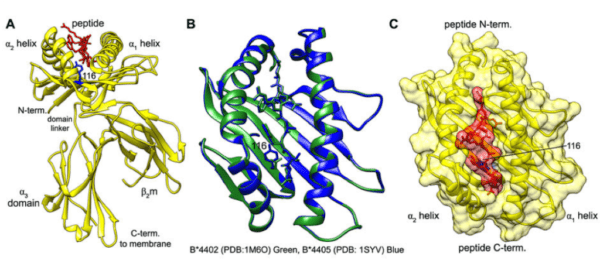
Bailey, A. et al. Selector function of MHC I molecules is determined by protein plasticity. Sci. Rep. 5, 14928; doi: 10.1038/srep14928 (2015).
Disrupting the Reception
If anything in this process changes, such as a change of the MHC molecule or change in the amino acid in the peptide antigen, the T cell receptor may fail to recognize the antigen, which can compromise the immune response. The T cell receptor tolerates some changes, so recognition can be successful. Other changes are not tolerated and disrupt the recognition process or alter the activation.
For example, our HPV-specific T cells recognize a peptide from the E7 protein of the human papillomavirus (HPV). The sequence is YMLDLQPETT. If the sequence is short one amino acid to YMLDLQPET, the T cells do not recognize it.
On the other hand, we generated our MBP-specific T cells by stimulating PBMC with the sequence ENPVVHFFKNIVTPRTP from myelin basic protein (MBP). They also recognize an overlapping sequence of FFKNIVTPRTPPPSQGK. Given their ability to recognize both of these sequences, the amino acids ENPVVH are not needed nor is the PPSQGK on the carboxy end. The core sequence recognized is within FFKNIVTPRTP.
Utility of Antigen-Specific T Cells (ASTCs)
This webinar highlights the usage of antigen-specific T cells when developing immunomodulatory therapeutics to a wide range of diseases caused by viruses, bacteria, tumor cells, and autoimmunity.
Watch On Demand
What This Means for Your Research
Antigen-specific T cells are vital to the study of immunological and inflammatory responses to bacteria, viruses, cancers, and other pathogens. Understanding the basic function of the T cell recognition process will help you design and execute more fruitful experiments.
We have T cells that recognize peptide antigens from CMV, HPV, influenza, tetanus toxoid, and myelin basic protein, and we’re developing others as well. We can also source custom T cells specific to your antigen of interest.