Discovery
|
Liz Hudson
Revolutionizing Lipid Nanoparticle Analysis with Machine Learning
A discussion with cryo-EM expert Karl Bertram on how to apply machine learning to LNP analysis
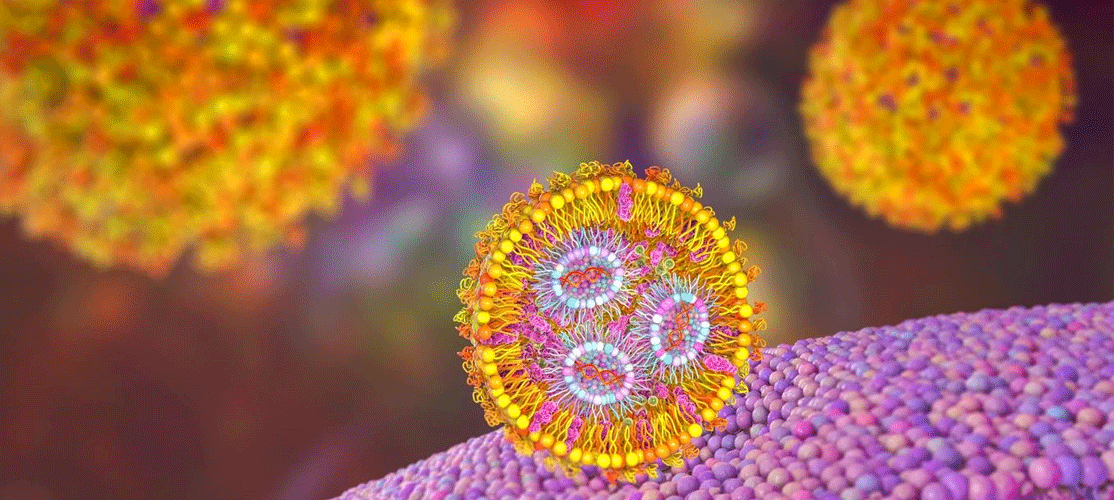
The potential of lipid nanoparticles (LNP) as a reliable mRNA delivery vehicle has become evident since the rapid and successful development of the Pfizer-BioNTech and Moderna COVID-19 vaccines, both of which are vector vaccines utilizing specifically designed LNPs to deliver virus specific mRNA and trigger an immune response against the encoded spike protein.
During the development and production of this kind of therapeutic, LNPs require extensive analysis to assess the functional relationship between critical quality attributes (CQAs), such as size, particle size distribution, shape, aspect ratio, morphology, aggregation and agglomeration, and critical mRNA payload characteristics.
Typically, LNP particle assessment can be challenging, with either highly qualitative results, through manual analysis of conservatively sized sample populations as with traditional electron microscopy approaches or based on average readouts across an aggregated particle population, as with non-image-based methods such as Dynamic Light Scattering. ATEM Structural Discovery (ATEM) has pioneered the application of artificial intelligence (AI) to address these limitations using cryogenic electron microscopy (cryo-EM), solving the low signal-to-noise ratio of cryo-EM data which has traditionally made the application of automation in this setting unviable. By rapidly analyzing thousands of particle cohorts with per-particle precision, the neural network developed by ATEM enables the production of quantitative data based on statistically relevant sample sizes.
“AI-based software and machine learning technology to analyze image data is found in countless modern applications,” explains Karl Bertram, Co-Founder and Managing Director at ATEM. “If you think about self-driving cars, facial recognition or Snapchat filters, the underlying challenges in pattern recognition are often comparable to the hurdles we encountered when designing our neural network.”
What are the intricacies of analyzing LNP particles?
RNA-loaded lipid nanoparticles have numerous characteristics which contribute to their suitability, effectiveness and efficacy. To produce a functional drug, particles should fall within an ideal size range and display desirable morphology. The strength of using a visual, single particle characterization method like cryo-EM is that many important critical quality parameters can be obtained in a single assay. Carefully trained neural networks are then able to analyze the resulting datasets and to make profiling decisions for particles, including particles which display previously unseen morphological characteristics.
“If you want to analyze LNP micrographs,” Karl explains, “you need to evaluate morphological features like shapes, diameters and other diverse, sometimes never seen before morphological patterns. For example, some particles show a biphasic nature and protrusions, which we call ‘blebs’, and some particles display arrays of characteristic membranes or other structurally distinct phase separation(s). While analyzing these images, reproducible classification decisions need to be made on the basis of individual features for each and every particle.”
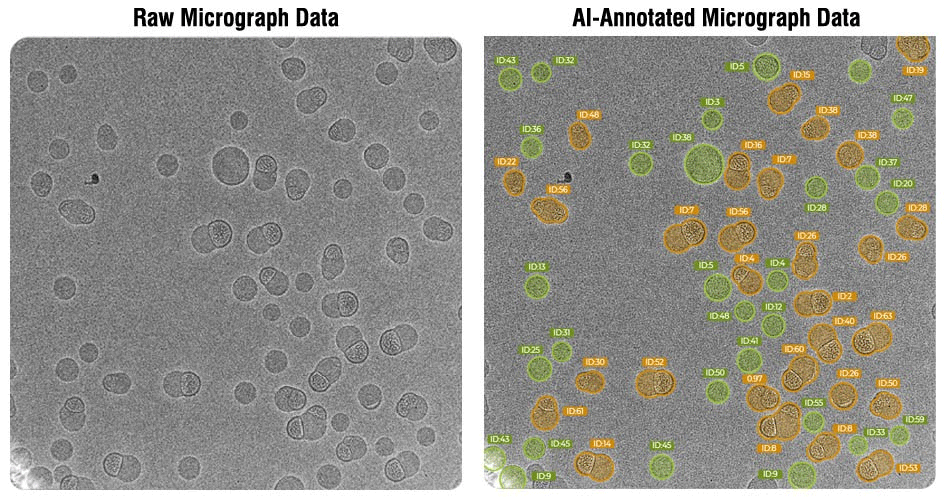
Left: Raw micrograph data showing LNP particles revealed via cryo-electron microscopy (cryo-EM). In this example, cryo-EM was used to produce images of an mRNA-laden LNP sample. Right: Automatically annotated particles highlighted according to morphological class, with green denoting solid core particles, orange for biphasic dense particles, and yellow for biphasic split particles (none seen in this micrograph).
Traditionally a manual process, ATEM’s unique approach to analyzing cryo-EM data subverts the margin for human error during annotation. “If you sit a human down in front of a screen to do focused work like this over the course of hours, that human operator is going to get tired. The opportunity for error or declining accuracy increases. With AI, the neural network doesn’t get tired, it just continues to produce data at a determined degree of quality,” Karl explains.
How do you train an AI to perform intuitive and reliable particle analysis?
The machine learning model is trained by feeding in carefully curated data, or learning materials, exactly as you would learn as a human being. This training material is produced by having an operator manually annotate a high volume of sample data, and these annotations are then used to teach the model how to identify and define important characteristics like morphologies, particle boundaries, and so on. The model then iteratively applies this knowledge to unannotated novel data and is nurtured until it is ‘qualified’ to do the job. In this way, the model can both recognize shapes it already knows and make logical decisions about particles displaying unique shapes, emulating the decision-making undertaken by human operators.
“Amazingly, the model is able to learn intuitively in ways we don’t fully understand yet,” adds Karl. “For example, we trained our model with biphasic particles that displayed just one bleb, and the resulting neural network was adaptive enough to also find and correctly classify particles with two or more blebs as biphasic particles, even though these particles were never “seen” by the model during the training period.”
Where a technology can effectively undertake leaps of logic, it is important to understand how quality control is applied, and the checks and balances put in place to ensure particle analysis and classification remain within expected parameters, and data production remains reliable.
“Extensive validation studies are needed,” Karl clarifies. “We don’t run a model which is continuously adapting and learning. Once the model has been fed training material, the neural network then undergoes rigorous testing. Once all tests are passed, we freeze the learning capabilities of the model, ensuring that it behaves in predictable in a way that has been previously validated. During routine operations, we also conduct additional spot checks on every analysis result to ensure trustworthy results. We aim to achieve greater than 95% accuracy. In practice, we are typically achieving more than 98%.”
How can better statistical relevance impact the development of LNPs?
Traditionally, cryo-EM-based LNP analysis was performed by acquiring several micrograph images from one sample and then manually analyzing each micrograph by hand. This technique typically visualizes a relatively small number of particles per image. “With a manual process, you possibly manage to analyze a hundred particles,” explains Karl, “draw a circle around each particle and measure the diameter. The drawback of this kind of manual, small scale analysis is that you do not have the necessary statistical sampling to obtain representative results, and you are likely to generate imprecise data with a large margin of statistical error. Particle analysis by AI is the only method which can provide the required level of accuracy to automatically analyze sufficiently large sets of image data to reach the desired statistical depth and significance.
“The time saving offered by automation is tremendous,” Karl continues. “We estimate that a qualified human could properly annotate 50-100 particles from micrographs with an acceptable degree of accuracy in about half an hour. A machine learning model can do that with an exceptionally high degree of accuracy in a split second.”
In this way, ATEM have evolved cryo-EM-based LNP characterization from a purely, qualitative assay, to a quantitative method that produces statistically relevant data with an impactful level of accuracy. Researchers can confidently work with these results, either during the discovery optimization phase, or later down the line at the manufacturing, quality control and release testing stages where it’s important that every batch of drug product is homogeneous, with the same biophysical properties and a reproduceable, well-defined structure-function relationship.
Interest in mRNA research and subsequent demand for analytical applications is rising steeply, with more and more programs entering discovery and development, following the successful demonstration by the COVID-19 vaccines and other novel LNP-based drugs that this kind of therapeutic and delivery vehicle can be efficacious and safe.
The industry is constantly looking for viable new vectors to deliver drug substances or genetic information into the human body. By maintaining precision over the analysis of thousands of particles, which is potentially weeks of manual annotation, and accomplishing this task within minutes, the application of AI to LNP analysis can drive viability and support impactful, rational research decisions that contribute to successful development.
Learn more about the ATEM LP solution
Recommended content suggestions:
- Cryogenic Electron Microscopy (cryo-EM)
- Advanced mRNA LNP Characterization by Machine Learning-Assisted cryo-EM (Poster)
- Explore the Latest Innovations in Structure-based Drug Design (Webinar)
Karl Bertram holds a PhD in biochemistry and structural biology and has an extensive scientific background in advanced cryo-EM technology. Karl obtained his PhD at the Max Planck Institute for Biophysical Chemistry in Göttingen, Germany, where he significantly contributed towards solving the first high-resolution 3D structures of the human spliceosome. During his earlier academic career, he obtained a Master of Science degree in Biochemistry from the Ludwig Maximilian University (LMU) Munich and spent time for a research visit at the Rockefeller University in New York City.
Liz Hudson is Senior Marketing Manager at Charles River Laboratories, Discovery.