
Validation of Viral Inactivation
The risk of viral contamination is common to all biologics when production involves either animal or human materials. Validating the process of viral inactivation testing is essential to establish the safety of biological products, especially when there is a high potential for source material to be contaminated. In many instances the contamination has occurred with agents whose presence was not known or suspected, so a thorough evaluation and viral testing procedure is necessary.
The FDA’s latest guidance documented in Medical Devices Containing Materials Derived from Animal Sources (March 2019) provide requirements for viral clearance studies. Viral inactivation testing data is usually determined by comparing an estimate of the amount of virus in the unprocessed source material with the amount of virus inactivation provided by manufacturing and sterilization processes. As suggested in the FDA guidance, a review should be performed to estimate the amount of virus in the unprocessed source material and to optimize the design of the viral inactivation testing study.
These types of studies are generally performed using a scaled-down version of specific production and sterilization steps with appropriate model viruses. The model viruses used in these types of studies should reflect the actual viral contaminants that may be present in the source animal tissue (e.g., DNA-based and RNA-based, enveloped and non-enveloped viruses).
For over 20 years, we’ve conducted viral clearance studies for medical devices leading clients through the risk assessment, planning, and execution of such viral inactivation testing studies. We support clients by preparing study concepts that will be discussed with regulatory agencies and ensuring acceptance prior to a study’s execution.
Our sites in Wayne, PA and Cologne, Germany can accommodate viral clearance studies for medical devices.
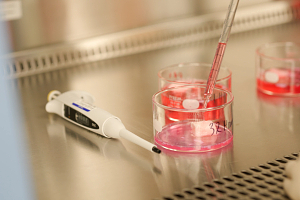
Optimizing Viral Clearance Studies for Medical Devices: Challenges, Expectations, Examples
In this webinar, our experts provide key strategies you can apply to your own medical device viral clearance program, including study guidelines, the types of materials and model viruses used, and methods for performing viral clearance testing on solid materials.
Watch the Webinar
Viral Clearance for Medical Devices
In viral clearance studies, the virus is spiked into the starting material of the downscaled process step under investigation and samples are collected at the beginning, during, and end of the process. The samples are analyzed quantitatively for viral content using cell-based infectivity assays.
There are two questions specific to conducting viral clearance studies for medical devices:
- How can a solid material (e.g., tissue, powder, suspension of solid particles) be spiked to mimic potential contamination conditions?
- How can a sample be collected from solid material during or after treatment?
The spiking process should ensure homogenous distribution of the virus on the starting material. You should be sure the virus penetrates solid material in a way which best reflects a potential and worst-case contamination of the source material.
In cell-based assays, only liquids can be analyzed; therefore, any residual virus left on solid material after treatment must be quantitatively extracted from the material into an extraction solution. As the materials can be different before and after treatment (e.g., de-mineralization of bone material), the extraction process before and after treatment can also be different.
These two specific challenges require project-specific solutions, which should first be addressed in a feasibility study. This is done to ensure the main study goes smoothly without any unexpected findings and deviations and will be accepted by regulatory agencies.

Reducing Viral Clearance Challenges
Designing a viral clearance study is not always straightforward. Get insider tips to ensure VC success and patient safety.
Watch Webinar
Setup of Viral Clearance Study for Medical Devices
-
Establish Downscale Model of the Process Steps to be Analyzed
- This is frequently done by the researcher, but can be delegated to our team for assistance
-
Set Up Experimental Design (non-GLP/GMP) for Feasibility Study
- Establish the spiking process
- Identify the best virus extraction process from processed material
- Incorporate recovery assays to ensure a minimal dynamic range of reduction can be demonstrated (≥ 4 log10)
- Add potential quench assays
- Add cytotoxicity and interference assays
- Consider inactivation potential if unclear (optional)
-
Run Quality-Assured Main Study (GLP/GMP)
- Conducting a second run of some pre-tests under quality-assured conditions (cytotoxicity, interference, and recovery assays at a minimum)
- Evaluate spiking, process performance, and sampling as specified in the feasibility study (typically performed in duplicate runs)
Frequently Asked Questions (FAQs) about Medical Device Viral Inactivation Studies
-
How long does a viral clearance study for medical devices usually take?
A typical quality assured viral clearance study for medical devices can take anywhere from 10-14 weeks depending on the nature of the device, the number of process steps, and the number of viruses that need to be analyzed.
-
What is the total log10 reduction per virus typically requested by regulators?
This depends on the risk assessment, which is a crucial part for defining the extent of a viral clearance study. Ideally, one can define a maximal viral load in viruses of risk within the starting material. In this case, a minimal overall reduction can be calculated. However, this is frequently not possible or difficult to define. Having two steps which provide cumulatively ≥ 6-8 log10 reduction for the analyzed viruses is frequently regarded as sufficient, but it is frequently difficult to achieve.
This is always product specific and should be discussed with our experts. The results of viral inactivation studies should always demonstrate that the sum of the log reduction in the virus of select processing steps and sterilization process(es) is within the acceptable limits to produce a safe product.