

GI Partners Acquires CDMO and Cell Solutions
As Rose BioSolutions, the established CDMO and Cell Solutions businesses continue to support the biotechnology ecosystem with cell sourcing capabilities and CDMO services to accelerate your advanced therapy from development to delivery.
Learn More
Lentivirus Packaging Services
Below is a list of the lentivirus packaging services that we provide. We are also happy to customize your order, but please be aware that the prices and delivery times will vary based on the complexity of the order.
| Lentivirus Packaging Services | Standard Timeline | |
|---|---|---|
| Purified (for in vitro or in vivo) | Small-scale lentivirus packaging | Please inquire for estimated timeline |
| Large-scale lentivirus packaging | ||
| Preclinical lentivirus packaging | ||
| Clinical-grade | CGMP lentivirus production | Please see our Lentivirus CGMP Production page |
Quality Control
Infectious titer is by transduction assay. We offer additional testing such as physical titer, ELISA p-24. Contact us to learn more.
Custom Lentivirus Vector Design
Charles River offers a broad range of custom lentivirus cloning services at a reasonable cost and with a quick turnaround time. Our highly experienced scientists are ready to tackle difficult cloning projects, including large or toxic clones or clones with high GC content or highly repetitive sequences. Please contact us with your project details and our team will get in touch as soon as possible with an estimated price and projected turnaround time. You can also visit our Molecular Cloning page for more information.
Recombinant Lentivirus Packaging
Recombinant lentiviruses are derived from HIV-1, so certain precautions must be taken to ensure its safe use in gene delivery. The biggest concern is the possibility of generating replication-competent lentivirus through crossover events between elements in the viral vector and the packaging cell line. To improve safety, viral accessory genes are deleted and essential genes are supplied in trans by the packaging and envelope plasmids. To produce lentivirus particles, the transfer plasmid containing the gene of interest (GOI), the envelope plasmid, and the packaging plasmid are co-transfected into the packaging cell line (usually HEK293T cells).
For our lentivirus packaging services, the lentivirus particles are purified using sucrose gradient to ensure safe use in vivo. Viral titer is then determined using RT-qPCR with primers to the long-inverted terminal repeats (LTRs) present in the viral genome.
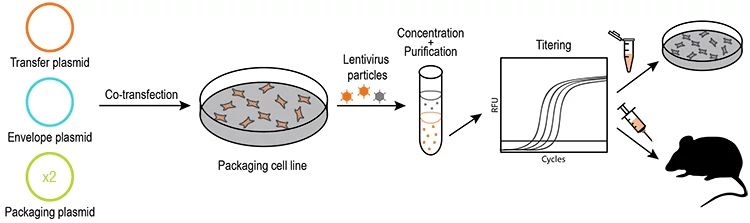
Note: By default, our Lentivirus Packaging services use 2nd generation lentiviral plasmids.
Related Products
In addition to our lentivirus packaging services, we also offer catalog viral vector products, including control viruses and ORFs. Learn more about lentivirus products.
Frequently Asked Questions (FAQs) for Lentivirus Packaging
-
Why choose lentivirus?
Lentiviruses are a subgroup of retroviruses: viruses that use viral reverse transcriptase to produce DNA from their RNA genomes before integrating into the host genome. Unlike other retroviruses, lentiviruses have the ability to infect both dividing and non-dividing cells. To increase safety, the components for virus replication are divided across multiple plasmids during recombinant lentivirus production. Lentivirus is a particularly useful tool for generating stable cell lines expressing your sequence of interest or for gene therapy applications such as CAR-T.
Advantages of using lentivirus:
- Very efficient gene delivery tool
- Integrates into host genome
- Infects both dividing and non-dividing cells
- Large packaging capacity (~9 kb)
- Can be used to make stable cell lines
Comparison to Other VirusesCharacteristic AAV* Adenovirus Lentivirus Genome 4.8 kb (ssDNA) 36 kb (dsDNA) 9 kb (ssRNA) Packaging capacity 4.7 kb 7.5 kb 9 kb Infection Most dividing and non-dividing cells Most dividing and non-dividing cells Most dividing and non-dividing cells Transduction efficiency Moderate High Moderate Integration Non-integrating Non-integrating Integrating Expression Transient or stable Transient Stable Immunogenicity Very low High Low Biosafety BSL-1 BSL-2 BSL-2 *NOTE: Please see our AAV Packaging page for more information.
-
How much plasmid do I need to provide for lentivirus packaging?
If you will be ordering a clone you want packaged, please provide us with the RefSeq number. If you will be sending us a plasmid, please refer to the table below. When possible, we recommend sending DNA obtained from a maxiprep. If you do not have the recommended amount of plasmid for lentivirus packaging, we can prepare endotoxin-free DNA from your sample for an additional fee.
Lentivirus services Amount of plasmid to send Cloning 5-10 µg at conc. of >1 µg/µL Transformation (DNA preps) >10 µg Small-scale lentivirus packaging
Titer: 1×10⁷ IFU/mL
Large-scale lentivirus packaging
Titer: 108 IFU/mL>150 µg at 1 µg/µL or higher
>200 µg at 1 µg/µL or higher -
What is the biosafety level of recombinant lentivirus?
Since lentivirus can infect human cells, precautions should be strictly followed. Recombinant lentiviruses are considered to be at Biosafety level 2 (BSL2). Safety considerations have been implemented when engineering recombinant lentiviral vectors as gene delivery tools. One major safety strategy is splitting the viral essential genes and LTR containing lentiviral transfer vector into separate plasmids. The gene of interest (GOI) that is going to be delivered into cells is provided on a separate plasmid, called lentiviral transfer vector, which is flanked by the long terminal repeats (LTRs). The lentiviral transfer vector containing the GOI and LTRs will be packaged into the lentiviral particles, but the lentiviral packaging plasmids containing the viral essential genes will not be packaged due to lack of the packaging signal and LTRs. Our lentiviral vectors are third generation vector, which is even safer. 5’ LTR is hybrid and the 3’ SIN (self inactivating) LTR does not support lentiviral replication after integrating into the host genome, which makes it to be replication deficient.