
HuCD34+ NCG Mouse Details
The HuCD34+ NCG mouse is produced by engrafting human hematopoietic stem cells (HSCs) into the NCG model. NCG mice are irradiated and intravenously injected with hCD34+ HSCs, which differentiate into a variety of hCD45+ white blood cells (WBCs), including T cells and B cells. The mice are engrafted regularly and available on demand 14 – 16 weeks after engraftment.
This model is an ideal in vivo platform with a long survival period and stable reconstitution of immune cells. It can be used in longer-term in vivo studies to test drug efficacy.
Characteristics of the model include:
- Stable engraftment of human WBCs
- Long-term studies
- Multi-lineage engraftment
- Display robust T cell population
NCG Mouse Origin
The NCG mouse was co-developed by Nanjing Biomedical Research Institute of Nanjing University and Nanjing Galaxy Biopharma in 2014 and transferred to Charles River in 2016. This model was created by sequential CRISPR/Cas9* editing of the Prkdc and Il2rg loci in the NOD/Nju mouse, generating a mouse coisogenic to the NOD/Nju.
The NOD/Nju carries a mutation in the Sirpa (SIRP α) gene that allows for the engraftment of foreign hematopoietic stem cells. The Prkdc knockout generates a SCID-like phenotype, lacking proper T cell and B cell formation. The knockout of the Il2rg gene further exacerbates the SCID-like phenotype while additionally resulting in a decrease of NK cell production.
*CRISPR/CAS9 is used under licenses to granted and pending US and international patents from The Broad Institute and ERS Genomics Limited.
Not available
LOCATION: Wilmington
UNIT: W8H/W08
Download the Report
➤ DOWNLOAD OUR CATALOG for instant access to Standard List Pricing
➤ TALK TO US to discuss organization or volume-based discounts
Already have an eCommerce portal account?* Login to order research models, obtain quotes, view organization-specific pricing, and see inventory. Processing time required to validate new eCommerce access requests.
*eCommerce is available in US, Canada, UK, France, Germany, Austria, Netherlands, Denmark, Finland, Norway, Sweden, Spain, Portugal, Belgium, Luxembourg, and Switzerland
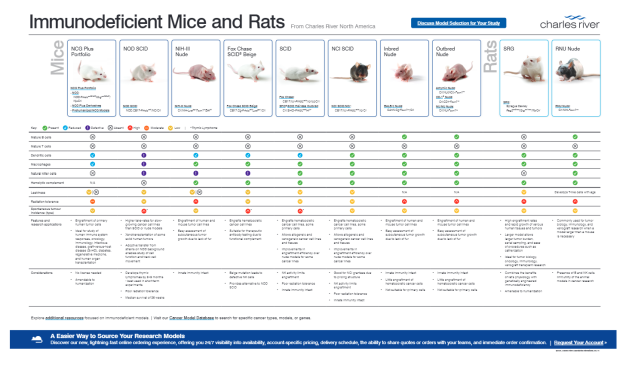
Immunodeficient Models Poster
This poster lists the major phenotypes of Charles River's immunodeficient mice and rats. It includes information on model features, degree of immunodeficiency, and gene functions.
Resources
- Product Sheet
-
Posters
- Assessment of sensitivity to a PD-1 check point inhibitor and cisplatin in bladder cancer patient-derived xenografts with various levels of PD-L1 expression in HuCD34 NCG mice
- Enhanced immune responses in human breast and colon cancer following checkpoint therapy in a CD34+ stem cell humanized NCG (HuCD34+ NCG) mouse model
- Evaluation of in vivo anti-tumor response of solid tumors in a novel immune cell humanized NOD-Prkdcem26Cd52Il2rgem26Cd22/NjuCrl mouse model
- The single mouse trial format predicts the sensitivity towards checkpoint
- NCG/CRL as a novel (Charles River) humanized mouse model for pre-clinical oncology studies: immunophenotypic characterization and performance monitoring
-
Genetically vs. Immuno-Humanized Mice
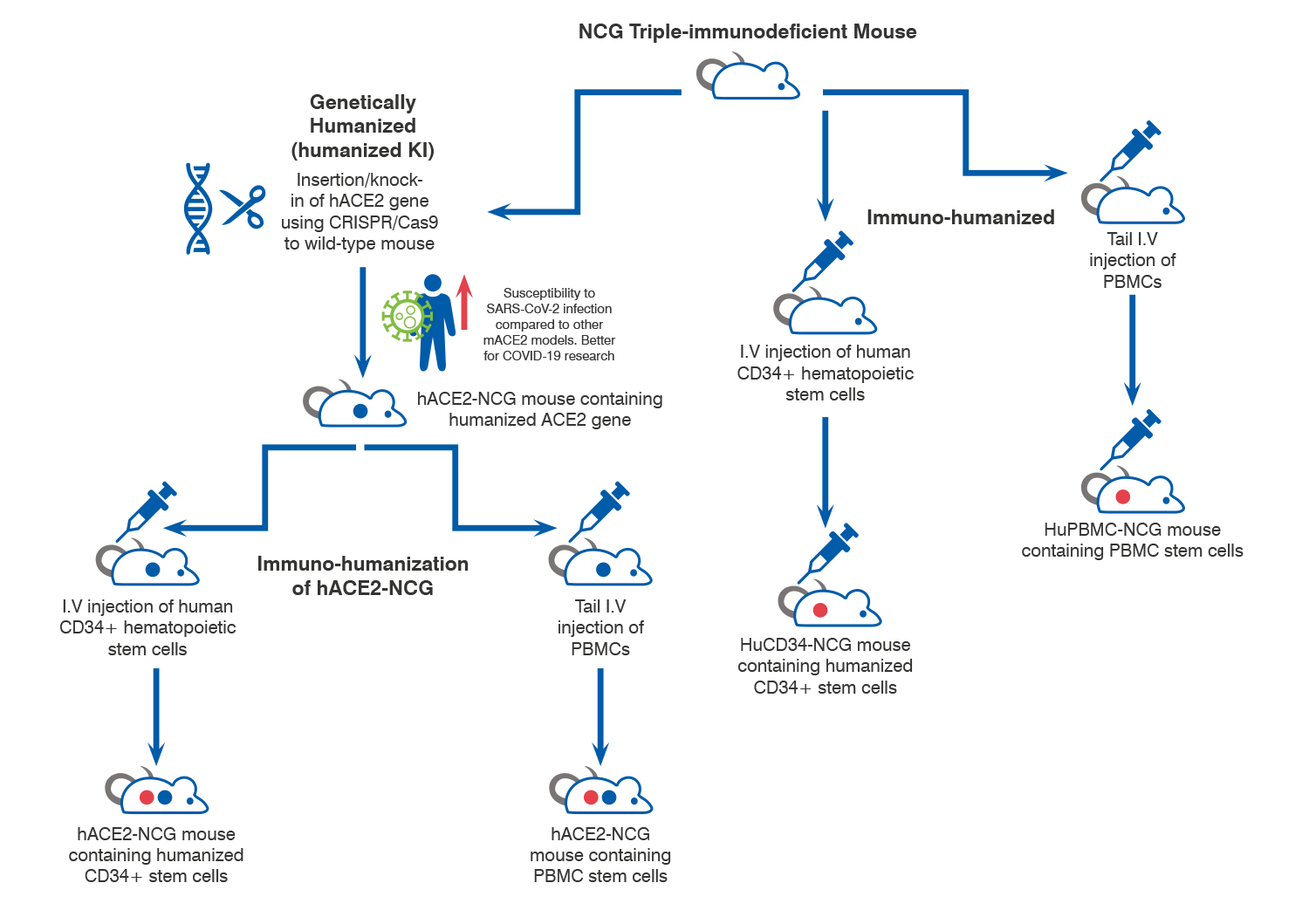
The hACE-NCG mouse is a genetically humanized model using CRISPR technology with the ability to be immuno-humanized with PBMC or CD34+ cells.
- Brochure
WEBINAR
Advance Your Oncology and Immunology Research with Next-Generation Mouse Models
Learn how NCG immunodeficient and humanized mouse models advance oncology and immunology research, accelerating predictive humanized and PDX applications. Watch on Demand