
BKS db/db Mice (JAX® Mice Strain) Details
db/db mice are used to model phase 1 to 3 of diabetes type II and obesity. Mice that are homozygous for the diabetes spontaneous mutation (Leprdb) demonstrate morbid obesity, chronic hyperglycemia, pancreatic beta cell atrophy and come to be hypoinsulinemic. Affected mice are polyphagic, polydipsic, and polyuric. Obesity begins at three to four weeks of age. The BKS background brings an uncontrolled rise in blood sugar, severe depletion of insulin-producing beta-cells of the pancreatic islets, peripheral neuropathy, myocardial disease and death by ten months. Exogenous insulin results in loss of control of blood glucose levels, while gluconeogenic enzyme activity increases. Metabolic efficiency is increased, while wound healing is postponed. To Charles River from The Jackson Laboratory in May 2002. Control models for the BKS db/db Mice are the BKS db (lean db/+), or the BKS db (lean +/+).
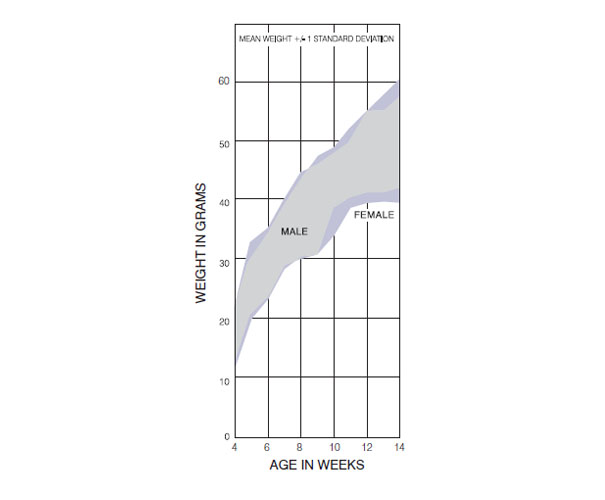
Growth chart data should be used as a guideline only.
The shaded areas on each chart are the mean weight plus or minus one standard deviation at a given age averaged across all production facilities. This represents approximately 67% of the population, with the remaining 33% falling outside of this weight range.
UNIT: A003
Download the Report
➤ DOWNLOAD OUR CATALOG for instant access to Standard List Pricing
➤ TALK TO US to discuss organization or volume-based discounts
Already have an eCommerce portal account?* Login to order research models, obtain quotes, view organization-specific pricing, and see inventory. Processing time required to validate new eCommerce access requests.
*eCommerce is available in US, Canada, UK, France, Germany, Austria, Netherlands, Denmark, Finland, Norway, Sweden, Spain, Portugal, Belgium, Luxembourg, and Switzerland
Try out the BKS db/db JAX® mouse with our animal evaluation program
POSTER: Metabolic & Cardiovascular Disease Models
Explore the models available in your area and identify which one is best suited for your study.
Download the Poster
Optimize Your Type 2 Diabetes Program
Our expertise in anti-diabetic drug discovery, spanning from target identification and pharmacology to IND studies, makes us well-suited to run your type 2 diabetes studies for you.
Learn More

JAX® Mice and Research Services
Charles River is the exclusive distributor of JAX® Mice and select research services in Europe, Korea, and Taiwan.

JAX® is a trademark of The Jackson Laboratory registered in the United States. All rights reserved.
BKS db/db Mice Resources
- Characteristics of JAX® db/db Mice
- Mouse Phenome Database: JAX® db/db
- A Charles River-Hosted JAX® Webinar: Comparing Mouse Models for Metabolic Disease – Diabetes, Obesity, and MASH
- Whitepaper: What is Genetic Drift and Why Does it Matter in Biomedical Research?
Comparing Mouse Models for Obesity and Diabetes Webinar: Questions and Answers
-
In terms of control mice for various diabetic models, Lepr on the B6 background in particular, can C57BL/6 mice be used as a control? Do these complex models have custom-matched control groups?
There are many possible controls for any of these models. Many people use heterozygous db/+ mice as controls, or wild-type controls from within the colony. As these mice are mated as heterozygous x heterozygous, you will get a variety of genotypes in the litter that is produced: homozygous, heterozygous, and wild type. Often, these littermate controls are the best genetic control because they are being produced under all of the same conditions.
However, if you are refreshing your colony to the B6J genetic background every 5 – 10 generations to minimize genetic drift, you might be able to use inbred C57BL/6J mice as controls. We would recommend checking through the published literature to determine what is accepted by your peers.
-
I am working on a potential protein that might be redox regulated and want to investigate the impact of its redox modulation state in type 2 diabetes. Which mouse model, TALLYHO or db/db (leptin receptor-deficient one), would closely resemble T2D?
The model you choose will ultimately depend on which diabetic phenotype you are looking to study. Oxidative stress is involved with several different diabetic phenotypes, likely regulated in different ways (cardiovascular complications, wound healing, liver metabolism, kidney disease, etc.). We would recommend performing a literature search of your specific phenotype of interest, as well as an in-depth look at both TALLYHO/JngJ (TH) and db/db mice to determine what model would best suit your work.
A curated list of references exists on the strain data sheets under the "Details/Phenotype" tab. Click on “Additional Resources” to access the full list
Reference for TALLYHO/JngJ (TH) mouse to look at oxidative stress in a hypertension model:
Two papers looking at various redox pathways in db/db mice:
-
Which model is best suited to study complications of diabetes such as retinopathy?
The publications below show several different models being used for retinopathy research:
Neuro-optic cell apoptosis and microangiopathy in KKAY mouse retina
Relevant model: KK.Cg-Ay/JRetinal Angiogenesis in the Ins2(Akita) Mouse Model of Diabetic Retinopathy
Relevant model: C57BL/6-Ins2Akita/JNeural degeneration in the retina of the streptozotocin-induced type 1 diabetes model
Relevant models: STZ-treated mice -
What is your opinion on diabetes predisposition – is it more obesity or more genetic? Is it better to choose db/db mice or NONcNZO10?
Diabetes is a complex metabolic disease that seems to be a mix of both environmental factors, such as obesity, as well as genetic. A more in-depth literature search will reveal several great reviews that talk about all of these factors and the role they play in disease development and progression.
The best model will depend upon the specific research question you want to answer. We provide a list of curated references on each of the JAX® strain data sheets, under the “Details/Phenotype” tab. Please see the examples below:
-
Db/db mice on the BKS background have a more severe phenotype than diabetic mice on the B6 background, yet BKS mice are resistant to diet-induced obesity. Why?
Diet-induced obesity, when eating a high-fat diet, is likely controlled by a wide range of genetic factors, while the db mutation is a genetic mutation that results in overeating, leading to obesity. High-fat diet feeding doesn't necessarily cause mice to eat more, while the db mutation does lead to hyperphagia. We believe that this is one reason we see the difference in phenotypes.
Another reason is susceptibility to islet atrophy. The B6 background suppresses islet atrophy allowing the mice to become hyperinsulinemic and thus show transient hyperglycemia. The BKS background is permissive to islet atrophy in later stages of disease, allowing progressive hyperglycemia.