.jpg?crop=true&keep=c&q=80&color=ffffffff&u=atq9fr&w=640&h=426)
In Vitro Cellular Uptake Assays for SLC Transporter Interaction Assessment
Drug transporters are routinely assessed in the drug discovery and development processes as potential sources of drug-drug interaction (DDI) or organ toxicity risks. They can also be targets for drug action or delivery. A test compound can be substrate and/or inhibitor to a transporter, and these interactions are mostly tested in vitro, using cell systems that overexpress a single transporter of interest. SOLVO, a Charles River Company, offers three such assay systems: the Vesicular Transport and the Transfected Monolayer Assay for assessing Efflux transporters, and a Cellular Uptake transporter assay. The choice from these setups is driven by client project needs and the test compound's PK properties.
Over the past few years various regulatory agencies have published new or updated guidelines on studying DDIs. Such recommendations were recently summarized in the internationally harmonized ICH M12 guidelines, which were adopted by the FDA, EMA, NMPA, PMDA, and other local agencies since its finalization in 2024. In addition to the transporter studies requested for drug approval (usually in the IND phase), there is also an expanding knowledge base on the general role of drug transporters in drug ADMET properties. Drug transporters are routinely screened in early development to assess compound permeability properties, as well as to detect potential toxic effects, such as hepatotoxicity, and their recognition as potential therapeutic targets or mediators of tissue-specific drug delivery is also growing.
Why do SLC transporter interactions matter?
From a functional perspective, clinically relevant drug transporters are categorized as either efflux or uptake transporters depending on the relative direction of transport. Uptake transporters typically belong to Solute Carrier (SLC) protein families, and are usually facilitative or secondary-active, using either an electrochemical gradient or ion gradients to facilitate the movement of substrates across membranes. SLC transporters generally mediate active compound to active drug elimination via excretory organs, especially the liver and the kidneys, but can also mediate drug access to different other tissues. It is mostly uptake transporters specific to these excretory organs that are often involved in drug-drug interactions, therefore their assessment is required by regulatory agencies for IND applications.
Multiple uptake transporters have a key role in mediating the traffic of endogenous substrates including signaling molecules and metabolites. Depending on their substrate range, this makes SLCs also popular pharmaceutical targets, for example, transport of signaling nucleosides via ENT transporters can be targeted in several CNS conditions such as epilepsy and seizures.
SLC Transporter Assays to Meet Your Needs
Compound interaction with uptake transporters can be twofold. A compound is substrate of an efflux transporter if it is relocated by it across the cell membrane in an active manner, and it can also be a transport inhibitor. Substrates are often inhibitors as well via a competitive mechanism, but non-competitive transporter inhibition is also often observed.
Assays using transporter-overexpressing cells are a popular and useful tool for assessing compounds as substrates to uptake transport. For substrate assessment, a test compound is co-incubated with the transporter-expressing cells, and its intracellular accumulation is measured, while inhibition assays measure the compound’s effect on the accumulation of a reference probe substrate. This assay is suitable for most types of test compounds regardless of their passive permeability or other PK properties.
-
Human Cellular Uptake Transporter Assays Availability
Uptake (SLC) transporter assays are available with a wide range of transporters overexpressed in various cellular backgrounds. All available assays with human uptake transporters are summarized in the table below. Assays were fully characterized using a pair of well-known substrate and inhibitor specific to the transporter in question to ensure assay performance. Assay characterization data is available upon request.
Human Cellular Uptake Transporter Assays
Transporter Background* Probe substrate** Reference inhibitor** OATP1B1 HEK-293 E217βG Rifampicin OATP1B3 CCK-8 OAT1 Tenofovir Probenecid OAT3 E3S OCT1 Sumatriptan Verapamil OCT2 Metformin MATE1 Metformin Pyrimethamine MATE2-K Metformin NTCP TC TCDC PEPT1 CHO Gly-Sar Tyr-Phe PEPT2 Gly-Sar Cefadroxil ENT1 MDCKII Uridine Dilazep ENT2 Adenosine Dipyridamole ENT4 HEK-293 MPP+ Pyrimethamine LAT1 Leucine JPH203 LAT2 Leucine JX009 OCTN1 TEA Verapamil OCTN2 CHO Carnitine Pyrimethamine OCT3 HEK-293 MPP+ Quinidine OAT2v1 cGMP Indomethacin OAT4 E3S Benzbromarone OAT7 E3S Sulfobromophtalein OATP2B1 E3S Rifamycin SV OATP1A2 E3S Sulfobromoftalein CNT1 MDCKII Uridine Adenosine CNT2 Uridine CNT3 Uridine 2’-deoxycitidne MCT8 T3 Sorafenib MCT10 T3 Imatinib THTR1 HEK-293 Thiamine Amprolium THTR2 Thiamine Fedratinib SGLT1 AMG Phlorizin SGLT2 Methyl α-D-glucopyranoside Dapaglifozin SGLT5 D-fructose SGLT6 Myo-inozitol URAT1 MDCKII Uric acid Benzbromarone HPT1 Gly-Sar Cefadroxil ASBT HEK-293 TC TCDC ASCT2 L-serine L-cysteine OSTαβ E3S Ko143 *Cellular background of the overexpression cell line.
**For certain transporters, multiple probe substrates and reference inhibitors are available. -
Preclinical Species Cellular Uptake Transporter Assays Availability
Uptake (SLC) transporter assays are available with a wide range of transporters overexpressed in various cellular backgrounds. All available assays with preclinical species uptake transporters are summarized in the table below. In vitro models using preclinical species transporters allow for inter-species comparison and for assessing human-relevance of interaction findings. Assays were fully characterized using a pair of well-known substrate and inhibitor specific to the transporter in question to ensure assay performance.
Preclinical Species Cellular Uptake Transporter Assays
Transporter Background* Mouse Sglt2 HEK-293 Rat Asbt HEK-293 Rat Ntcp HEK-293 Rat Oat1 CHO Rat Oatp1a1 HEK-293 Rat Oatp1a4 HEK-293 Rat Oatp1b2 HEK-293 Rat Ostαβ HEK-293 Rat Pept2 CHO Dog Sglt2 HEK-293 Cyno Ntcp HEK-293 Cyno Oatp1b1 HEK-293 Cyno Oatp1b3 HEK-293 Cyno Oatp2b1 HEK-293 *Cellular background of the overexpression cell line.

ICH M12 Updates: How the New Global Standard for DDI Impacts Your In Vitro Studies
The recent update to the International Council of Harmonisation (ICH) M12 guidelines provides a definitive version of their guidance. See what impacts ICH M12 impacts your in vitro studies in this on-demand webinar.
Watch Now
Benefits of Uptake (SLC) Transporter Interaction Assays
Uptake transporters with the appropriate substrate preference can also be leveraged for specific drug targeting, for example, the small peptide uptake transporters PEPT1-2 can facilitate intestinal compound uptake. The diversity of SLCs and their potential utility in disease treatment and tissue targeting is still being discovered, but discovery stage interaction assessment screens are already more and more common. When selecting the uptake transporters to be studied for a specific drug development program, it is important to consider their localization, main function, and their putative interaction with the test compound.
Single-transporter overexpression systems are the preferred in vitro model for assessing compound interactions due to their high sensitivity and specificity. In this case, the transporter protein of interest is overexpressed in a host cell line that has low intrinsic transporter expression and is easy to reliably culture and maintain. Certain transporters can also be tested in tissue barrier models to mimic a more physiological context, for example, most SLCs are maintained in cryopreserved hepatocytes or freshly isolated kidney proximal tubule cells. These systems, however, contain several transporters with potentially additive effects on the handling of the test compound, therefore individual transporters are best assessed in overexpression systems.
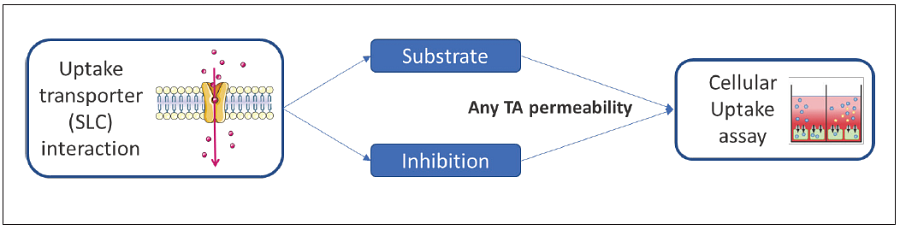
Uptake transporter inhibition or substrate assessment. The Cellular Uptake assay is suitable for testing compounds as potential efflux substrates and inhibitors, regardless of their passive permeability. This is the preferred approach for both regulatory studies and discovery stage work. (TA - Test Article)
The Transfected Cell-based Uptake assay is a selective and sensitive in vitro system for assessing test compound interaction with uptake transporters. It is the most commonly used assay format for testing compounds both as potential substrate and inhibitors. Data generated with this assay system is routinely accepted by regulatory agencies, and it is also a popular tool for early-stage screens in case uptake carriers are therapeutic targets or mediators for compound targeting. Our site offers assay setups adapted for the specific needs of our Sponsors’ projects, ranging from fully regulatory interaction assessments to discovery stage multi-compound screens. interaction assessments to discovery stage multi-compound screens.