
Environmental Risk Assessment Services
Pharmaceuticals can have significant environmental impacts after they are excreted from humans or animals and enter the environment directly or via septic systems and sewage treatment plants. An environmental (risk) assessment (ERA) involves analyzing the fate and hazard profiles to identify the potential risks associated with these compounds on environmental organisms.
At Charles River, we combine our testing and regulatory expertise, which enables us to build the most efficient and suitable dataset for your product. Our team of experts includes study directors with many years of experience in physico-chemical properties, analytical methods, environmental fate, and ecotoxicology testing, as well as regulatory consultants with a high level of scientific expertise and know-how on regulatory aspects. Leveraging our vast experience in conducting risk assessments for a variety of legal frameworks, we can find the best solution for your drug. By following emerging guidelines and changes in existing guidelines, both in the US and EU, we know what will be required and how to meet regulator's expectations.
Support and Testing of an Environmental Risk Assessment
Global Regulatory Support
- Preparations of claims for Categorical Exclusions (US)
- Preliminary testing and Tiers 1-3 (US)
- Phase I, Phase IIA, and IIB assessments (EU)
Regulatory Support and Testing Services
FDA Tiered Approach
In the US, environmental assessments for pharmaceuticals must be submitted as part of certain new drug applications (NDAs), abbreviated applications (ANDAs), investigational new drug applications (INDs), and for various other actions, unless the action qualifies for a categorical exclusion.
EMA Tiered Approach
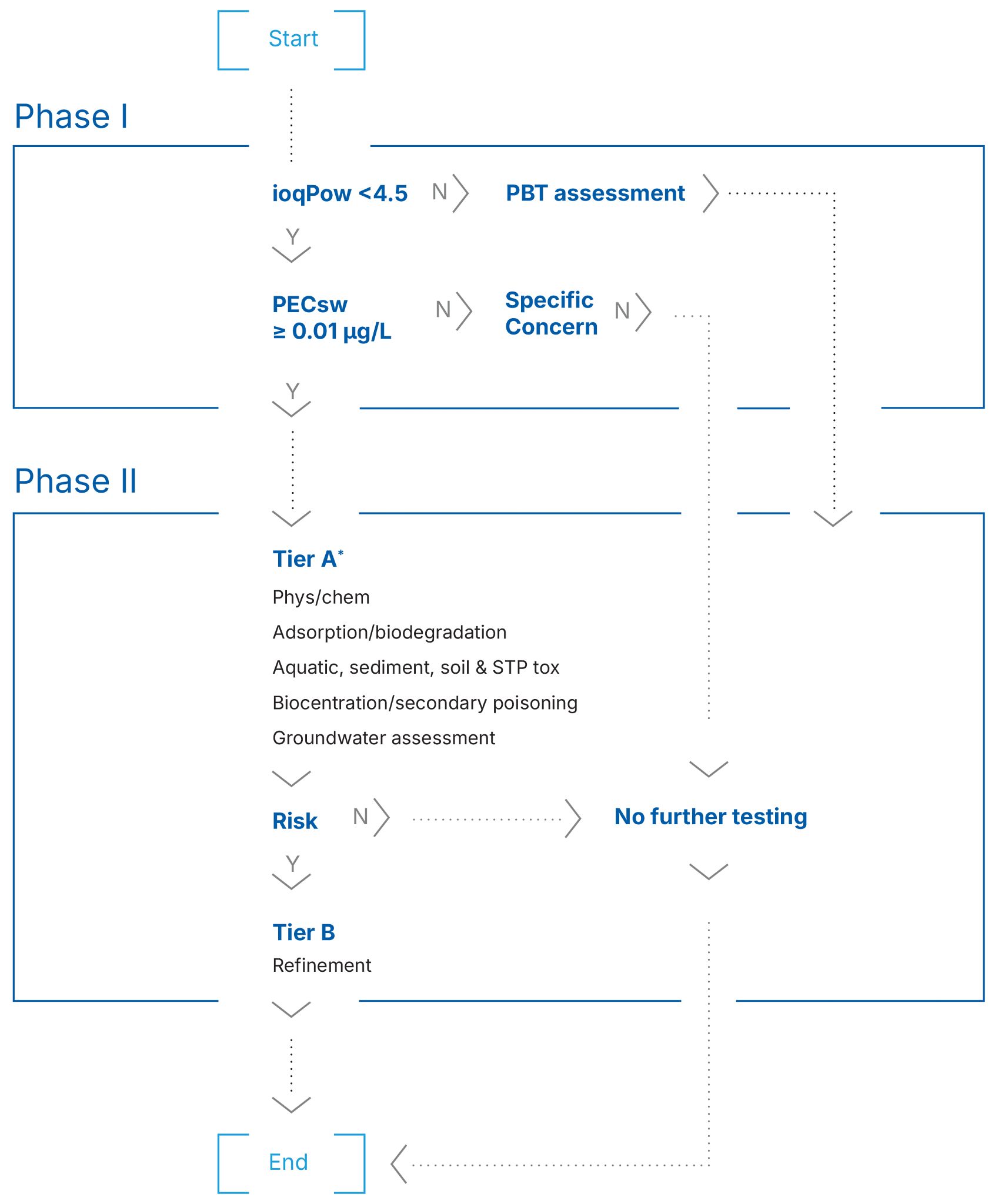
Since 2006, an environmental risk assessment (ERA) has been required for all new marketing authorization applications (MAA) for medicinal products, including those for generics. The procedure described by the European Medicines Agency (EMA) follows a tiered approach.
The outcome of Phase I determines the need of a Phase II Tier A data package, including physico-chemical properties, environmental fate, and ecotoxicological studies. If based on the risk assessment for the relevant environmental compartments, a risk is identified, Tier B of the Phase II assessment describes refinement options.
*Tier A Studies
- Water solubility (OECD 105)
- Dissociation in water (OECD 112)
- Adsorption (OECD 106)
- Biodegradation (OECD 301)
- Algal growth inhibition (OECD 201)
- Daphnia reproduction (OECD 211)
- Fish early life stage (OECD 210) or more appropriate fish test (for ED)
- Activated sludge respiration inhibition (OECD 209)
- Sediment toxicity test (OECD 225, 218, 219 or 233)
- Aerobic transformation in soil (OECD 307)
- Soil micro-organisms, nitrification test (OECD 216)
- Terrestrial plants, growth test (OECD 208)
- Earthworm, reproduction test (OECD 222)
- Collembola, reproduction test (OECD 232)
- Bioconcentration study (OECD 305)
Environmental Impact Assessment of Veterinary Medicinal Products
The introduction of active pharmaceutical ingredients (APIs) into the environment through the prescribed use of veterinary medicinal products (VMPs) can potentially endanger the environment. Exposure to the environment can occur following the administration of e.g., an aquaculture treatment or through veterinary treatment of livestock or companion animals.
To assess the impact of this exposure, submission of an environmental risk assessment (ERA) is included in the authorization process for new and generic VMPs. Within the VICH regions, the risk assessment process and data requirements follow a tiered approach as described in VICH GL 6 (Phase I) and VICH GL 38 (Phase II).
Getting The Support You Need
The approach as described by the US FDA is slightly different from the EU approach. In practice, an ERA prepared for Europe is mostly sufficient for the US, while the opposite may not necessarily be the case. However, as with the EU, an ERA must be documented in an expert report, authored by an individual with demonstrated expertise. Similarly, the ERA may be a lengthy process, it is recommended that an ERA program is commenced early in the Phase III stage of the drug development process.
Environmental Risk Assessment for Pharmaceuticals Timeline
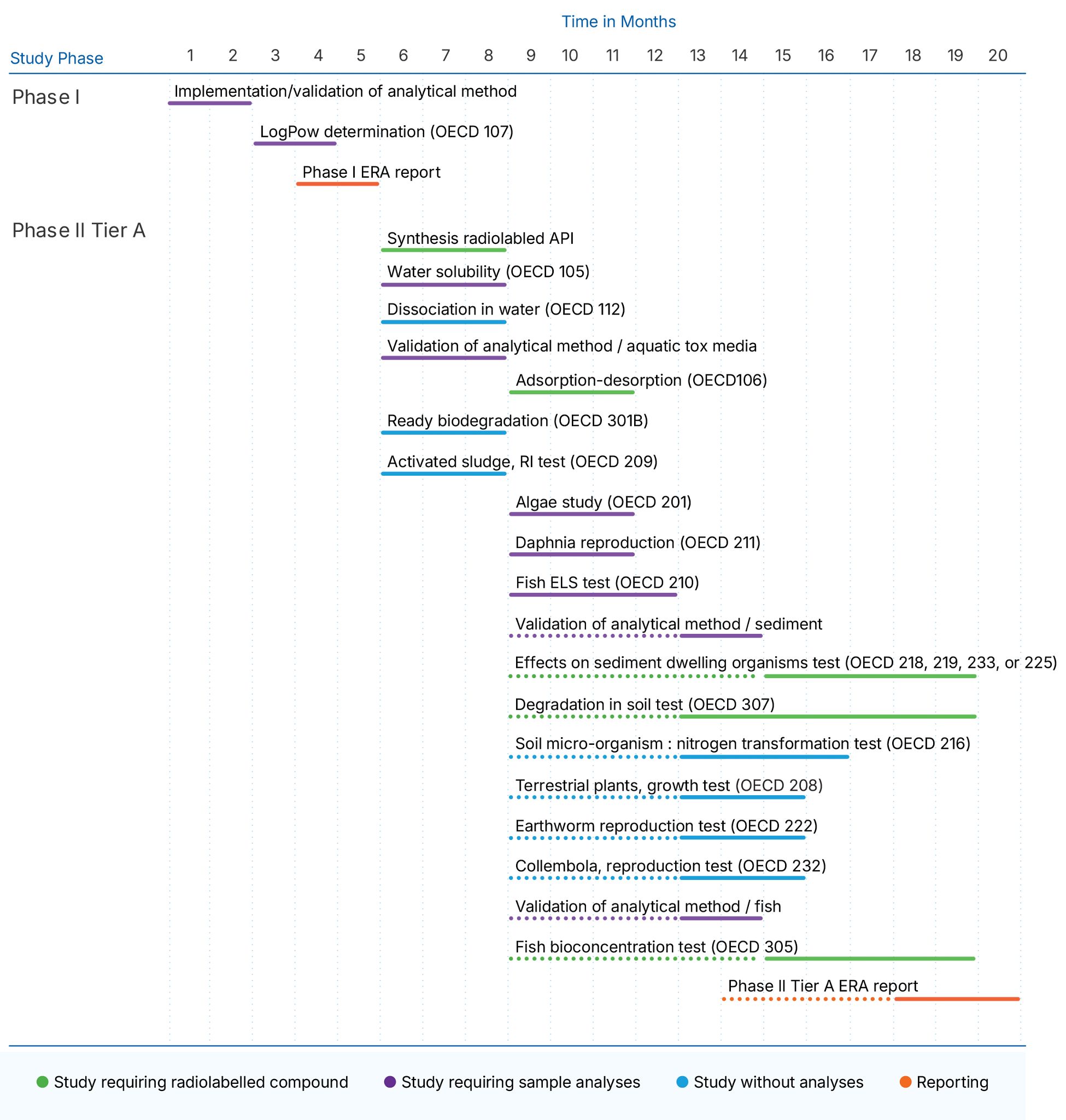
The environmental risk assessment of pharmaceuticals can be a lengthy and involved process, taking several years depending on the product and target market. With extensive experience in study design across multiple industrial sectors, our team has a thorough understanding of these unique regulatory requirements, from study design to the review and interpretation of data. We can assist clients in the pharmaceutical arena, every step of the way.
Frequently Asked Questions (FAQs) about Environmental Risk Assessment
-
What is environmental risk assessment?
Providing of an environmental risk assessment (ERA), is a current regulatory requirement in the EU. Similarly, a US FDA New Drug Application must contain an evaluation of the potential environmental impact of the drug substance, applying to both new and existing products with certain user variations.
-
What studies are included in an Environmental Risk Assessment for a pharmaceutical?
An environmental risk assessment (ERA) can consist of physicochemical, environmental fate, and ecotoxicity studies. The final program design will be dependent on the properties of the medicinal product, usage, and existing data.
-
What is an Environmental Impact Assessment?
An environmental impact assessment (EIA) is the veterinary medicinal product equivalent to an ERA. Similar studies will be required, but the final program design will also be dependent on the intended market. For example, there are differences in the registration requirements between Europe and the United States.