
GI Partners Acquires CDMO and Cell Solutions
As Rose BioSolutions, the established CDMO and Cell Solutions businesses continue to support the biotechnology ecosystem with cell sourcing capabilities and CDMO services to accelerate your advanced therapy from development to delivery.
Learn More
Set your course for streamlined gene therapy manufacture with a proven lentiviral vector production platform
With 20+ years of advanced therapies contract development and manufacturing organization (CDMO) experience, our viral vector center of excellence has established a robust lentivirus production platform to reliably streamline the route to GMP lentiviral vector manufacturing for gene and gene-modified cell therapy developers.
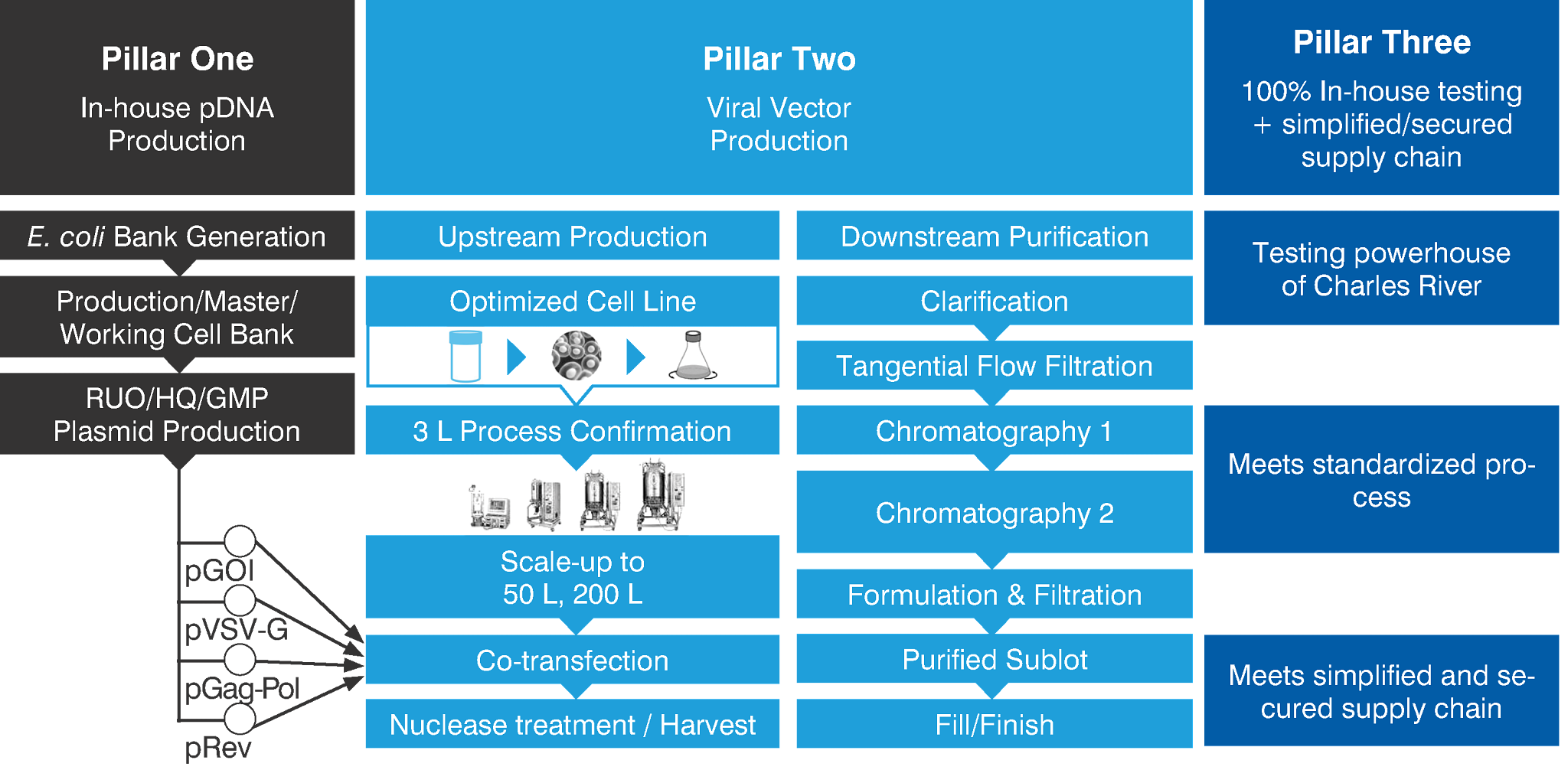
The Lentivation™ LVV manufacturing platform can reduce a program's timeline to GMP by up to 60%, translating to less than seven months, when compared to traditional lentiviral vector manufacturing workflows. Utilizing in-house plasmid DNA production, optimized single-use upstream and downstream purification processes, and 100% qualified, in-house analytical capabilities, Lentivation enables clients to rapidly scale up while simplifying complex supply chains.

Speed
Expedited development and 100% in-house analytics

Experience
Differentiated CDMO and fully integrated testing powerhouse

Predictability
Cost-effective, reliable path to GMP and clinic
Ready to discuss an upcoming lentiviral vector manufacturing program?

Explore our Viral Vector CDMO Facility
Specializing in GMP-compliant production of adeno-associated virus (AAV), lentivirus, adenovirus, and retrovirus for gene and gene-modified cell therapies.
Explore the Facility
“We value this new partnership with Charles River, an industry leader in biopharmaceutical services. In the near term, this collaboration will accelerate the Gates Institute CAR-T programs with their plasmid and lentiviral vector production. Looking ahead to our long-term collaboration, we remain committed to advancing patient impact more broadly.”
Terry Fry, MD, Executive Director, Gates Institute
Overcome GMP lentivirus production challenges for your gene or gene-modified cell therapy
Lentiviral vector manufacturing has many challenges, including scalability, safety, and regulatory concerns that require innovating novel methods for gene delivery. Finding a CDMO partner with the experience and dedication to produce quality material, scaled for early to late-stage clinical trials, is critical for program success.
Choose between multiple manufacturing strategies for GMP lentivirus production, and gain access to proprietary HEK293 and 293T production cell lines for adherent and suspension culture.
-
Suspension Lentivirus Production Services
- Suspension cultures allow for the use of serum-free, chemically defined media that can enable a more streamlined production of vectors intended for clinical use.
- In addition, suspension cultures can be more predictably scaled from 2L and 10L to 50L and 200L bioreactors.
-
Adherent Lentivirus Production Services
- Adherent production is also available for products that might require it for historical or productivity reasons.
- Our scientific experts will guide you through the selection of cell line and culture conditions based on the size of your transgene and quantity of GMP lentivirus required for your clinical trials.
| Lentiviral Vector Production Technology | Key Features | Adherent (CellSTACK, etc.) | Suspension (2-200 L bioreactors) |
|---|---|---|---|
| 2nd Generation | Three plasmids | HEK293, 293T | HEK293-s, 293T-s |
| 3rd Generation | Four plasmids, increased safety | HEK293, 293T | HEK293-s, 293T-s |
-
Simplified and secured supply chain
- Standardized manufacturing processes and partnerships with global providers facilitate standardized BOMs, meaning raw materials are on hand on Day 0.
-
In-house plasmid DNA production
- Our plasmid DNA center of excellence enables us to jump-start your viral vector programs as early as possible.
- Off-the-shelf lentiviral packaging plasmids (Gag, Rev, and VSVG) in research, High Quality (HQ), and GMP grades are also available to expedite your lentiviral vector production.
-
Standardized GMP lentivirus production services
- With proprietary HEK293 and 293T producer cell lines for adherent or suspension culture, our viral vector CDMO team also offers large-scale chromatography purification services (IEX, AEX, affinity, SEC, etc.) based on client preference, material needs, timeline, and long-term development plan.
- The Lentivation™ vector platform provides lentiviral vector gene therapy developers with a rapid, cost-effective, and predictable pathway to GMP manufacturing, with the capability to reduce timelines by 60% or in fewer than 7 months compared to traditional process development.
-
Quality control capabilities
- In-house analytical method development and testing capabilities with a range of pre-qualified platform assays, well-versed assay tech-transfer capabilities, and industry-leading assay development services including ddPCR, p24 ELISA, RT-PCR assays, and functional titration assays.
- Final product with demonstrated infectivity.
-
Integrated cell therapy manufacturing capabilities
- Explore our CAR-T cell therapy manufacturing services.
Not ready for GMP lentivirus production? Explore research grade lentivirus packaging services.
Gene Therapy Research – Pitfalls and Best Practices
Advanced therapies offer immense potential but also involve significant challenges. Dive into the experiences of experts working with AAV and lentiviral vector-based gene therapies and empower your program.
Get the Insights
Concerned about project continuity and looking to reliably tech transfer an existing lentivirus production program? Explore Modular and Fast Track viral vector tech transfer frameworks.
Expedite your Lentivirus Production
Frequently Asked Questions (FAQs) About GMP Lentivirus Production Services
-
How long does it take to generate clinical-grade GMP lentivirus?
The protocol for clinical-grade lentivirus production involves many steps to ensure the quality and safety of the final product. Altogether, it can take 10-15 months to complete a GMP project.
The Lentiviral Vector Manufacturing Process:
- The first step of any campaign is the process development phase, in which various parameters involving the source plasmids, producer cell lines, and purification methods are optimized.
- Following this step, procedures must be adapted to the larger scales required to generate the increased amounts of material required for clinical trials.
- Next, an engineering run is performed to confirm that all of the processes and procedures yield the expected amount of virus at the larger scale.
- After the engineering run, a GMP run that fully complies with FDA and EMA guidelines is performed. This is the run that produces the actual material for clinical use. However, before this material can be used in patients, quality control testing must be conducted in order to confirm the final product’s identity and purity.
- Finally, release testing must also be completed before the final product is deemed ready for use in patients. The release testing confirms sterility and stability of the final product.
-
Why include an engineering run for lentivirus production?
The engineering run is a vital part of any GMP viral vector manufacturing campaign as it allows for the detection of any unforeseen issues that could impact GMP lentivirus production. The engineering run uses the exact same procedure as the GMP run, but is not performed in the CGMP facility (e.g., no regulated air supply and not subject to QA oversight). This run allows for the confirmation that all of the campaign-specific processes will be successful and that the expected viral titer will be obtained. Material produced during the engineering run can be used for in vitro or in vivo testing (or toxicity studies) but cannot be used in patients.
-
Can Charles River produce Gag, Rev, and VSVG plasmids to support LVV production?
Yes. Our integrated plasmid DNA center of excellence manufactures phase-appropriate custom or off-the-shelf research grade, High Quality (HQ) intermediate grade, and full GMP plasmids.
Explore Off-the-Shelf Gag, Rev, and VSVG plasmids for LVV packaging
-
What is the typical yield for GMP lentivirus production?
Because viral vector titer is highly sensitive to the size of the viral genome, the resulting viral vector manufacturing yield will vary depending on the size of the desired insert. Please contact us for more information about what yield may be obtainable with your insert.
-
How do retroviruses and lentiviruses differ?
Retroviruses are a family of viruses characterized by their ability to reverse transcribe their RNA genomes into DNA, which can then stably integrate into the host cell genome. Due to their ability to permanently modify the genetic makeup of a target cell, retroviruses attracted attention early on and became the first viral vectors to be used in gene therapy clinical trials. Importantly, retroviruses can only transduce dividing cells, whereas lentiviruses can transduce both dividing and non-dividing cells. Most retrovirus vectors are based on murine leukemia virus (MLV), a simple or gamma-retrovirus (as opposed to lentiviruses, which are more complex members of the retrovirus family). Retroviruses have a greater variety of stable producer cell lines available than do lentiviruses, due to their longer history of use, more simplistic genomes, and because some lentivirus accessory genes are toxic to mammalian cells.
-
Is recombinant lentivirus safe to use?
We have expertise in both 2nd and 3rd generation production methods, in which the lentivirus genome is edited down and distributed among three plasmids or four plasmids respectively, however we primarily use a 3rd generation lentivirus packaging system.
This greatly reduces the likelihood of recombination events that could allow generation of replication-competent lentivirus. Over the long history of lentivirus clinical trials, it has demonstrated a predominantly safe track record, although some insertional mutagenesis events have occurred in a limited number of patients. However, the continued development of self-inactivating vectors and other measures taken to reduce risk have resulted in increasingly safe lentiviral vectors.