Featured News
HERV-K: Solving the First Endogenous Reverse Transcriptase Crystal Protein Structure
The Charles River Structural Biology team was part of an initiative led by ROME Therapeutics to solve HERV-K, the first Endogenous Reverse Transcriptase (RT) protein structure. As HERV-K is implicated in some cancers, as well as autoimmune disease and neurodegenerative diseases, this advance enables structure-based drug design and helps pave the way for therapeutic approaches using reverse transcriptase inhibitors.
Exploring the Dark Genome: Solving Crystal Protein Structures of Human Endogenous Retroviruses
Our Biology team, working as part of a collaboration lead by ROME Therapeutics, has successfully expressed and crystalized a previously unexplored protein, solving Human Endogenous Retrovirus-K Reverse Transcriptase structure (HERV-K RT), with findings recently published by pnas.org. This paper examines the synergy between HERV-K Reverse Transcriptase (RT) structure and HIV-1 RT, and the opportunities for HERV-K RT-specific inhibition:

Human endogenous retrovirus-K (HERV-K) reverse transcriptase (RT) structure and biochemistry reveals remarkable similarities to HIV-1 RT and opportunities for HERV-K–specific inhibition
Read the paper
Endogenous retroviruses like HERV-K are the result of ancient integration of viruses into the human genome through evolution and account for 8% of genomic DNA. They resemble retroviruses in their genomic structure, and copies that integrated more recently still express intact proteins like RT. The PNAS paper reveals not only that endogenous RT can be crystallized, but also that the crystal structure of HERV-K RT bears a striking resemblance to the RT protein of HIV, despite a very different protein sequence. These findings provide important insights for evolutionary biology, as well as targeted therapeutic development.
Expression of HERVs is associated with a number of diseases, including cancer, inflammatory diseases and neurodegeneration, as well as aging. The resolution of HERV-K RT breaks new ground by showing binding by several known compounds and could enable more effective drug design and optimization of selective inhibitor drug molecules.
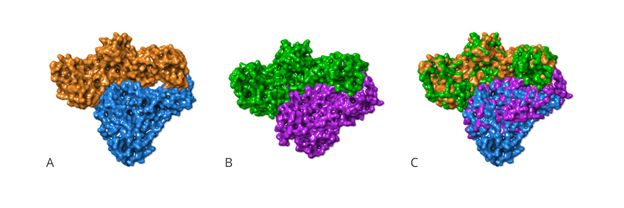
Graphic overview of (A) HERV-K and (B) HIV-1 reverse transcriptase dimer protein structures. Each of the monomeric units is shown in a different color. The two molecules per dimer are colored differently. (C) Superimposition of the two structures shows a striking similarity despite poor protein sequence homology.
Protein Modelling to Inform Drug Development: First-of-its-Kind Crystal Structure
Learn how HERV-K, an ancient endogenous retroviral protein, was modelled for the first time with Crystallography expert Paul Wan.
Keep reading