
X-Ray Crystallography Services
The structural biology team at Charles River carries out high-resolution structure determination by X-ray crystallography to support both stand-alone and integrated drug discovery projects. We have access to regular UK and European synchrotron data collection facilities to provide fast turnaround and high-throughput structure determination (including fragment screening campaigns).
Integration of protein production, crystallization, and structure solution allows for efficient streamlining of the structure determination process. The resulting structures, combined with the significant industrial design experience of our crystallographers and integrated with results from advanced biophysical assays, allow us to detail protein-ligand interactions at a structural, kinetic, and thermodynamic level and provide insight to drug design projects.
Protein Crystallization
- Robotic nanoliter-scale screening and imaging
- Screening with known ligands
- Automated optimization of conditions for crystal growth
- Co-crystallization or soaking of ligands
X-Ray Crystallography
- Electron density maps
- Scaled and merged diffraction data
- Complete atomic coordinates
- Structure interpretation
- Ligand binding analysis (where appropriate)
- Advice on medicinal chemistry design (where appropriate)
Integrated Computational Chemistry
Integrating computational chemistry with your protein X-ray crystallography research can add important layers of information about your target and compound, enabling you to make data-driven decisions about lead candidates and informing your downstream study design. Through a digital deep-dive into your target's binding pocket, our CADD team can interrogate further structural activity relationships (SAR) enabling a rapid evaluation of alternative ligands for compatibility and make recommendations on the most promising compounds for synthesis and testing.
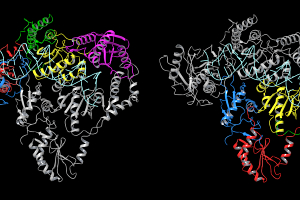
HERV-K: Solving the First Endogenous Reverse Transcriptase Crystal Protein Structure
The first human endogenous retrovirus-k reverse transcriptase protein structure (HERV-K RT) has been successfully solved by Charles River Structural Biologists working as part of a cross-functional team lead by ROME Therapeutics.
Read more