
SEND at Charles River
We've been actively volunteering with CDISC developing SEND standards since 2001 and have served as the SEND Findings Sub-Team Lead, Global Governance Group SEND Representative, and CDISC SEND Industry Leader. Currently, Charles River leads the Dermal Ocular, Controlled Terminology, Safety Pharmacology, and SEND Conformance Rules CDISC SEND teams and is the CDISC SEND Mentoring Leader. As part of the CDISC SEND team, we were heavily involved in the development of all of the CDISC SEND Implementation Guides. Charles River also participates in creating additional CDISC data modeling standards.

Understanding SEND: Ensure Your Dataset Complies with the Most Recent Updates
Learn how to effectively navigate the evolving regulatory landscape with advice from SEND experts in this webinar on demand.
Watch the Webinar
Engage with our Experts
Members of the Charles River SEND team are also part of the Pharmaceutical Users Software Exchange (PHUSE) SEND working group. As a part of this group, Charles River participants focus on answering SEND implementation questions submitted through the SEND Implementation Wiki and developing the Nonclinical Study Data Reviewer’s Guide (nSDRG) template through the nSDRG working group.
Sponsor companies are ultimately responsible for the inclusion of SEND datasets as part of regulatory submissions. With Charles River’s world-class SEND capabilities and expertise, you will have:
- Validated, submission-ready SEND dataset packages for your study
- The SEND dataset package containing all necessary accompanying materials (Define XML Document, Define stylesheet, and nSDRG)
- Decades of experience and dedicated SEND resources
- Our data standards expertise to provide guidance navigating the evolving data standardization requirements
Charles River has been using a validated system (Instem Submit SEND Suite) since 2015 to produce SEND datasets. Our experts have completed well over 10,000+ SEND datasets. SEND data can be produced for all in-scope study designs and endpoints.

Get Our SEND E-Guide
SEND regulations can be a challenge to navigate on your own. Our E-Guide can help.
Access the E-Guide
SEND Resources and Answers
Charles River’s SEND team is always available to answer your SEND-related questions. Some of the most common questions we receive are:
Are SEND datasets required for non-GLP studies?
Yes, SEND is required for both GLP and non-GLP studies when the study design is in-scope for SEND. Both GLP and non-GLP studies may be submitted to FDA to support clinical safety, so the decision to include SEND is independent of GLP status.
What study designs are in-scope for SEND?
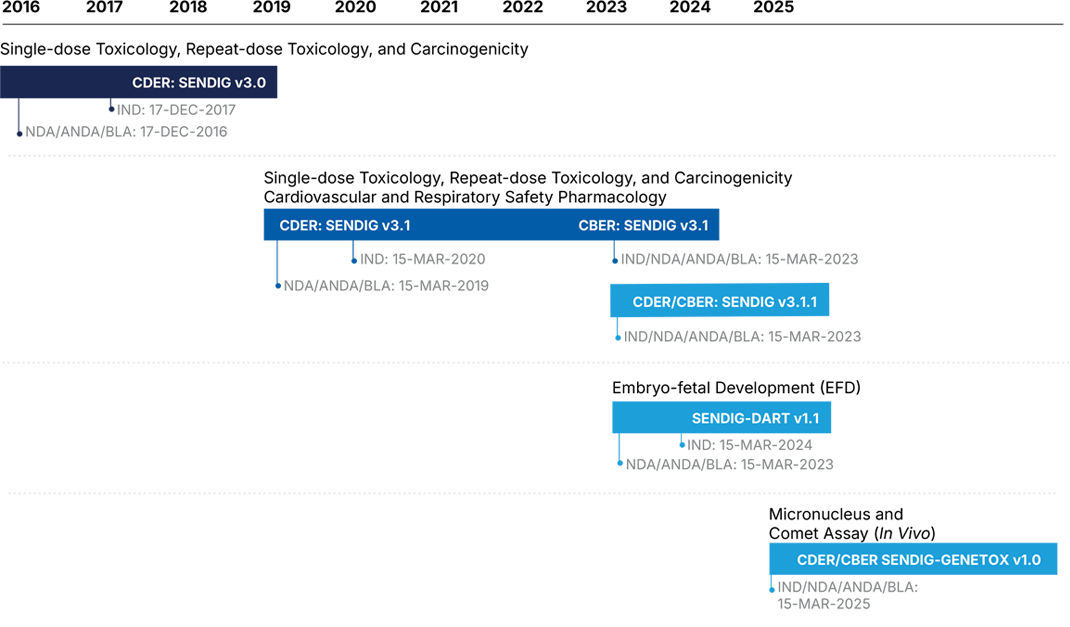
There are published SEND Implementation Guides (SENDIGs) that cover study designs for single-dose toxicology, repeat-dose toxicology, carcinogenicity, cardiovascular, respiratory, animal rule, embryo fetal development, micro nucleus and comet assay (in vivo) studies.
SEND Requirements by Study Start Date (protocol signature date):
Access SEND Guidelines
The CDISC and PHUSE websites offer guidelines and additional documents that can help you along the way.
- CDISC SEND
- Electronic Common Technical Document (eCTD) and Technical Rejection Criteria
- FDA Study Data Standards Resources
Do you need assistance creating your SEND dataset packages?
Other Frequently Asked Questions (FAQs) About SEND Dataset Services
-
What is included in a SEND dataset package?
A SEND dataset package contains the SEND datasets (.xpt files), the Nonclinical Study Data Reviewer’s Guide (nsdrg.pdf), and the Define XML Document (define.xml).
-
Do interim and draft reports require SEND datasets?
Yes, SEND is required for studies when the study design is in-scope for SEND regardless of what report type (draft, interim, final) is included in the regulatory submission.
-
Which FDA Centers require SEND datasets to be submitted?
Both CDER and CBER require SEND datasets. The requirement dates are communicated in the FDA Data Standards Catalog.
-
When is a simplified Trial Summary dataset (ts.xpt) file needed?
A simplified Trial Summary dataset containing the study start date is required for studies submitted in eCTD folders 4.2.3.1, 4.2.3.2, or 4.2.3.4 when the study start date is prior to the SEND requirement date.
-
Is the tumor.xpt file a part of the SEND dataset package?
No, the tumor.xpt file is not a part of the CDISC SEND standard however, the Nonclinical Study Data Reviewer’s Guide for carcinogenicity studies includes information on traceability between the tumor.xpt file and SEND domains.
-
What eCTD folders are subject to the Technical Rejection Criteria (TRC)?
The TRC check is run against the eCTD folders 4.2.2.1 Single Dose Toxicity, 4.2.3.2 Repeat Dose Toxicity, and 4.2.3.4 Carcinogenicity. Although TRC checks are not performed against other folders in the submission, SEND is still required for studies with in-scope study designs.