
The Science is Evolving — Your Study Design Can Too With VCGs
In science and drug development, there is a responsibility to advance practices and ultimately reduce animal models. Thousands of standard toxicology studies continue running concurrent control groups, generating data the industry already largely possesses. The standard for VCGs is being built right now.
We are proud to work with Charles River on this important initiative. We have an incredible opportunity to advance sustainable science by reducing our reliance on animal models, and VCGs are one way in which we are utilizing technology to make progress in this area.”
Philippe Detilleux, Global Head of Preclinical Safety, Sanofi
To navigate a shifting landscape where regulatory agencies are signaling change, modern study designs must actively embrace the 3Rs imperative to optimize nonclinical development.
Virtual Data, Real Animals
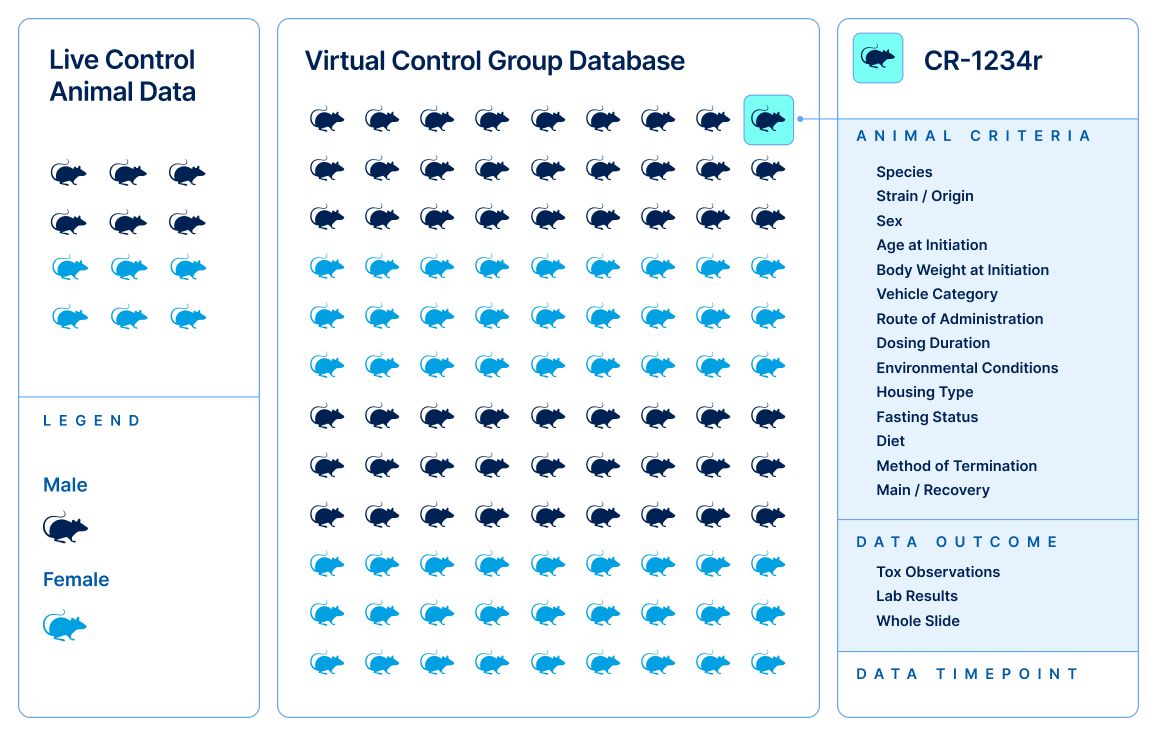
Virtual control groups can transform nonclinical studies by reducing or partially replacing selected control group animals. This methodology replaces traditional concurrent vehicle-dosed controls with a curated set of historical control data drawn from animals run under identical conditions—including the same species, strain, sex, age range, diet, husbandry, and dosing parameters.
The underlying data is real biological data from real animals. When the matching is done correctly, the biological relevance is equivalent.
VCGs are a credible, scalable innovation that can transform nonclinical development while maintaining decision quality. Backed by a curated data foundation across decades of historical controls, matched to studies through a methodology validated down to the tiniest detail.

Virtual Control Groups in Nonclinical Research: A Re-Analysis of 20 Studies Using VCG Data
Published in a leading journal, this research highlights Charles River’s expertise in safety assessment and regulatory strategy, showing how data-driven science delivers clearer insights and stronger confidence in New Approach Methodologies (NAMs).
Explore the results
VCGs Are Not Universal
VCGs perform best in standard study designs with:
- Well-characterized historical control data
- Endpoints with low biological variability
- Studies where the primary scientific question is about the treated groups, not the controls themselves
They require additional caution or are not currently appropriate:
- In studies involving novel endpoints or biomarkers with limited historical precedent
- Highly novel species or strains with thin historical databases
- Vehicle formulations with known biological activity
- Complex multidisciplina
The Work Behind the VCG Standard
We bring together the industry's largest nonclinical dataset, decades of GLP study experience, and a fully industrialized VCG capability. Validated on real studies, with real data, and ready for the science this moment demands.
The Data Foundation
- Spans decades of GLP-compliant study execution across species, strains, and study designs
- Standardized, harmonized, and continuously refreshed as an actively curated scientific resource
- Enforces a 3–5 year recency window to ensure biological relevance as animal biology and husbandry practices evolve
The Matching Methodology
- Selection criteria that are biologically critical are defined by toxicologists, pathologists, statisticians, and data scientists
- Matching parameters include species, strain, sex, age, body weight, route of administration, vehicle category, testing facility, and dosing frequency
- Proprietary grading scales offer complete transparency, ensuring rigorous biological alignment is confirmed prior to deployment
The Quality Layer
- Every VCG deployed on a regulated study carries full data lineage documentation
- Documents which animals were selected, why, what the matching criteria were, and what the statistical methodology was
- Comprehensive audit trail ensures the methodology remains defensible
We conducted a retrospective analysis of 20 GLP toxicology studies — 10 rat and 10 large models — replacing concurrent control groups with curated VCGs and comparing outcomes across study-level decisions and detailed endpoints.
What We Did
- Replaced concurrent control groups with curated VCGs
- Compared outcomes and concordance across study-level decisions and detailed endpoints
- For pathology, it relied on the microscopic findings of previous studies
What We Found
- 100% concordance in NOAEL across all studies between concurrent control group (CCG) and VCG designs
- Core study conclusions unchanged
- Some endpoint-level variability — low severity, non-impactful
Where variability occurred, it did not influence safety conclusions or risk characterization.
Charles River Is Actively Shaping the Regulatory Future of VCGs
We introduced the VCG concept to the FDA in 2023, participated in the FDA’s AI Innovation initiative in 2024, and has an active Context of Use submission with the EMA. FDA draft guidance was issued in March 2026. Japan, the US, and the EU are actively harmonizing VCG methodologies. Charles River is at the table for all of it, leading the CROs in the VICT3R consortium and contributing to regulatory qualification efforts globally.
Available Study Frameworks
Every study goes through a rigorous scientific feasibility assessment. For eligible studies, two designs are available:

Dual Design
The right starting point for sponsors building their own evidence base. A VCG runs alongside a full concurrent control group. No animal reduction, complete data collection, and validation.

Hybrid Design
A principled bridge position for programs where the evidence is strong and the risk tolerance is right. A reduced concurrent control group combined with a VCG, enabling partial animal reduction while maintaining scientific confidence.
Both designs are available for non-GLP and GLP-eligible nonclinical studies, with current scope covering 4-week rat and large models general toxicology studies.
Supported Study Designs
Core VCG eligibility currently applies to 4-week general toxicology programs (Rat: Sprague Dawley, Wistar Han), and Large Test System Models, across multiple routes of administration and dosing frequencies, at Charles River Safety Assessment sites. We are undergoing a full VCG database qualification, implementing SOPs, training, and reporting process that aligns with GLPs best practices
The Science Is Proven
There are currently more than 15 pharma/biotech company collaborations underway.
- 27 retrospective studies conducted internally, and peer reviewed with our partners with a 100% NOAEL concordance with some endpoint variability with low impact to the overall study conclusions (ref.Virtual control groups in nonclinical research: A Re-analysis of 20 studies using virtual control group data - ScienceDirect)
- 15+ pharma and biotech companies in active collaboration
- Active regulatory engagement: FDA, EMA, VICT3R consortium
Driving innovation through VCGs.”
Laura Lotfi, MSc from Charles River and Guillemette Duchateau-Nguyen from Roche
Let’s Build The Future of Nonclinical Science Together
The companies that adopt VCGs thoughtfully now — that build the scientific documentation, engage regulators proactively, and publish their validation experience — won’t just benefit from the technology. They’ll help write the guidance that defines how this is done for everyone who follows.
Here’s Where to Start
Conduct a VCG Readiness Assessment
Map your pipeline — what study types are coming, what species, what durations — against the current VCG evidence base, and identify where you could begin piloting. Start with a well-characterized study type where the risk of a misstep is manageable and the learning is maximal.
Invest in Data Infrastructure
Ensure your internal historical data is standardized and queryable. Even if you’re relying entirely on CRO-provided VCGs, understanding the data quality requirements positions you to be a better scientific partner in that conversation.
Engage With Regulators and Share Learnings
One of the most valuable contributions early adopters make is the data they contribute to the regulatory dialogue. Publications, IND-enabling tox package submissions that include VCG documentation, pre-submission discussions with FDA and EMA are all ways to expand the evidentiary base that will eventually make VCGs a standard accepted method.
Frequently Asked Questions (FAQs) About Virtual Control Groups
-
What are nonclinical virtual control groups?
VCG replaces concurrent vehicle-dosed control animals with a curated set of historical control data matched to a study’s specific parameters. The underlying data is real biological data from real animals run under the same conditions. The difference is temporal, not scientific.
-
What limitations of traditional concurrent control groups do VCGs address?
Every concurrent control group consumes the same procurement, monitoring, and necropsy resources as treated animals to generate a biological baseline we largely already possess in historical archives. At the program level, that adds up to hundreds of animals and significant cost for data that rarely surprises us. VCGs contextualize findings against historical data.
-
Why do I need VCG data?
VCGs reduce the number of animals required for a study without compromising scientific rigor. They can also unlock study design flexibility, allowing sponsors to redistribute animal capacity toward additional dose groups, satellite cohorts, or improved statistical power. Early adopters also contribute to the regulatory evidence base that will define this methodology for the industry.
-
Are VCGs accepted by regulatory agencies?
VCGs are not yet codified in GLP guidance as a standard accepted method. Charles River actively engages with FDA, EMA, and international harmonization bodies including the VICT3R consortium to advance that qualification process. Early adopters who engage regulators proactively through pre-IND meetings, scientific advice requests, and transparent study documentation are helping write the guidance that will make VCGs table stakes.
-
How do VCGs fit into the regulatory landscape?
The FDA Modernization Act 2.0 explicitly removed mandatory animal testing as a precondition for IND submission and encouraged scientifically justified alternatives. The EMA's 3Rs commitments are directionally aligned, and ICH M3(R2) has always accommodated well-documented deviations from standard study design. VCGs are not yet codified in GLP guidance as a standard method. Charles River engages directly with FDA and EMA on VCG methodology and participates in the VICT3R consortium to help shape the standards that will govern the field.
-
How does a VCG get selected? And what if the match isn't strong enough?
VCG eligibility is assessed during protocol design, before the study starts. Charles River scientists evaluate your planned study against the database across the variables known to drive control animal biology — species, strain, sex, duration, vehicle, and facility. If the data supports a strong match, the VCG is finalized with full documentation. If it doesn't, the team will recommend a hybrid design or flag that a VCG isn't appropriate for this study. That recommendation is the quality control working as intended.
-
Is my data secure? Who owns the data that makes VCGs possible?
Your compound, study numbers, and proprietary test article information are never retained in the VCG data lake. Only de-identified animal and study design parameters — species, strain, sex, vehicle, husbandry — are used for matching. The right to use concurrent control data in historical databases has been established in Charles River master service agreements since 2005, and every sponsor benefits from the scientific depth that collective archive makes possible.
-
What's the difference between a Dual Design and a Hybrid Design?
Both study designs incorporate a VCG alongside traditional methods. They differ in how much they replace versus supplement the concurrent control group. In a Dual Design, a full concurrent control group runs in parallel with a VCG of equal size — no animal reduction yet, but direct side-by-side validation of VCG performance. In a Hybrid Design, the concurrent control group is reduced and a VCG fills the remainder, delivering meaningful animal savings while retaining a live biological anchor. The right approach depends on your study type, species, and how much validation evidence already exists for your endpoints.