
Understanding Method Development and Qualification to Validation
Charles River Laboratories has a team of experts ready to partner with you to navigate the path from client-specific method development, through product-specific qualification (studies performed pre-validation to generate sufficient data to determine the methodology meets your needs) and validation studies (validating data and specifications generated in qualification studies) in a phase-appropriate manner, from preclinical to commercial and beyond.
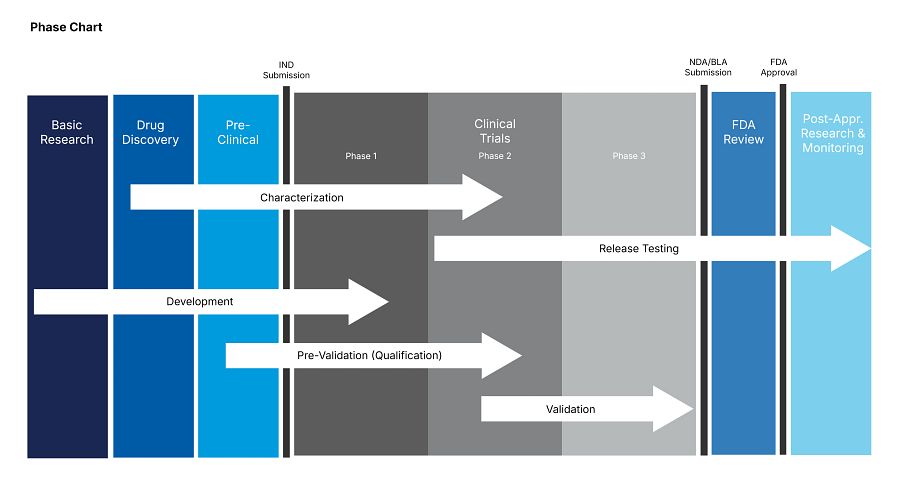
Charles River offers a range of generically validated platform methods for early clinical development, allowing clients to save time and resources. Our off-the-shelf assays are documented to be fit for purpose, allowing early-stage clients to proceed directly to GMP testing, saving time and cost associated with Qualifications. For clients in the later-stage processes, we can design and execute GMP-compliant product-specific qualification and validation studies.
Comprehensive Method Development and Qualification Solutions for Enhanced Product Quality
Our method development and qualification approach helps clients generate reliable data efficiently. Available analytical assay capabilities include, but are not limited to:
- Flow cytometry assays
- qPCR and ddPCR
- HPLC/UPLC
- ELISA/Ella technology
- AUC
- Cell-based assays
- Microbial adventitious agents
- Viral adventitious agents
Method Development and Qualifications Services
Our services encompass a wide range of testing and characterization techniques to ensure the efficacy and quality of your products; method development includes the execution of:
- In-process testing
- Assay fit-for-purpose (FFP) studies
- Product characterization for process/site comparisons
- Material and intermediate hold-time studies
- Material/vendor comparisons
- Development of cell-based assays (e.g. in vitro bioassays, binding assays)
- Molecular biology
- Extended characterization of CQAs/PQAs
Method Development and Qualifications Areas
Method development and qualification (MDQ) plays a crucial role in ensuring the safety, efficacy, and quality of therapeutic products, highlighting key areas of testing from analytical testing and viral clearance to cell banking and release testing. Each area is vital to maintaining high standards in product development and regulatory compliance.
- Analytical and Residual
- Cell Banking Services
- Unprocessed Bulk Testing
- Viral Clearance
- Cell Line Characterization
- Bioassay and Potency Testing
- Stability Testing
- Release Testing
- Viral Safety
When you choose Charles River, you're not just selecting a service provider; you're gaining a dedicated ally committed to your success. Our one-on-one consultations ensure that we understand your unique needs and timelines, enabling us to tailor our solutions specifically to your requirements. We have the scientific expertise and reliable execution to keep you informed and your project moving forward.
Frequently Asked Questions (FAQs) About Method Development and Qualifications to Validation
-
What parameters should be optimized for method development?
To ensure a method is suitable for validation, method development should include the optimization of critical reagents, calibration curve, quality control samples, selectivity, specificity, sensitivity, accuracy, precision, recovery, stability of the analyte in the matrix, and, for ligand binding assays, the minimum required dilution.
-
What is matrix effect and how do I evaluate it during method validation?
A matrix effect is the alteration of the analyte response due to interfering components in a sample matrix. Different independent sources or lots should be evaluated before the method validation phase by analyzing replicates of low- and high-quality controls, each prepared from at least six different sources or lots.
-
Can I get a custom method developed?
Yes, our team can develop custom methods, and the associated qualification study will ensure consistent, interpretable results through preliminary tests of performance characteristics, such as specificity, accuracy, and precision, in accordance with ICH Q2(R2). Although not as rigorous as full method validation, it is essential to occur before advancing in the development lifecycle, typically before or during Phase 1 clinical trials.
-
What are the regulatory guidelines for method validation to ensure that analytical methods are accurate, reliable, and suitable for their intended purpose?
Method validation is a regulatory requirement guided by organizations such as the ICH, FDA, and EMA, ensuring that analytical methods are accurate and reliable for their intended use. Key aspects include defining objectives, developing procedures, and conducting rigorous testing to ensure specificity, accuracy, and precision, with thorough documentation. Compliance with security and data integrity standards (21 CFR Part 11 and EP Annex 11) is essential. Recent updates, such as ICH Q14 and Q2(R2), emphasize a science- and risk-based approach for analytical procedures. Data from method qualification can also be included in an Investigational New Drug (IND) application.
-
What is analytical method lifecycle and lifecycle management?
The analytical method lifecycle is the end-to-end process of developing, validating, and maintaining a lab method to ensure it reliably measures what it's designed to do. Lifecycle management is the evaluation of methods and samples to ensure they remain accurate and compliant over time through continuous monitoring, improvement, and control.