
Discovery Proteomics Services
Proteomics is widely applicable in biomarker discovery, disease research, drug discovery, and development. Proteomics services and techniques can be applied to the analysis of a single protein or used for the large-scale analysis of a specific proteome including protein abundances, protein modifications, protein-protein interactions, and protein-compound interactions.
Charles River’s proteomics services team offers sample extraction, protein fractionation, peptide fractionation, protein mass spectrometry, protein identification, and protein quantification.

The scientists on Charles River’s proteomics team have deep expertise across the whole proteomics pipeline. Chemists, biologists and proteomics scientists come together to deliver rich data within biological context of your proteomics project.
-
Protein Mass Spectrometry Platforms
Our regular investment in the latest protein mass spectrometry equipment, related technology, and software creates a robust proteomics infrastructure that allows us to deliver your protein expression data in an efficient manner. Our bioinformatics platform includes Thermo Scientific™ Proteome Discoverer™ software, MaxQuant, DIA-NN and Skyline proteomics. Instruments include Thermo Scientific™ Orbitrap Exploris 240 mass spectrometer in line with Thermo Scientific Vanquish Neo UHPLC liquid chromatography system.
-
Protein Identification Using the “Bottom-up” Method
Using trypsin for proteolytic digestion, the “bottom-up” proteomics method identifies proteins in a sample by analyzing resulting peptides with liquid chromatography-mass spectrometry (LC-MS). This methodology can be applied to one or a few proteins (e.g., from SDS-PAGE gel pieces), or many proteins (e.g., 100-1000s proteins) in whole cell lysate.
The scientists from our proteomics services team can also use alternative proteases, utilize an exclusion list method, and/or perform offline sample fractionation to suit your project’s specific requirements. These are effective strategies to confirm the correct expression of a recombinant protein and identify potential contaminants which may interfere with downstream assays.
-
Accurate Mass Assignment of Proteins Using “Top-down” Analysis
Analysis of intact proteins by LC-MS accurately determines the protein mass and any modifications. We can perform covalent fragment screening using “top-down” protein analysis. Should you require bespoke methods, our team can access different LC column materials and available data analysis software packages to best serve your needs.
-
Quantitative Proteomics
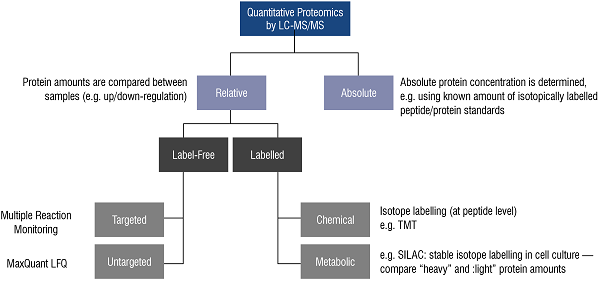
Quantitative proteomics measures global proteome dynamics in a cell, tissue or organism. Various quantitative proteomics strategies such as protein mass spectrometry are available to determine relative changes in protein metrics between samples, either using isotopic labels or in a label-free manner. We can perform isotopic labeling chemically, at the peptide level, or through metabolic labelling of cells. In addition, we can apply isotopically labelled standards to the determination of absolute protein concentration in a sample.
Custom Metabolite Synthesis and Isotopic Labelling Service

Account for likely sites of metabolism, minimizing the risk of loss of labeling.
Proteomics services play a critical role in your development program, helping us to understand the pathogenesis of disease and identify pathways involved in response to your drug. Supporting discovery, these protein mass spectrometry projects can first quantify as many proteins as possible across a broad dynamic range before resulting data is interrogated using a robust bioinformatics platform. Specific disease biomarkers similarly benefit from a targeted strategy, for example, where we can use proteomics to quantify fewer than 100 proteins with great precision, sensitivity and throughput.
Capture Compound® Mass Spectrometry (CCMS)
CCMS is an analytical technique that identifies drug-protein interactions. Part of our proteomics services suite, we use CCMS to analyze on-target activities of small molecules. CCMS protein metrics mediate therapeutic effects in phenotypic screens or of known compounds with unexplained activities, and identify off-target or undesired activities of key molecules. Unique to CCMS, covalent association of the Capture Compound® with the target molecule provides a significant advantage over standard chemo-proteomic techniques. Read More on CCMS
Proteome Integral Stability Alteration (PISA) Proteomics
Understanding drug-protein interactions is an important part of the drug discovery process, particularly in studying target engagement, off-target interactions, and drug mechanism of action. Charles River uses the Proteome Integral Stability Alteration (PISA) assay to identify probable specific binding partners to your drug candidates.
This proteomics assay is based on the concept that the thermal stability of a protein is altered when a ligand binds, such as a small molecule. The assay is functionally agnostic, so it can be used to determine both on- and off- protein targets, and is powerful tool in understanding a drugs mechanism of action. PISA assays can be tailored to your requirements and can utilize both living cells and cell lysates, as well as tissue homogenates. Treatment with different concentrations of your therapeutic small molecule can provide invaluable information on target engagement potencies.
The Charles River proteomics services team works with all disciplines in our organization, drawing on therapeutic area expertise to deliver a relevant, comprehensive dataset to drive your informed decisions.
Charles River’s proteomics services are available as fee-for-service and stand-alone project pricing models. We welcome projects of any size, from small bespoke protein mass spectrometry experiments to larger integrated projects. Our scientists will be happy to help you determine the best solution for your program.
Frequently Asked Questions (FAQs) for Proteomics Services
-
What is proteomics?
Proteomics is the large-scale analysis of a specific proteome including protein abundances, protein modifications, protein-protein interactions, and protein-compound interactions using protein mass spectrometry and other technologies. Proteomics services are widely used for biomarker discovery, disease research, and drug discovery and development.
-
Why is it important to measure protein abundance?
Relative quantification of proteins across different samples can reveal important biological insights. Understanding how proteins change in response to a disease or external stimulus (e.g., introduction of a drug) can reveal which signaling mechanisms and pathways are involved and can be used to identify biomarkers of disease. Protein abundance can be measured using protein mass spectrometry.
-
What protein mass spectrometry techniques does Charles River use for quantitative proteomics services?
For label-free quantitative analysis of global proteome changes between sample,s we typically use the MaxQuant LFQ software package, while multiple reaction monitoring (MRM) assays can be employed to obtain highly sensitive measurements of protein amounts in a targeted manner. Isotopic labelling strategies for protein quantification include SILAC (stable isotope labelling in cell culture), or, for increased multiplexing, the TMT (tandem mass tag) methodology can be employed. The option for offline high pH fractionation to increase protein coverage and the use of high-resolution mass spectrometers (e.g., Qexactive™ Plus), results in high quality quantitative proteomics data for our clients.
-
How can I measure protein phosphorylation changes?
Proteomics is a powerful analytical tool for measuring phosphorylation of proteins. Proteomics services can be used to map phosphorylation sites of a single protein, for example to reveal sites phosphorylation present under certain in vitro conditions. Additionally, using phosphopeptide enrichment strategies and specifically designed software packages, we can assess global phosphorylation across the whole proteome, in both a qualitative and quantitative manner.
-
Does Charles River offer protein characterization services for regulatory submission such as IND?
Yes. To help clients generate the data needed to gain the level of product characterization required for regulatory submission, Charles River offers protein analysis as part of an integrated package of expert analytical services. Charles River support clients during preclinical development, GLP, and clinical studies support, INC, CMC, human clinical trials, BLA and lot release.