
How Does Early Biomarker Discovery Impact Drug Development Research?
Early Biomarker discovery and validation testing serves as a critical tool in drug discovery and development. The ability to develop biomarkers in in vitro and in vivo models and translate them to the clinic can greatly accelerate candidate development as well as decrease associated risks and reduce timelines. Charles River can work with you to perform a complete Biomarker analysis without any information regarding the drug candidate name or MoA.
Including biomarkers from the early stages of research helps define the mechanism of action of a drug candidate and which study strategies to adopt throughout the drug development pipeline. The steps to consider when implementing biomarker analysis begin with determining what role(s) the different biomarkers will play in your study.
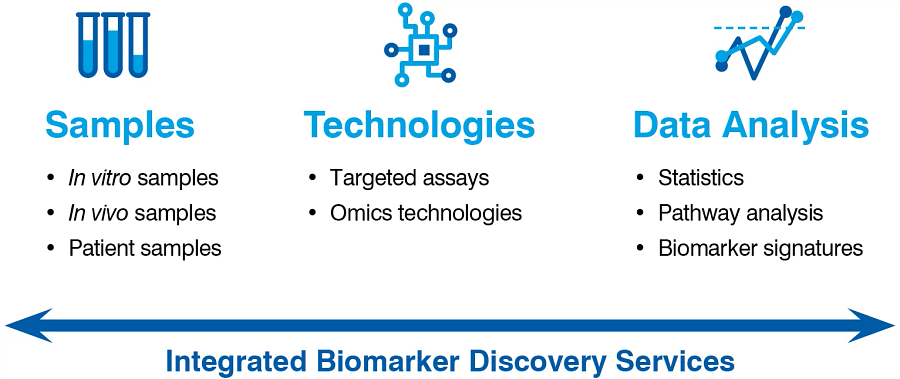
Graphic showing Biomarker Research process
Once key biomarkers are identified, it is crucial to run a fit-to-purpose test to assess whether the selected biomarkers fit for this role, and with the available instruments/resources. This is followed by extensive biomarker testing and validation to assess the biomarker’s performance, followed by an analysis and final report. The data collected can then be used for implementing the new studies. Of note, biomarker identification could also be performed retrospectively by analyzing clinical data and validating those biomarkers during pre-clinical studies.
How are Biomarkers Used in Drug Discovery?
From early discovery stages through clinical support, biomarkers are used to identify the impact on cells, tissues, and organs by a compound before a clinical effect is evident.
Biomarkers are divided into seven general classes:
- Susceptibility/risk
- Diagnostic
- Monitoring
- Prognostic
- Predictive
- Pharmacodynamic/response
- Safety
Choosing the right biomarkers is based on whether they are detectable, quantifiable, and able to be validated in the relevant in vitro and in vivo models. With a wide range of biomarker assays and multi omics technologies, Charles River can support you with your Biomarker discovery, development, and bioanalysis, adding value to your overall program and stopping unviable drug candidates early.

eGuide: Biomarker Solutions from Discovery to Clinical Trials
Learn how strategic biomarker integration can accelerate research & de-risk pipelines to bring life-saving therapies to patients faster. This guide helps you uncover smarter ways to de-risk studies and accelerate timelines, without compromising scientific rigor.
Read the Guide
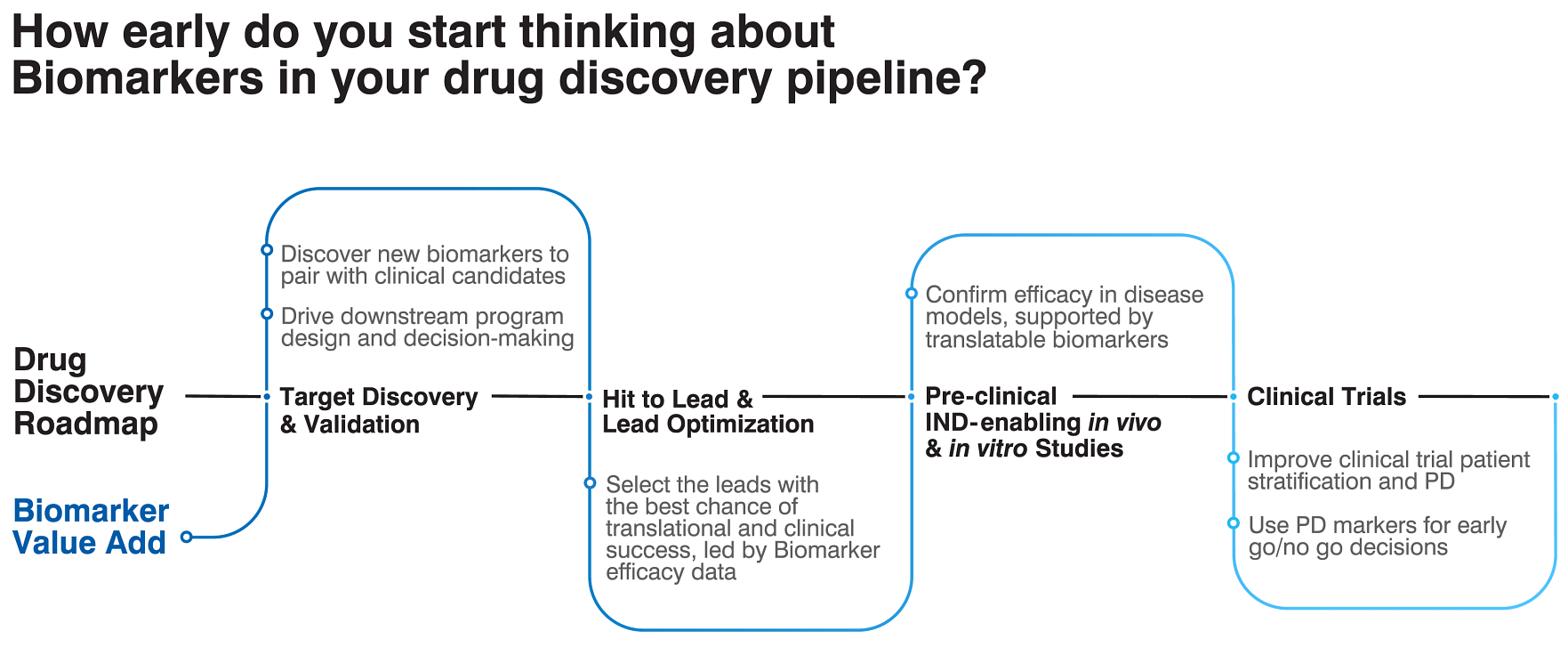
Charles River has an experienced biomarker discovery and validation team across multiple global sites that can support you with your biomarker analysis.
The Future of Biomarker Discovery
Learn more about the advancing applications of biomarker research along the drug discovery and development pipeline, and how biomarkers are being leveraged earlier in the discovery phase to support translational and IND success in our recent interview with Stefan Kostense.
Read more
Frequently Asked Questions (FAQs) About Early Biomarker Discovery and Validation
-
What is the difference between integral, integrated, and exploratory biomarkers?
According to the NCI, integral biomarkers are essential for the study execution and are usually performed in real-time. Integrated biomarkers are associated with a key scientific question or hypothesis, for which there are predefined protocols for the sample collection, biomarker testing, and statistical analysis. Exploratory biomarkers are all other biomarkers that are neither integral nor integrated.
-
Where would the biomarker analysis be performed?
We have multiple world-wide sites across four continents (North America, Europe, Asia, and Oceania) that can perform biomarker analysis. Upon initial discussion of your request, we will be able to engage the most suitable site for your study. In case of multiple technologies involved in the program, we will provide a project leader as a single point of contact, so that you do not need to coordinate the different sites. We will connect the dots for you.
-
Which key instruments/technology platforms do you offer for biomarker analysis?
It really depends on the type of biomarkers. There are several platforms available for early Biomarker discovery. Some examples include bulk RNA sequencing with NGS platforms, proteomics and metabolomics, protein detection and quantification with MSD and Luminex platforms. If a bespoke assay of a technology platform is unavailable in-house, we can then outsource the execution of the assay to our partners.
-
For which therapeutic areas do you offer biomarker services?
Charles River offers a comprehensive range of early biomarker discovery services in key therapeutic areas and safety assessment. Our scientists have the expertise to relate biomarkers to the early stage of many drug development programs. We employ multidisciplinary teams of experts in oncology, inflammation, immunology, infectious diseases, metabolism, and diseases of the cardiovascular, GI tract, and central nervous systems.