
Improve Potency and Selectivity Using Structural Biology Services
Evolution of medicinal chemistry leads during the lead optimization stage is critical to an efficient drug discovery project. Structural biology and protein structure determination decipher the structure-function relationship of biological reagents, enabling changes to your ligands to improve the potency and selectivity of your lead molecule.
Protein Analysis and Structure Services are available as standalone research projects, or as part of integrated structure-based drug design, or full drug discovery programs. We can provide unit-based milestones or full-time equivalent (FTE) services tailored to your specific timeline and budget.
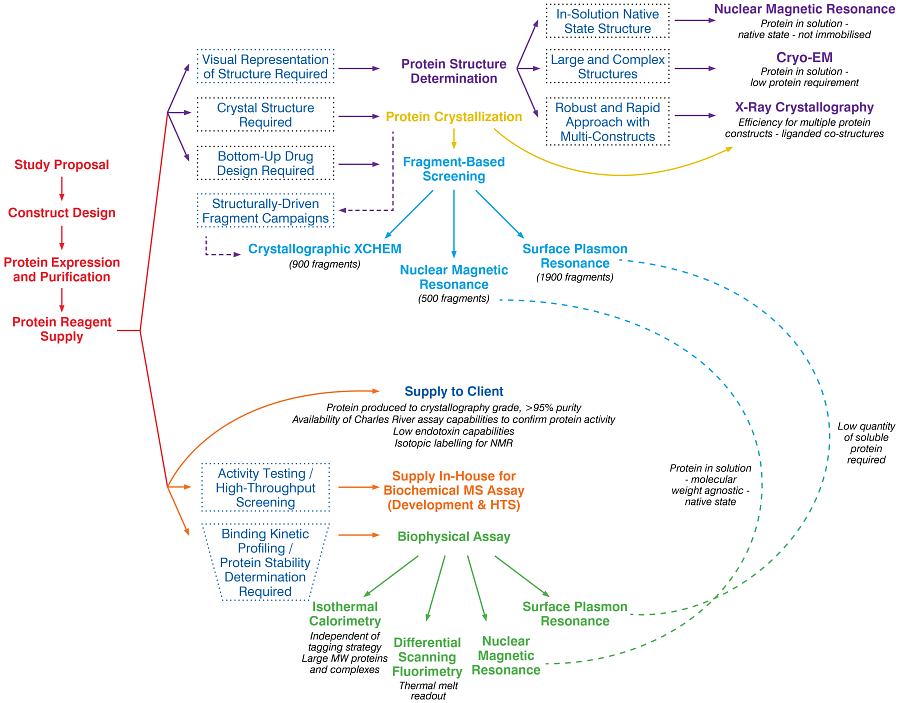
Workflow and Assay Selection Criteria for Protein Structure Determination
We offer structural biology services through gene to structure. In addition, a range of biophysical techniques are available to accelerate the understanding of your ligand’s interactions with its biological target.
Our Protein Structural Biologists are experienced in working flexibly with you to design a program or study from our comprehensive suite of assays and services that fully supports your research goals, resources, and project criteria.
Select Your Protein Analysis and Structure Service:
-
Protein Expression & Production Services
- Construct design and cloning
- Expression in E. coli, mammalian, or baculovirus/insect cells
- Expression scale up from shake flasks to 20 L scale
- Automated protein purification
- Purity of >95% routinely achieved
- Quality Control prior to project continuation (mass spectrometry and gel analysis)
- Capability of generating labelled proteins for NMR and crystallization
-
Construct Design & Cloning
- Rational construct design using bioinformatics and AI prediction
- Fusion tags for affinity purification and/or solubility
- Cloning in expression plasmids for E. coli, mammalian, or baculovirus/insect cells platforms
-
Protein Crystallization
- Overseen by experienced crystallization experts
- Robotic nanoliter-scale screening and imaging
- Automated optimization of conditions for crystal growth
- Co-crystallization or soaking of ligands
- High-throughput crystallization to support XChem at Diamond (fragment screening by crystallography)
-
X-ray Crystallography
- Electron density maps
- Scaled and merged diffraction data
- Complete atomic coordinates
- Structure interpretation
- Ligand binding analysis
- Advice on medicinal chemistry design
- Computer-aided drug design (CADD) support, including:
- Ligand design and docking
- Antibody engineering and TPD modeling
- Water network mapping
-
Cryogenic Electron Microscopy (Cryo-EM)
- Services provided in collaboration with our industry-leading partner, ATEM Structural Design
- ATEM's innovative platform integrates biochemistry, hardware, and artificial intelligence to provide in-depth structural insights about challenging targets at commercial scale
- Provides a considered approach to solving structures which pose a challenge using NMR and X-ray crystallography, such as membrane and large multiple subunit proteins
- Maintains protein in a biologically relevant environment
-
Nuclear Magnetic Resonance (NMR)
- In-house 500-member fluorinated fragment library for screening by 19F NMR
- Ligand-based approaches to determine ligand binding
- Protein-observed NMR to study proteins and protein:protein interactions in solution
- Orthogonal biophysical method to validate hits from HTS or SPR screening
-
Surface Plasmon Resonance (SPR)
- SPR is used extensively in early-phase drug discovery for hit finding, hit characterization, and mode-of-action investigations
- One of the few techniques that can measure kinetic parameters, ka and kd
- The structural biology group runs both Biacore (Biacore 8K+, Biacore S200, Biacore T200) and Bruker instrumentation (Bruker Sierra SPR-24 Pro) to cover a wide range of assay throughputs
-
Crystallographic XChem
- Our team access Diamonds XChem platform to conduct Crystallographic Fragment screening
- XChem is run by our experienced Crystallographers on site at Diamond
- Full data analysis to find novel hits that traditional larger compounds in screening libraries may find challenging
-
Thermal Shift Assay (TSA)
- TSA can determine ligand and target engagement by increased thermal stability of ligand / target complex
- Fragment screen by TSA observing thermal stability against fragment libraries (in-house collections available)
-
Isothermal Titration Calorimetry (ITC)
- Highly sensitive solution-based method, often described as the “gold standard” for measuring the interaction between two molecules.
- As well as measuring affinity and stoichiometry, ITC is unique amongst other common biophysical techniques for also measuring the thermodynamics of an interaction – the enthalpy (ΔH), entropy (ΔS), and Gibbs free energy change (ΔG).
-
Mass Spectrometry (ESI, PMF)
- ESI-MS for intact mass and post-translational modification derivation
- PMF-MS for protein Identification
- Further complimentary MS techniques available as either a characterization or screening tool
Explore the Latest Innovations in Structure-Based Drug Design
Structural biology is undergoing an exciting transformation. In this webinar, you will discover how structure-based drug design is accelerating in both capability and importance. Learn more about emerging technologies like Cryo-EM, the resolution of new kinds of structures, and other technological advances in the field.
Watch Now
Frequently Asked Questions (FAQs) About Structural Biology and Protein Structure Determination
-
How do structural biology services contribute to the lead optimization phase of research and development processes?
Structural Biology enables drug hunters to visualize structures of target proteins involved in disease pathways at the atomic level. This understanding helps identify binding sites and structural features crucial for drug interaction.
-
What role does understanding the structure-activity relationship (SAR) of biological macromolecules play in lead optimization?
Structural insights allow for the rational design of lead compounds with improved binding affinity, selectivity, and pharmacological properties. This approach can lead to the development of more effective and safer drug candidates. Structural images can guide the iterative process of lead optimization by providing feedback on the chemical modifications necessary to enhance the potency, specificity, and pharmacokinetic properties of lead compounds while minimizing off-target effects.
-
Do you offer bespoke solutions tailored to individual research projects, or primarily provide standardized services?
While the work plans from genes to obtaining a 3D protein structure are well established, each project and biological target are different. Our teams work collaboratively with our clients to deliver results, whether following a validated protocol or developing a bespoke experimental pathway.
-
What are the best techniques for protein structure determination and analysis?
The main structural biology techniques include X-ray crystallography and cryo-electron microscopy, with NMR spectroscopy also used in appropriate circumstances. Each enables researchers to elucidate the atomic-level structures of target proteins involved in disease pathways. X-ray crystallography has been the leader in structural determination for many decades, and as such, has very well-documented experimental protocols. However, with the advent of the "resolution revolution," Cryo-EM is fast becoming the technique of choice, especially for larger more complex proteins where traditional X-ray crystallography has proved challenging. Our teams can suggest the best technique to use for each project proposal.