
ASO Screening and Profiling
Antisense oligonucleotide therapy (ASO Therapy) uses single-stranded oligonucleotides that can alter RNA expression and splicing and thereby reduce, restore, or modify protein expression in personalized ASO gene therapy.
Screening assays are designed to measure the results of distinct mechanisms of action, such as RNaseH recruitment, splicing modification, and miRNA targeting. Thorough ASO profiling ensures efficient binding and effective modulation to predict successful personalized antisense therapy.

Advance Your ALS Therapy with ASOs
In this webinar, you will learn more about the process of ASO design, in vitro screening, and efficacy studies.
Watch the Webinar
ASO-Induced Gene Knockdown In Vitro Assay
Charles River has developed a miniaturized (384-well format), reverse transcription PCR (RT-qPCR)-based assays to measure antisense oligonucleotide (ASO)-induced gene knockdown or splicing. This assay uses negative (e.g., scrambled or mismatch) and gene-specific positive control antisense oligonucleotides for assay development to identify and profile ASOs with the ability to reduce or restore expression levels of gene(s) of interest (GOI).
Alternating cycles of ASO treatment and testing of ASO with the use of concentration-response curves, ASO lead selection can be performed for lead selection and prioritization. Our comprehensive ASO screening services employ both human (patient-derived) cell models as well as relevant rodent cell models to allow transition into in vivo pharmacology and safety studies.

Do You Have a Strategic Approach to Your ASO Development?
In our recent webinar you will hear from our experts about how a holistic approach to ASO therapy development can lead to a more efficient path to clinic through:
- Relevant disease models including patient-derived cells
- Lead optimization
- Predictive efficacy
Our ASO Design Services
Our partners at Fios Genomics have built pipelines automating ASO design and assessing potential off-targets. They can help with designing ad-hoc ASO candidate sequences capable of transcript down-regulation, translational up-regulation, and splice modulation. These ASOs can be tailored to preferentially target individual alleles, as well as to ensure cross-species reactivity, simplifying experimental validation.
ASO Therapy Experimental Study Design
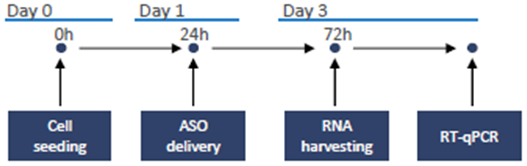
In the following example, 192 ASOs were tested at 30 nM concentration for their ability to reduce target gene expression in a mouse neuronal cell line. A selection of antisense oligonucleotides was tested in a 6-point CRC (3-fold dilutions).
Format: 96-well plates (ASO transfection) and 384-well plates (RT-qPCR)
ASO delivery: Transfection using RNAiMax, in biological duplicates (two separate wells in a single experimental run)
RNA harvesting: Cells-to C (subscript T) 1-step Taqman® kit, GOI and housekeeping gene (HKG) amplified in singleplex reactions in technical triplicates
ASO-Induced Gene Knocked Down Assay Quality Control
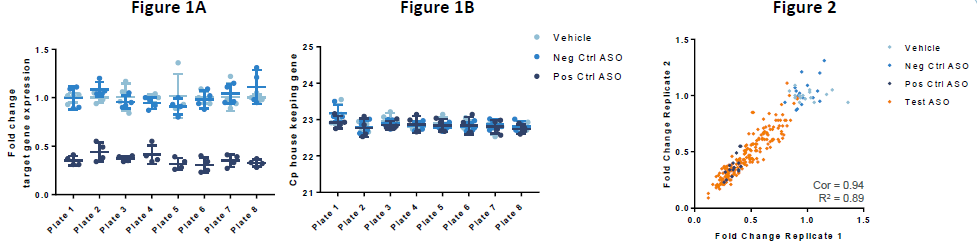
- Strong separation of assay signal for positive and negative control antisense oligonucleotides for all plates tested (Figure 1A)
- No effect of control ASOs on housekeeping gene expression as compared to vehicle-transfected controls (Figure 1B)
- No marked intra-plate or inter-plate variability was observed between positive and negative control ASOs (Figures 1A-B)
Excellent reproducibility, as evident from the Pearson correlation between relative gene expression of the biological duplicates, Cor=0.94 (Figure 2)
Antisense Oligonucleotide Profiling Screen
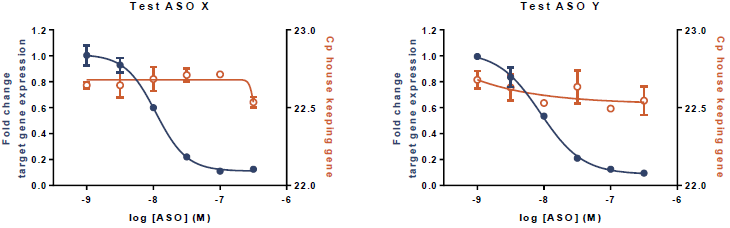
Test ASOs X and Y concentration-dependently induced target gene knockdown without affecting housekeeping gene expression
- Up to ~90% ASO-induced target gene knockdown was obtained
- Potency of ASO-induced target gene knockdown was ~ 10 nM (plC(subscript50) = ~8.0)
Frequently Asked Questions (FAQs) for ASO Screening Services
-
How does ASO screening work?
The technology involved in ASO therapy development focuses on alteration of mRNA expression. This approach can be via RNAse H mediated knockdown of mRNA, and subsequent protein expression, or via induction of alternative splicing (exon skipping or inclusion) or miRNA targeting. View the animation of the first FDA approved n of 1 antisense oligonucotide therapy, administered at Boston Children's Hospital.
-
What diseases stand to benefit the most from the development of a new antisense therapy?
ASO therapy is one that is most often applied to genetic disorders, although several clinical programs target more common diseases such as dyslipidemia. Currently neurodegenerative and neuromuscular rare diseases that affect the central nervous system, such as ALS and Duchenne muscular dystrophy, are positioned for novel therapies using antisense technologies. There are also studies towards targets that are expressed in liver for more common indications.
-
How ASO Screening Technology is used to develop antisense oligonucleotides evolved?
For decades, researchers have tried to harness the promise of ASO therapy and RNAi technologies to modify protein expression because of the potential for rapid drug development and rational design. Read more about antisense oligonucleotide therapy advances and clinical successes.
-
Have oligonucleotide therapies reached the clinic?
In recent years antisense oligonucleotides have become a trendsetting class of marketed drugs. The best-known ASO therapy is nusinersen/Spinraza®, developed by Ionis and Biogen for spinal muscular atrophy. Sarepta has developed Eteplirsen/EXONDYS 51® (exon skipping) for Duchenne muscular dystrophy. Akcea and Ionis developed Inotersen/Tegsedi™ for the treatment of hereditary transthyretin amyloidosis. Read more about RNA editing, its potential impact, and the future of ASO therapy.